Can You Add More Solar Panels Later? Expanding a Kerala Plant
Your plant suits today's bill, but an EV, another AC or a second floor may come in a few years. Can you add more solar panels later without starting over with KSEB? Yes, if you plan for it now. This guide explains what KSEB counts, what the subsidy pays for, and how to leave room on the roof and on paper.
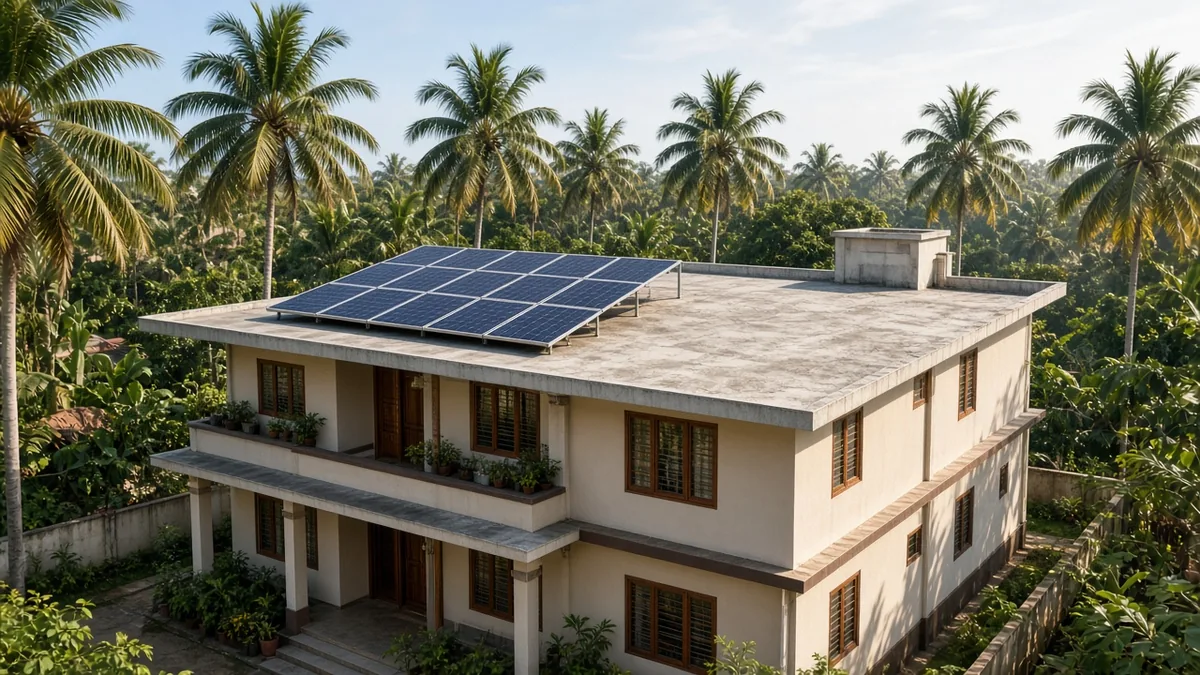
Quick answer: Adding panels to an existing plant is not a capacity enhancement under KSERC rules, so your plant size stays the same. A bigger inverter outside ±10% is, and needs fresh feasibility. PM Surya Ghar pays only up to 3 kWp, so plan the inverter, connection and roof for your final size and add unsubsidised panels later.
Can you add more solar panels later to a Kerala plant?
- KSEB counts your plant by the inverter's AC kW, not by the panel kWp (Regulation 3(73)).
- Adding panels to an existing net-metered plant is not a capacity enhancement (proviso to Regulation 2.3(iii)).
- A new inverter more than 10% bigger than the old one is an enhancement and goes back through feasibility (Regulations 2.3(iii) and 17.4).
- Above 3 kW, the plant needs a three-phase inverter, with one narrow exception until 31 March 2027 (Regulation 16.5).
- PM Surya Ghar pays on panel kWp, and nothing beyond 3 kWp, so panels you add later are usually unsubsidised.
- Roof space, shade and your connected load decide how far you can grow, so plan them on day one.
Meaning first: when KSEB talks about your plant size, it means the inverter. The regulation defines plant capacity as the nominal AC capacity of the inverter in kW (Regulation 3(73)). That is why the two parts of a plant grow in different ways. Panels can be added behind an inverter that has spare room, while a bigger inverter changes the plant size on paper. If the kW and kWp labels on your quote still confuse you, read our guide to inverter kW vs panel kWp first and come back.
For homes already on net metering, the rule on adding panels is plain. The proviso to Regulation 2.3(iii) says that replacing or adding solar panels, or replacing the inverter with a new or hybrid inverter within ±10% of the original inverter capacity, is not an enhancement of capacity. Your existing metering status stays as it is. Panel additions still have one technical limit: the inverter's AC output must never exceed its rated capacity at any time of use (Regulation 16.6).
What is the bigger-inverter-now, more-panels-later plan?
Think of it as a 5/3 design. You fit a 5 kW inverter today but only about 3 kWp of panels, then fill the spare inverter room with panels when your use grows. For KSEB this is a 5 kW plant from the start, because plant capacity is the inverter rating. The feasibility, registration fee and phase rules are all decided at 5 kW now, and adding panels later is not a capacity enhancement under the Regulation 2.3(iii) proviso.
Three gates decide whether a 5 kW inverter is possible on your house. First, a plant above 3 kW needs a three-phase inverter; only where no three-phase network exists when you seek feasibility can a single-phase inverter up to and including 5 kW be allowed, for feasibility sought till 31 March 2027 (Regulation 16.5). Our single phase 3 kW inverter cap guide covers that exception in detail. Second, plant capacity cannot exceed your connected load in kW (Regulation 6.6). Third, the transformer must have room for it.
The transformer gate is checked at feasibility. KSEB grants feasibility and registration transformer by transformer, or feeder by feeder, on a first come, first served basis (Regulation 17.3). Applying once at the size you will finally need means you hold that capacity from the start. How the hosting limit is worked out is explained in our page on KSEB feasibility and transformer hosting capacity.
Two ways to plan for growth, side by side (rules from the KSERC 2025 regulations).
| Point | Size the inverter for the future now | Small inverter now, replace it later |
|---|---|---|
| Plant capacity KSEB records | The future size from day one (Regulation 3(73)) | The small size now, then the new inverter size |
| Adding panels later | Not an enhancement (Regulation 2.3(iii) proviso) | Only up to what the small inverter can carry |
| New application needed later | No, if the inverter stays within ±10% | Yes, an inverter swap outside ±10% is an enhancement (Regulation 17.4) |
| Transformer room | Claimed at the first feasibility (Regulation 17.3) | Checked again when you apply to enhance |
| Phase and load limits | Checked once, at the larger size | Checked again at the new size (Regulations 16.5 and 6.6) |
How does the PM Surya Ghar subsidy work when you expand?
The central subsidy follows the panels, not the inverter. MNRE's guidelines say the CFA is the same whatever size of inverter you fit, and is worked out on the rated DC capacity of the module system (clause 5(k)). The residential slabs stop at 3 kWp, with no additional CFA beyond that (clause 5(e)). So on a 5/3 plan, the panels you install first are the ones that carry the subsidy, and every panel added past 3 kWp is paid for in full by you. The scheme amounts themselves are on our PM Surya Ghar Kerala guide.
If you start below 3 kWp, the guidelines leave room to claim the rest later. Under clause 5(n), a home that already took CFA and later increases its plant size can claim additional CFA only for the balance capacity up to 3 kW overall. MNRE's own example: a household with 1 kW under PM Surya Ghar that grows to 4 kW can claim extra CFA for 2 kW only, which is ₹48,000. The implementation period runs till 31 March 2027 (clause 2(d)), so plan any top-up well before then.
Illustrative example: one Kerala home, two growth paths. CFA uses MNRE's general-category rates of ₹30,000 per kWp for the first 2 kWp and ₹18,000 for the third (clause 5(h)). Final plant size is 5 kWp either way.
| Step | Path A: 5 kW inverter with 3 kWp now | Path B: 2 kWp now, grow later |
|---|---|---|
| Panels at first install | 3 kWp | 2 kWp |
| CFA at first install | ₹30,000 × 2 + ₹18,000 × 1 = ₹78,000 | ₹30,000 × 2 = ₹60,000 |
| Panels added later | 2 kWp | 3 kWp |
| Extra CFA on the later panels | ₹0 (nothing beyond 3 kWp) | ₹18,000 for the balance 1 kW (clause 5(n)) |
| Total CFA | ₹78,000 | ₹78,000, once the clause 5(n) top-up is approved |
| KSEB paperwork later | None for panels, if the inverter stays | New feasibility if the inverter grows beyond ±10% |
Two scheme conditions apply to the later panels too, if you want them inside the subsidised 3 kWp. The modules must meet the Domestic Content Requirement, made in India from Indian cells, and any non-DCR module in the installation makes it ineligible for CFA (clause 5(m)). Mixing cheaper non-DCR panels into a subsidised plant is therefore a real risk; see DCR vs non-DCR panels and the ALMM rules before you buy the extra modules.
What happens if you fit a bigger inverter later?
A larger inverter is where expansion turns into paperwork. If the new inverter is more than 10% above the original capacity, the ±10% proviso no longer covers it, so it is an enhancement of capacity under Regulation 2.3(iii). Regulation 17.4 then asks you to submit an online application seeking feasibility, with the technical details and the ₹1,000 application fee. After feasibility you register and pay ₹300 per kW or part thereof (Regulation 17.8, Table 1).
From there the normal windows apply: feasibility within 15 days, a registration application within 45 days, and the plant completed within six months of registration (Regulation 17.15, Table 2). Meter and commissioning come within 15 days of submitting the completion report. The full step list is in our KSEB solar application timeline. The enhanced plant also has to pass the phase, load and transformer gates again at its new size.
How to plan roof space, shade and future loads
Leave a clear, shade-free strip of roof for the panels you plan to add, and keep it free of new water tanks, staircase cabins or satellite dishes. Ask the installer to mark that strip on the layout drawing and to plan the string routing for it now. Trees grow and neighbours build, so walk the roof with the installer and agree where later shade could fall; our guide to solar panel shading after installation shows what to look for.
Then write down the loads you expect to add: an electric car, another air conditioner, an induction hob, a second floor. An EV changes the sizing sum the most, and our guide to sizing solar for EV charging walks through it. If those loads also need a higher connected load from KSEB, plan that change together with the solar, keeping the connected-load gate from the section above in mind.
If you are still choosing between sizes, our guide to choosing a solar system size compares them for typical Kerala homes. A good rule of thumb for the conversation with your installer is simple: size the inverter and the KSEB application for the plant you expect to end up with, and size the first set of panels for the use you have today.
Checklist: what to ask before you sign
- What AC kW will KSEB record for this plant, and is the inverter three-phase if it is above 3 kW?
- How many kWp can this inverter safely carry, and how many panels does that leave room for?
- Is my connected load at least equal to the inverter kW?
- Which part of the roof is kept free for the later panels, and is it drawn on the layout?
- Are the first panels DCR modules, and what kWp will the subsidy be claimed on?
- If I add panels later, will the same make and wattage still fit the inverter's input limits?
Want a second opinion on your expansion plan? Send us your latest KSEB bill for a free bill and transformer check, and we will tell you how much room your roof, connection and transformer leave for growth.
Check this against your bill
FGE Solar can review your latest KSEB bill and tell you which system size is worth pricing.
Frequently Asked Questions
Do I need KSEB permission to add panels to my existing plant?
Not as a capacity enhancement. The proviso to Regulation 2.3(iii) says adding solar panels does not count as enhancing the plant. The inverter's AC output must still stay within its rating (Regulation 16.6).
Will I get subsidy on panels I add after the first install?
Only for any balance up to 3 kW overall. MNRE's clause 5(n) allows extra CFA for the remaining capacity up to that size. Panels beyond 3 kWp get no CFA at all (clause 5(e)).
Can I put a 5 kW inverter on a single-phase connection?
Normally no, because plants above 3 kW need a three-phase inverter. The exception is a site with no three-phase network at feasibility, for feasibility sought till 31 March 2027. Both points are in Regulation 16.5.
Does a bigger inverter change my subsidy amount?
No. Clause 5(k) of the MNRE guidelines pays CFA on the rated DC capacity of the modules, whatever the inverter size. A 5 kW inverter with 3 kWp of panels is subsidised as 3 kWp.
What fees apply if I enhance the plant with a new inverter?
You apply again for feasibility with the ₹1,000 application fee under Regulation 17.4. Registration then costs ₹300 per kW or part thereof under Regulation 17.8.
Is it better to oversize the inverter or the panels?
They solve different problems. Extra inverter room lets you add panels later without enhancing the plant capacity under Regulation 2.3(iii). Extra panels behind a small inverter are allowed only while its AC output stays within rating (Regulation 16.6).
Official Sources and Accuracy Note
- 01KSERC (Renewable Energy and Related Matters) Regulations, 2025 (gazette PDF)
Key takeaways list: Reg 3(73) definition, Reg 2.3(iii) proviso, Reg 16.5 phase rule and Reg 17.4 enhancement application, each opened in the gazette.
govt source · opened 2026-10-28 - 02MNRE Guidelines for PM-Surya Ghar: Muft Bijli Yojana, CFA to Residential Consumers (PDF)
Key takeaways list, subsidy bullet: guideline clauses 5(e) and 5(k) say CFA follows module DC capacity and stops at 3 kWp.
govt source · opened 2026-10-28 - 03MNRE PM-Surya Ghar CFA guidelines, copy hosted on the MNRE GIGW server, Oct 2026 upload (PDF)
b8 cross-check: the October 2026 MNRE upload carries the same clause 5(k) and 5(e) wording.
govt source · opened 2026-10-28
Accuracy note: This guide is built from government pages, regulator orders, and news sources on the web. Rules and amounts change. Some details may be outdated or wrong. Check the official links below before you pay, apply, or complain to KSEB.