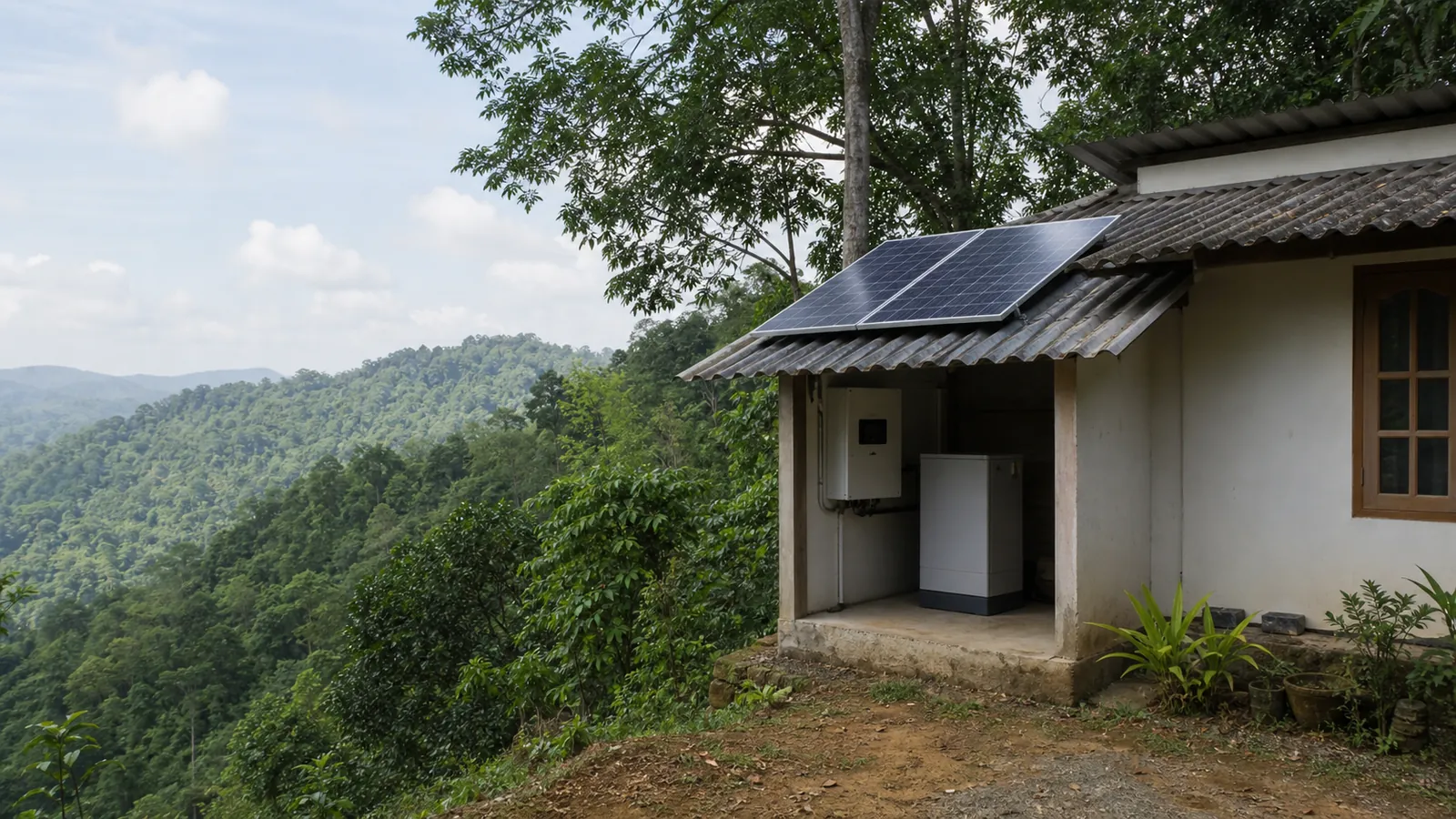
1. Off Grid Solar Panels
Solar panels convert sunlight into DC electricity.
The panel array must be sized to generate enough energy for both daytime consumption and battery charging.
Generate, store and use your own solar electricity without depending on a regular grid connection.
An off grid solar system combines solar panels, battery storage, an inverter and power-management equipment to provide electricity independently of the utility grid. It can be suitable for remote homes, farms, plantations, estate properties, houseboats and other locations where grid access is unavailable, expensive or unreliable.
FGE Solar designs and installs complete off grid solar systems in Kerala based on your daily electricity consumption, peak loads, available sunlight and required battery backup.
An off grid solar power system generates electricity during daylight hours, supplies your active loads and stores surplus energy in batteries for use when solar generation is low or unavailable.
Unlike an on-grid system, a standalone off-grid system does not depend on KSEB electricity for normal operation.
Solar panels convert sunlight into DC electricity.
The panel array must be sized to generate enough energy for both daytime consumption and battery charging.
The charge controller manages electricity flowing from the solar array to the battery bank.
It helps regulate charging voltage and protects the battery system from inappropriate charging conditions.
The battery stores solar electricity for:
Battery capacity is one of the most important factors in a successful off grid solar setup.
The inverter converts stored DC electricity into AC electricity that normal household or business appliances can use.
Inverter capacity must be selected according to your peak simultaneous load rather than only the solar-panel capacity.
The system supplies the appliances and equipment included in the design.
These may include:
A properly designed off-grid system starts by deciding exactly which appliances must operate and for how long.
A complete off grid solar system consists of more than panels and batteries.
The off grid solar array generates the electricity required by the property.
Panel selection depends on:
The controller manages charging between the solar array and battery bank. Some off-grid inverters include integrated MPPT charging, while other designs use separate charge controllers.
Battery storage determines how much energy is available after sunset and during periods of poor solar generation.
Common battery options include:
The correct option depends on budget, usable capacity, maintenance requirements, expected cycling and manufacturer warranty.
The inverter converts DC battery power into AC electricity. It should be selected according to:
Solar panels may be installed on:
The mounting design must account for the site and environmental conditions.
A professional system should include appropriate:
Where supported by the inverter or energy-management system, monitoring can show:
An off grid power system makes the most sense where a grid connection is unavailable, difficult or insufficient for the property's requirements.
Properties located far from existing electricity infrastructure can evaluate whether installing a standalone solar system is more practical than extending a grid connection.
Off-grid solar can power selected loads such as:
The system must be designed around motor-starting loads and operating hours.
Plantation homes, worker accommodation and remote estate buildings in districts such as Idukki and Wayanad may benefit where utility access is limited or unreliable.
An appropriately designed standalone solar-and-battery system can reduce reliance on generator operation for selected electrical loads.
The system design must consider limited mounting area, weight and the operating environment.
Off-grid solar can support:
Homestays, eco-resorts and other remote businesses can use off grid solar power where stable grid access is unavailable.
An off grid solar system for home is not automatically the best solar option for every property.
It is most suitable when independence from the electricity grid is genuinely required.
You already have a reliable KSEB connection and your primary objective is reducing electricity costs.
An on-grid system generally avoids the additional cost of a large battery bank.
You have a grid connection but also need battery backup during power outages.
Hybrid solar can provide a middle path between full off-grid independence and standard on-grid solar.
The off grid solar system price is typically higher than an equivalent on-grid system because battery storage and additional power-management equipment are required.
Indicative complete system ranges:
| System Size | Indicative Installed Price |
|---|---|
| 1 kW | ₹1.10–₹1.60 lakh |
| 2 kW | ₹1.90–₹2.70 lakh |
| 3 kW | ₹2.70–₹3.80 lakh |
| 5 kW | ₹4.20–₹6.00 lakh |
| 10 kW | ₹8.00 lakh+ |
These ranges are indicative only.
The final off grid solar power system price depends heavily on the required battery capacity.
Major factors include:
Two 5 kW off-grid systems may have very different prices.
A property needing only evening lighting and refrigeration requires much less battery storage than a property expected to run air conditioners, pumps and appliances throughout the night.
For this reason, compare quotations based on:
The correct quotation requires a load assessment.
FGE Solar reviews:
Correct sizing is the most important part of an off grid solar electric system.
If the system is too small, the batteries may run out before the next adequate solar-charging period.
If it is unnecessarily oversized, the initial investment can be much higher than required.
List every appliance you want the system to operate.
For each appliance:
Power in watts × hours used per day = daily watt-hours
Add all loads to estimate total daily consumption.
Identify appliances that may operate simultaneously.
The inverter must be capable of supplying this combined load, including motor-starting requirements where applicable.
Determine how long the property should operate without meaningful solar charging.
This may be:
Longer autonomy requires substantially more battery capacity.
The solar array must generate enough energy to:
| Daily Consumption | Indicative Solar Capacity | Indicative Battery Storage |
|---|---|---|
| Up to 5 units/day | Around 3 kW | 15–20 kWh |
| 5–10 units/day | Around 5 kW | 20–30 kWh |
| 10–20 units/day | Around 8–10 kW | 30–50 kWh |
| Above 20 units/day | Custom | Custom |
These are starting points, not universal design rules.
Actual requirements depend on appliances, location, weather, autonomy requirement and battery usable capacity.
Battery storage is the key difference between off-grid and standard grid-connected solar.
Lithium batteries generally offer:
Their upfront cost is usually higher. Actual lifespan depends on battery quality, operating temperature, depth of discharge, cycle frequency and manufacturer specifications.
Lead-acid batteries generally offer:
They typically require more maintenance and provide less usable capacity from the same nominal battery rating.
There is no single answer for every project.
For long-term permanent installations, lifecycle cost and usable energy should be considered alongside purchase price.
For budget-sensitive or occasional-use applications, lead-acid may still be considered where appropriate.
FGE Solar should specify the battery:
in the written proposal.
| Feature | Off Grid | On Grid | Hybrid |
|---|---|---|---|
| Grid connection required | No | Yes | Yes / design-dependent |
| Battery required | Yes | No | Yes |
| Power during grid outage | Yes | Normally no | Yes for configured backup loads |
| Surplus export | No | Depending on applicable grid arrangement | Depending on configuration |
| Upfront cost | Higher | Lowest | Higher |
| Primary use | Grid independence | Reduce grid electricity use | Solar savings + backup |
| Best for | Remote/no-grid properties | Reliable grid locations | Grid-connected properties needing backup |
Grid independence is the main requirement.
Your property has reliable utility electricity and your main objective is reducing electricity imports.
You want a grid connection together with battery backup.
FGE Solar designs each off grid solar system installation around the property's actual electrical loads.
We assess:
The proposal defines:
Panels, battery, inverter and balance-of-system equipment are selected according to the approved design.
The team installs:
The completed system is tested to confirm:
Customers receive guidance on:
The standard PM Surya Ghar Central Financial Assistance for residential consumers is structured around eligible grid-connected rooftop solar installations.
A standalone off-grid solar system that operates without a grid connection does not normally fit that residential CFA route.
If subsidy eligibility is an important objective, compare an on-grid or suitable hybrid configuration and confirm the current scheme requirements before purchase.
Battery capacity depends on:
A load audit is required for accurate sizing.
Get a system recommendation based on how much electricity your property actually needs.
FGE Solar can assess:
Real Kerala homeowners and clinics. Real KSEB bill savings. Watch their stories.
See whether maintaining a grid connection with battery backup is a better fit.
Explore the lower-cost option for properties with a reliable KSEB connection.
Review your electricity consumption before selecting solar and battery capacity.
Understand ongoing panel, inverter and battery maintenance requirements.
Explore completed residential and commercial installations.
FGE Solar provides solar installation support across Kerala.