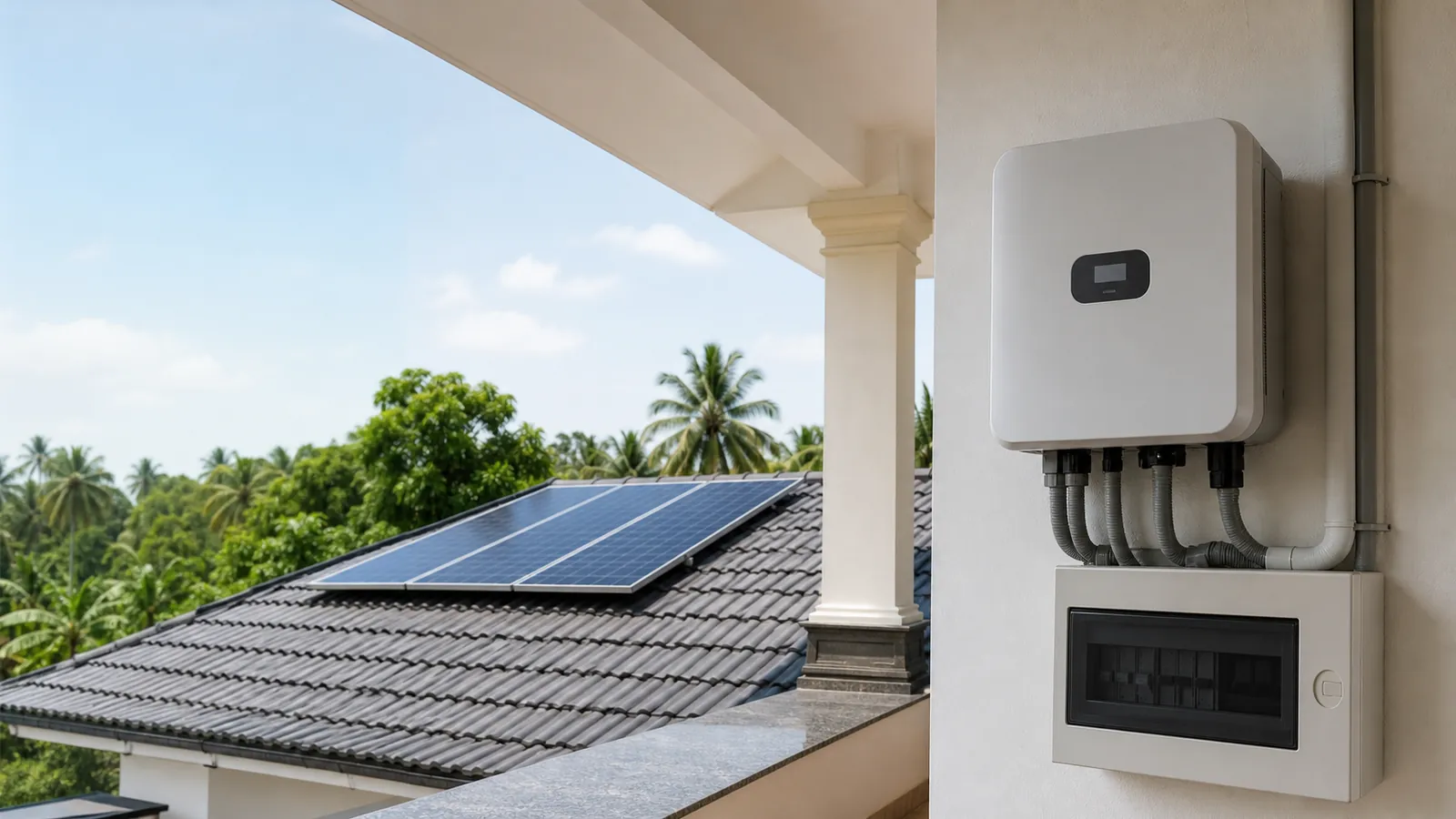
Choose On Grid Solar If
Your priority is:
- Lower upfront solar cost
- No battery replacement cost
- Simple grid-connected operation
- Reducing KSEB electricity consumption
- Residential rooftop subsidy eligibility where applicable
Generate solar electricity during the day while staying connected to the KSEB electricity grid.
An on grid solar system—also called a grid-connected or grid-tied solar system—uses rooftop solar panels to power your property first. Depending on the applicable metering arrangement, surplus generation can be exported to the grid, while electricity can be drawn from KSEB when your solar system is not producing enough power.
FGE Solar provides complete on grid solar system installation in Kerala, including site assessment, system design, rooftop installation, KSEB coordination, commissioning and eligible residential subsidy assistance.
An on the grid solar power system works alongside your existing electricity connection rather than replacing it completely.
During daylight hours, rooftop solar panels convert sunlight into DC electricity.
The solar inverter converts this DC electricity into AC electricity that your home or business can use.
The electricity generated by solar is first used by your appliances and other electrical loads.
When solar generation exceeds your immediate requirement, surplus electricity can be exported through the applicable grid-metering arrangement.
When solar generation is lower than your electricity demand—or at night—the property draws the required electricity from the KSEB grid.
An on-grid system normally does not contain a battery.
That is one reason an on grid solar system in Kerala usually has a lower initial cost than an equivalent hybrid or off-grid system.
System flow
An on grid solar system for home can be a practical option when your main objective is reducing grid electricity consumption rather than obtaining battery backup.
It is commonly suited to homes and properties that have:
A typical on grid home solar system can supply electricity for appliances such as:
The recommended solar capacity should be based on your actual electricity consumption rather than choosing a system only by roof size.
On-grid systems are also commonly used for:
Businesses with substantial daytime electricity demand can use a high proportion of solar generation directly.
An on-grid system may not be the best choice if:
In these situations, compare hybrid or off-grid solar systems.
A professional solar panels on grid system contains several components working together.
Solar panels capture sunlight and generate DC electricity.
Panel selection depends on:
Higher-wattage panels can help fit more system capacity into roof areas where space is limited.
The inverter is one of the most important components in a solar energy on grid system.
It converts DC solar electricity into AC electricity and synchronises the system with the electricity grid.
Inverter selection should consider:
The mounting structure secures the panels to your roof.
The design varies according to:
The structure should be selected according to the property's roof condition and local environmental exposure.
A grid-connected installation requires suitable metering to record electricity flowing between the property and the grid.
The bidirectional meter records electricity imported from the grid and surplus solar electricity exported from the renewable-energy system.
A complete solar panel on grid installation should include appropriate:
Compatible inverters generally provide system-generation and performance data.
Monitoring helps users track:
Choosing the right system depends on whether your priority is lower cost, independence from the grid or backup power.
| Feature | On Grid Solar | Off Grid Solar | Hybrid Solar |
|---|---|---|---|
| Grid connection | Required | Not required | Required / system-dependent |
| Battery | Usually no | Yes | Yes |
| Initial cost | Lowest of the three | Higher | Higher |
| Uses grid at night | Yes | No | Can use grid or battery |
| Power during grid outage | Normally no | Yes | Yes, for configured backup loads |
| Main objective | Reduce grid electricity use | Grid independence | Solar savings + backup |
| Residential subsidy | Eligible systems may qualify | Generally not standard off-grid systems | Depends on scheme/system compliance |
| Best suited to | Properties with reliable grid | Remote/no-grid locations | Properties needing backup |
Your priority is:
Choose hybrid solar when battery backup during electricity outages is important.
Choose off-grid solar when your property has no practical or reliable grid connection.
The on grid solar system price varies according to system capacity, solar-panel specification, inverter, roof type, mounting structure and installation conditions.
Indicative complete on-grid installation ranges:
| System Size | Indicative Price Before Subsidy |
|---|---|
| 1 kW | ₹60,000–₹85,000 |
| 2 kW | ₹1.15–₹1.60 lakh |
| 3 kW | ₹1.70–₹2.30 lakh |
| 5 kW | ₹2.70–₹3.60 lakh |
| 10 kW | ₹4.50–₹6.50 lakh |
These figures are indicative and should not be treated as a fixed quotation.
The price of an on grid solar system can change according to:
Eligible residential grid-connected rooftop installations may qualify for Central Financial Assistance under PM Surya Ghar.
The maximum CFA under the standard residential structure is ₹78,000.
Eligibility, technical approval and subsidy release remain subject to the official scheme.
The most accurate solar on grid system price comes after reviewing:
FGE Solar manages the installation of an on grid solar system from initial assessment through commissioning.
Our team reviews:
This information helps determine the appropriate system capacity.
You receive a project proposal containing:
The system should be designed around actual electricity use rather than simply selecting the largest system that fits on the roof.
For grid-connected projects, the applicable utility process must be completed. The process may include:
FGE Solar assists with the required project documentation and coordination. Final approval remains with the relevant utility and authorities.
After the appropriate project stages are completed, the team installs:
Installation time varies according to capacity, roof type, weather and site complexity.
Before the system is put into service, electrical and operational checks are completed.
The required inspection and grid-interconnection process is then coordinated.
The applicable meter and grid-connection process is completed according to KSEB requirements.
For eligible residential systems, FGE Solar can also assist customers with the relevant PM Surya Ghar documentation. Subsidy approval and payment are controlled through the official government process.
In a grid-connected renewable-energy system, solar electricity generated at the consumer's premises is first used to meet the property's electricity requirement.
When solar generation exceeds immediate consumption, surplus electricity can be exported to the grid.
The bidirectional meter records:
Electricity imported from KSEB
and
Electricity exported from the solar system
The applicable energy accounting, billing and settlement are governed by current KSEB and KSERC rules.
Solar panels do not generate electricity at night.
An on-grid property therefore draws electricity from KSEB when solar generation is unavailable.
Solar panels can still generate electricity under diffuse sunlight, but output may be lower.
The grid automatically supplies the remaining electricity requirement.
A standard on grid rooftop solar system normally shuts down during a grid outage.
This anti-islanding safety feature helps prevent the solar system from energising grid lines while utility personnel may be working on them.
If backup electricity during outages is important, consider a hybrid system with suitable battery storage.
Get a system recommendation based on your actual electricity use and rooftop conditions.
FGE Solar can assess:
Real Kerala homeowners and clinics. Real KSEB bill savings. Watch their stories.
Estimate your system size and potential savings based on electricity consumption.
Check the current Central Financial Assistance available for eligible residential rooftop-solar systems.
Understand grid connection, metering and the applicable energy-accounting process.
See whether battery backup is worth the additional investment for your property.
Explore completed on-grid residential and commercial installations.
FGE Solar provides solar installation services across Kerala's 14 districts.