PM Surya Ghar Last Date: 31 March 2027 and the Reported Extension
The PM Surya Ghar last date is 31 March 2027 in MNRE's guidelines. A short extension has been reported, not yet officially confirmed. If you are a Kerala homeowner still deciding, the real question is whether KSEB's steps and the subsidy inspection can be finished before that date. This guide separates the official date from the reports and shows how to work back from it.
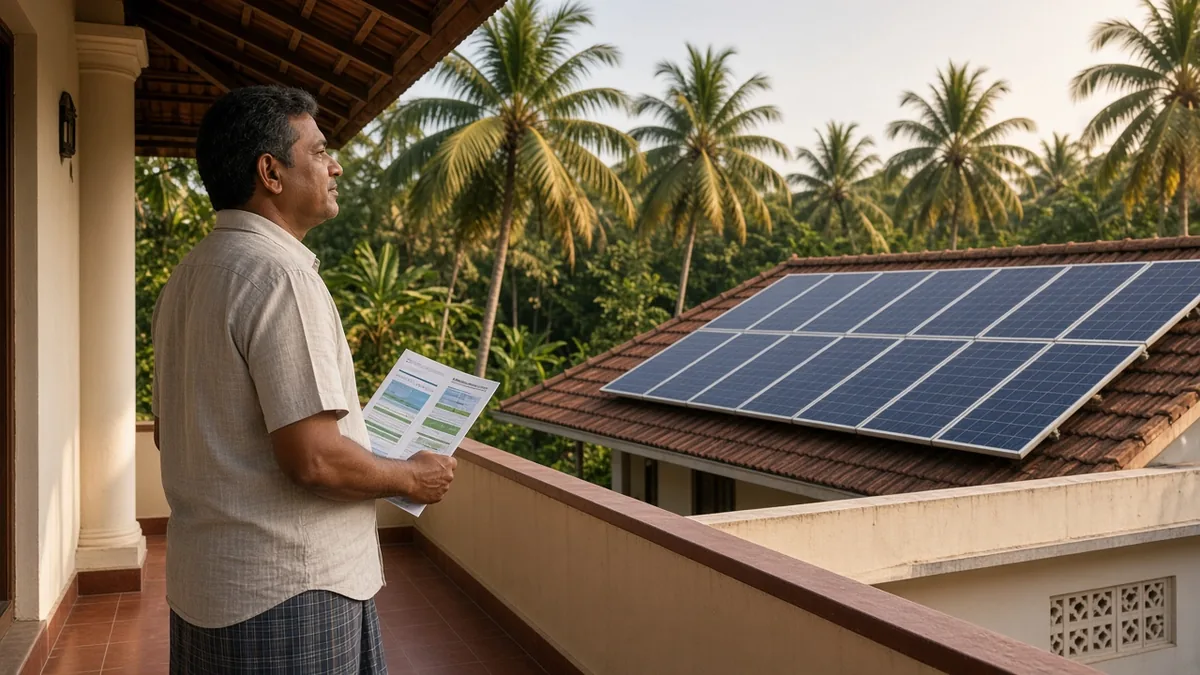
Quick answer: MNRE's guidelines set the scheme's implementation period till 31 March 2027. Reports in September and October 2026 say a one-to-four month extension is being considered, but no order has been issued. The subsidy is paid only after KSEB inspects your plant, so start now and finish well before March.
What do the extension reports say?
Reported, not yet officially confirmed: two outlets report that the Centre may give PM Surya Ghar a little more time after 31 March 2027. The Economic Times (ETEnergyWorld, 3 September 2026) cites MNRE's response to its queries, saying an extension of three to four months will be given if required. Mint (12 October 2026) quotes MNRE Secretary Santosh Kumar Sarangi as saying the ministry may ask for another one or two months. The two reports cite different lengths, and neither cites a notified order.
According to ETEnergyWorld, MNRE said it expects to reach 90 lakh-plus households before March 2027 and that a successor scheme is under stakeholder consultation. The report quotes the ministry as saying an extension of a few months, three to four, will be done if required.
Mint reports that Secretary Sarangi said the scheme may fall short of its 1 crore target by the end of this financial year. According to Mint, he said the ministry may ask for one or two more months to cover the last 10 lakh homes. Mint also reports that the follow-up scheme's contours are yet to be finalised.
What is officially confirmed about the PM Surya Ghar last date
The end date is written into MNRE's own guidelines. The scheme was approved on 29 February 2024 with an outlay of ₹75,021 crore, to be implemented till FY 2026-27 (clause 1(a)). The implementation period of the scheme is till 31 March 2027 (clause 2(d)). As of 28 October 2026, that is the date to plan around.
The scheme also has a fixed target, which explains why the end date gets so much attention. MNRE's stated aims are rooftop solar for 1 crore residential homes and 30 GW of rooftop capacity by 2026-27 (clause 3(a) and 3(f)). For the scheme amounts and who is eligible in Kerala, see our PM Surya Ghar Kerala guide.
The subsidy is paid at the end of the process, not when you apply. After installation you update the portal with system details and geo-tagged photos (clause 6(j)). KSEB, as the DISCOM, then inspects the plant, signs the agreement and approves the application on the National Portal (clause 6(k)). The e-token is activated after that inspection, you redeem it, and the CFA is processed within 15 days of DISCOM approval (clauses 6(p) and 6(t)).
Two more scheme rules matter near the end. The scheme is fund limited, so the portal accepts up to 1 crore active applications, and once that limit is reached MNRE may set a time period for completing installations (clause 8(c)). In plain words, the closer the scheme gets to its target, the less room there is for a late or stalled file.
On the KSEB side, PM Surya Ghar plants up to 10 kW get deemed feasibility after online checks of transformer capacity, connected load and the phase rule (Regulation 17.6). Deemed does not mean skipped: if the transformer has no balance hosting capacity, or the plant is bigger than your sanctioned load, the normal feasibility study applies instead, as our page on KSEB feasibility and transformer hosting capacity explains.
How late can you start and still finish by March 2027?
Work back from 31 March 2027 using the maximum KSEB windows in Regulation 17.15, Table 2. Illustrative example for a home applying on 2 November 2026.
| Step | Maximum window | Latest date if every window is used |
|---|---|---|
| Feasibility | 15 days from application | 17 November 2026 |
| Apply for registration | 45 days from feasibility | 1 January 2027 |
| Scrutiny and registration | 3 + 3 working days | About 12 January 2027 |
| Plant completed and report submitted | 6 months from registration | About July 2027, after the scheme ends |
| Meter and commissioning | 15 days from the report | Too late if the plant uses its full window |
Registration also has a shelf life. A KSEB registration is valid for six months, and KSEB may extend it once by up to another six months for good reasons, but only if no other applicant is waiting for the same transformer or feeder capacity (Regulation 17.9(v) and (vi)). If the plant is not installed within the validity, the registration fee is forfeited and the capacity goes to the next applicant (Regulation 17.9(vii)).
The example shows the trap. Every KSEB step has a maximum, and the six-month completion window alone runs past 31 March 2027 for anyone registering now. So treat the windows as ceilings, not a plan. If your home starts this month, aim to have feasibility, registration and installation done in weeks, leaving a clear margin for inspection and meter work before the end of March. The full step list is in our KSEB solar application timeline.
Meter delays are the usual last-mile risk, because the DISCOM inspection that releases the e-token sits at the very end. Under the guidelines, KSEB installs the meter after the rooftop work is complete, and the net meter can come from KSEB or be bought by you from enlisted meter vendors (clause 6(l)). If your plant is installed but waiting, our page on KSEB net meter delays explains what you can do.
What this means for you now
- Plan to the official end date in the MNRE guidelines. Do not plan around an extension that has only been reported.
- If you have already applied, check your PM Surya Ghar application status and clear any pending step.
- Keep your documents ready so no window is lost; our Kerala solar documents checklist lists them.
- Read the vendor agreement on the portal before you approve it; our vendor agreement guide shows what to look for.
- Ask the vendor for a written installation date and confirm the panels are DCR modules, as our DCR vs non-DCR guide explains.
- If you still hold an old Phase II claim, that has its own separate deadline; see our Phase II subsidy claim page.
Illustrative example of what is at stake. A home that installs 3 kWp of panels gets CFA of ₹30,000 × 2 + ₹18,000 × 1 = ₹78,000 under the guideline rates (clause 5(h)). Against MNRE's benchmark cost of ₹50,000 per kW for the first 2 kW and ₹45,000 for the third (clause 5(g)), a ₹1,45,000 benchmark system would net down to ₹67,000. Your actual quote may differ; the benchmark is MNRE's reference figure, not a market price.
Talk to your vendor about their own queue as well. Installers across the state are working to the same date, so ask how many plants they have booked for the coming months, when your panels will actually reach the site, and who will file the completion details on the portal. Get those answers in writing, together with the installation date.
An official notice extending the scheme could not be found yet on the MNRE website or the National Portal, and no PIB release announcing one was found. This guide will be updated when MNRE publishes one.
Checklist: what to do this week
- Find your application number and note the stage it shows on the portal.
- Ask KSEB, through the portal or your section, whether feasibility has been granted or deemed.
- Fix a written installation date with your registered vendor.
- Keep the bank account details for the subsidy up to date on your profile.
- Book the inspection request as soon as the plant is installed.
Not sure you can finish in time? Send us your latest KSEB bill for a free bill and transformer check, and we will tell you whether your timeline is realistic before you commit.
Check this against your bill
FGE Solar can review your latest KSEB bill and tell you which system size is worth pricing.
Frequently Asked Questions
Is 31 March 2027 the end of PM Surya Ghar?
Yes, as of 28 October 2026. MNRE's guidelines set the implementation period till 31 March 2027. No notified extension was found on that date.
Will PM Surya Ghar be extended?
Reports say it may be. ETEnergyWorld reports MNRE saying three to four months if required, while Mint quotes the Secretary on one or two months. Both are reports, and neither cites a notified order.
When is the subsidy actually paid?
Only after KSEB inspects the plant and approves it on the National Portal. The e-token is then activated and redeemed. CFA is processed within 15 days of that approval.
Can I get the subsidy on more than 3 kW before the deadline?
Only the first 3 kWp earns CFA, whatever the plant size. Clause 5(e) gives no additional CFA beyond 3 kWp. Clause 5(k) counts module DC capacity, not the inverter rating.
Can my application lapse if I wait?
MNRE may set a period after which an inactive application becomes dormant. You can reactivate it from your portal profile, within the 1 crore active-application cap (clause 8(b)).
Do I pay KSEB fees before the plant is built?
Not for PM Surya Ghar plants. The application and registration fees are collected in the bills issued after commissioning (proviso to Regulation 17.4).
Official Sources and Accuracy Note
- 01ETEnergyWorld (The Economic Times): PM Surya Ghar scheme may get 3-4 month extension; successor scheme under consultation, 3 Sep 2026
Callout: ETEnergyWorld reports MNRE's reply to its queries that a 3-4 month extension will be given if required.
news source · opened 2026-10-28 - 02Mint: India may mandate locally made inverters, domestic battery components under next rooftop solar scheme, 12 Oct 2026
Callout: Mint reports Secretary Sarangi saying the ministry may ask for another one or two months.
news source · opened 2026-10-28 - 03MNRE Guidelines for PM-Surya Ghar: Muft Bijli Yojana, CFA to Residential Consumers (PDF)
b4: guideline clause 1(a) approval date, outlay and FY 2026-27, and clause 2(d) implementation till 31 March 2027.
govt source · opened 2026-10-28 - 04MNRE PM-Surya Ghar CFA guidelines, copy hosted on the MNRE GIGW server, Oct 2026 upload (PDF)
b4 cross-check: the October 2026 copy on the MNRE GIGW server repeats clauses 1(a) and 2(d) word for word.
govt source · opened 2026-10-28 - 05KSERC (Renewable Energy and Related Matters) Regulations, 2025 (gazette PDF)
b7: Reg 17.6 proviso, deemed feasibility for PM Surya Ghar up to 10 kW and its three conditions.
govt source · opened 2026-10-28
Accuracy note: This guide is built from government pages, regulator orders, and news sources on the web. Rules and amounts change. Some details may be outdated or wrong. Check the official links below before you pay, apply, or complain to KSEB.