DCR vs Non-DCR Solar Panels in Kerala: ALMM Rules 2026
DCR vs non-DCR solar panels is the first choice on a Kerala rooftop quote. DCR panels are Indian-made modules built from Indian-made cells, and only they qualify for the PM Surya Ghar subsidy. Non-DCR panels are allowed if you give up the subsidy, but a net-metered home still needs a panel model on MNRE's ALMM List-I, and plants commissioned after 31 December 2026 also need cells from ALMM List-II (Give It Up homes have until 31 March 2027).
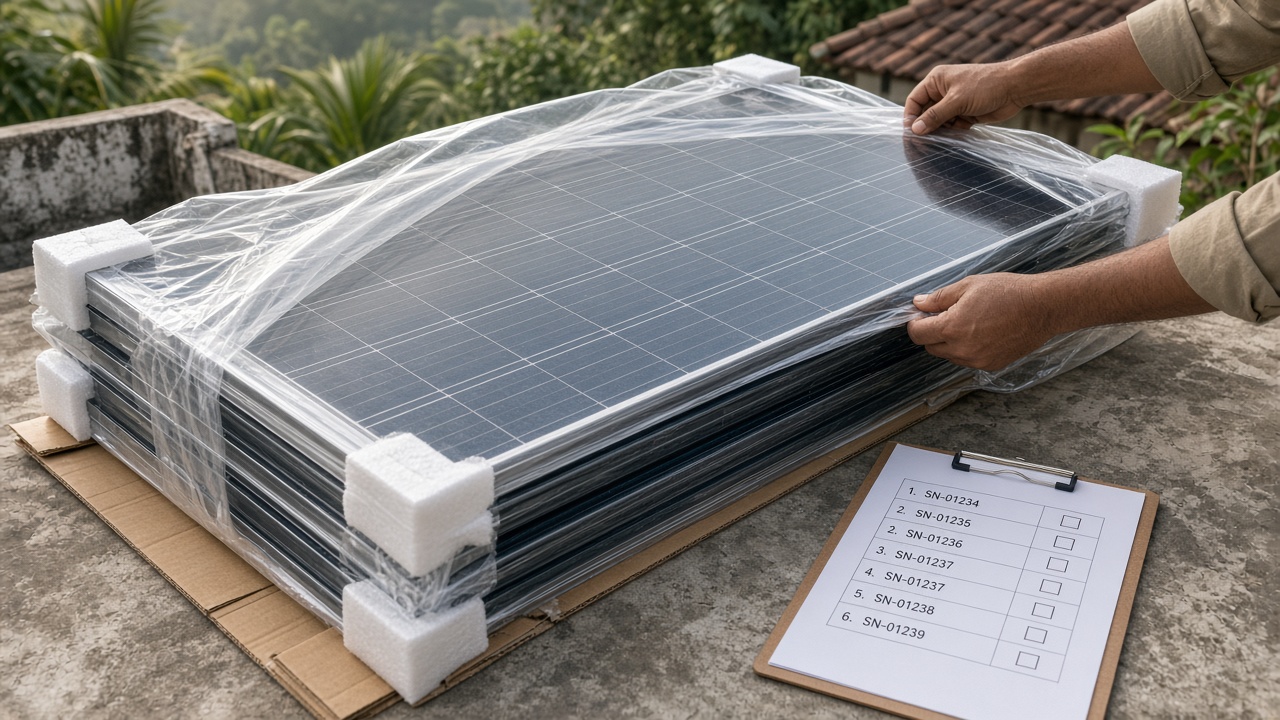
Quick answer: Want the subsidy: choose DCR panels whose exact model is on ALMM List-I. Giving up the subsidy: non-DCR panels are allowed, but net metering still needs a List-I model. Cells are exempt from List-II if the plant is commissioned by 31 December 2026; Give It Up homes applying on the national portal are exempt until 31 March 2027.
DCR vs non-DCR solar panels: the plain difference
DCR stands for Domestic Content Requirement. Under the PM Surya Ghar guidelines for central financial assistance (CFA, the central subsidy), a DCR panel is a module manufactured in India from solar cells also manufactured in India. This is an essential condition for the subsidy: using non-DCR modules in any form makes the installation ineligible. A non-DCR panel is any module that fails that test, such as one assembled in India from imported cells.
Non-DCR panels are allowed when you do not take the subsidy. The same guidelines say consumers who install rooftop solar without CFA, including those who give it up under the Give It Up campaign, are free to do so without domestically manufactured cells or modules.
No ALMM exemption changes the subsidy rule. MNRE's order of 4 August 2026 says ALMM orders have no impact on Domestic Content Requirement provisions, which stay governed by each scheme's own guidelines.
What ALMM List-I and List-II mean
ALMM is MNRE's Approved List of Models and Manufacturers, set up under an order of 2 January 2019 so that panels and cells are really made in the factories that claim them. List-I covers solar PV modules and was first issued on 10 March 2021. List-II covers solar PV cells; its first list came out on 31 July 2025 and it is updated regularly.
MNRE's ALMM page says only models and manufacturers on List-I may be used in projects under Government schemes and in net-metering projects. Its 4 August 2026 order adds that net metering here also covers net billing, gross metering, virtual net metering and group net metering. So every home plant that exports to the grid needs a List-I panel model, whether the panel is DCR or not.
When your home plant needs ALMM List-II cells
| Home plant | Panels: ALMM List-I | Cells: ALMM List-II |
|---|---|---|
| Net-metered, commissioned by 31 Dec 2026 | Required | Exempt |
| Net-metered, commissioned after 31 Dec 2026 | Required | Required |
| Give It Up home that applied on the national portal | Required | Exempt until 31 Mar 2027 |
| Behind-the-meter, own use only, no export | Not required | Not required |
The cell rule has changed more than once. PIB reported on 28 July 2025 that ALMM cells would be mandatory for projects commissioned from 1 June 2026. On 25 May 2026, PIB reported that there would be no blanket extension, with case-by-case claims by developers on a NISE portal by 30 June 2026; that portal was later reopened until 23 July 2026.
Then MNRE's order of 18 July 2026 replaced the May decision. Net-metering projects, which include home rooftop plants, can now be commissioned without List-II cells until 31 December 2026. Any net-metered plant commissioned after that date must use cells from List-II.
Homes in the Give It Up campaign, which forgo the subsidy, stay under the existing scheme guidelines until the scheme ends on 31 March 2027, as PIB reported on 25 May 2026. They must apply only through the PM Surya Ghar national portal. MNRE's 4 August 2026 order confirms that such homes are exempt from List-II until 31 March 2027, while their panels must still be on List-I.
A behind-the-meter plant, used only for your own home and never exporting to the grid, is outside both lists under the same order. In Kerala such a plant must be intimated to KSEB before connection (Regulation 9.2), cannot exceed your connected load (Regulation 9.4) and needs a reverse power flow relay so no energy reaches the grid (Regulation 9.5).
How to check a panel or cell model on the ALMM lists
- Open MNRE's ALMM page and go to Relevant Documents; the newest files are at the top.
- For panels, open the newest 'List-I under ALMM order for Solar PV Modules' file; in late September 2026 that is the one dated 16 September 2026.
- Search the file (Ctrl+F) for the exact model code printed on the panel datasheet or nameplate, and find it in the Enlisted Models column.
- In the same row, check the manufacturer name, the factory location and the Validity To date; a listing stays valid only while its BIS registration is valid.
- For cells, ask the installer for the cell maker and cell model, then search the newest List-II revision (the 9th, dated 21 August 2026) for that maker, factory and model.
- Save the matching rows as a PDF or screenshot and keep it with your quote.
Choosing DCR or non-DCR for a Kerala home
Start with one question: will you claim the central subsidy? If yes, your installer must supply DCR panels and the exact model must be on List-I. If no, non-DCR panels are an option, yet the List-I rule for grid-connected plants still applies. If the plant will be commissioned after 31 December 2026, add one more check: the cell maker and model must be on List-II (Give It Up homes have until 31 March 2027).
- Panel make and exact model code, so you can match it to a List-I row.
- A written statement that the panels are DCR, if you will claim the subsidy.
- Cell maker and cell model, if the plant may be commissioned after 31 December 2026.
- The expected commissioning month, because the List-II test looks at the commissioning date, not the order date.
Check this against your bill
FGE Solar can review your latest KSEB bill and tell you which system size is worth pricing.
Frequently Asked Questions
Can I get the PM Surya Ghar subsidy with non-DCR panels?
No. The scheme guidelines say non-DCR modules in any form make the installation ineligible for central financial assistance. MNRE's August 2026 order adds that ALMM exemptions do not relax this.
Do non-DCR panels have to be ALMM-listed?
Yes, for any net-metered or net-billed home plant. MNRE allows only List-I models in those projects. A behind-the-meter plant used only for your own consumption is the exception.
My home plant will be switched on in January 2027. Do the cells need ALMM List-II?
Yes. The List-II exemption covers net-metering projects commissioned by 31 December 2026. A Give It Up home that applied on the national portal is exempt until 31 March 2027.
Do I have to apply to MNRE to use the List-II exemption?
No. MNRE's 4 August 2026 order says the exemption for plants commissioned by 31 December 2026 needs no application on the NISE portal. It applies whether the project started before or after 18 July 2026.
Is every ALMM-listed panel a DCR panel?
No. List-I approves module models and their factories, while DCR also demands Indian-made cells. For the subsidy you need both: the guidelines require DCR and ask that modules follow the ALMM order.
Official Sources and Accuracy Note
- 01MNRE Guidelines for PM Surya Ghar: Muft Bijli Yojana, CFA to Residential Consumers (PDF)
Para 5(m) Domestic Content Requirement: modules must be domestically manufactured from domestically manufactured cells; non-DCR modules in any form make the installation ineligible for CFA.
govt source · opened 2026-09-27 - 02MNRE O.M. No. 283/54/2026-GRID SOLAR dated 4 August 2026: ALMM List-II clarification (PDF)
Para 1(f): ALMM O.M.s and orders have no impact on DCR provisions, which stay governed by each scheme's guidelines.
govt source · opened 2026-09-27 - 03MNRE Approved List of Models and Manufacturers (ALMM) page
Page introduction: ALMM Order of 02.01.2019, List-I for modules (first issued 10.03.2021), List-II for cells (first issued 31.07.2025), purpose of verifying where production is claimed.
govt source · opened 2026-09-27 - 04MNRE O.M. No. 283/53/2026-GRID SOLAR dated 18 July 2026: ALMM List-II window till 31.12.2026 (PDF)
Para 3: net-metering projects may commission with List-II exemption till 31.12.2026; those commissioned after 31.12.2026 must comply with List-II.
govt source · opened 2026-09-27 - 05PIB: MNRE issues amendment to ALMM order for solar PV cells (28 Jul 2025)
28 July 2025 release: ALMM for cells effective 01.06.2026 for projects commissioned from that date.
govt source · opened 2026-09-27 - 06PIB: No blanket extension of ALMM List-II beyond 1 June 2026 (25 May 2026)
25 May 2026 release: no blanket extension of List-II beyond 1 June 2026; developers' case-to-case claims on a NISE portal by 30 June 2026.
govt source · opened 2026-09-27 - 07MNRE notice: re-opening of NISE portal under O.M. dated 25.05.2026 (PDF)
Notice: portal closed at midnight on 30.06.2026 and re-opened for applications up to 23.07.2026.
govt source · opened 2026-09-27 - 08KSERC (Renewable Energy and Related Matters) Regulations, 2025 (final PDF on erckerala)
Reg 9.2 prior intimation to the licensee, Reg 9.4 capacity up to connected load, Reg 9.5 no injection and a reverse power flow relay for behind-the-meter systems.
govt source · opened 2026-09-27 - 09MNRE ALMM List-I for solar PV modules, updated 16.09.2026 (PDF)
Column headings: manufacturer, manufacturing facility, BIS registration, enlisted models, validity from/to (subject to valid BIS registration, else deemed delisted).
govt source · opened 2026-09-27 - 10MNRE ALMM List-II for solar PV cells, 9th revision dated 21.08.2026 (PDF)
Column headings: manufacturer, manufacturing facility location, type of solar cell, enlisted models, validity.
govt source · opened 2026-09-27
Accuracy note: This guide is built from government pages, regulator orders, and news sources on the web. Rules and amounts change. Some details may be outdated or wrong. Check the official links below before you pay, apply, or complain to KSEB.