Solar Panel Shading After Installation: What to Check and Fix
Your rooftop plant was set up in clear sun, but Kerala compounds do not stand still. Solar panel shading that creeps in later, from a growing coconut palm, a neighbour's new floor or a new water tank, can hold generation down for months before anyone notices. This guide shows how to spot it from the ground, what your installer had to check, and what you can safely change.
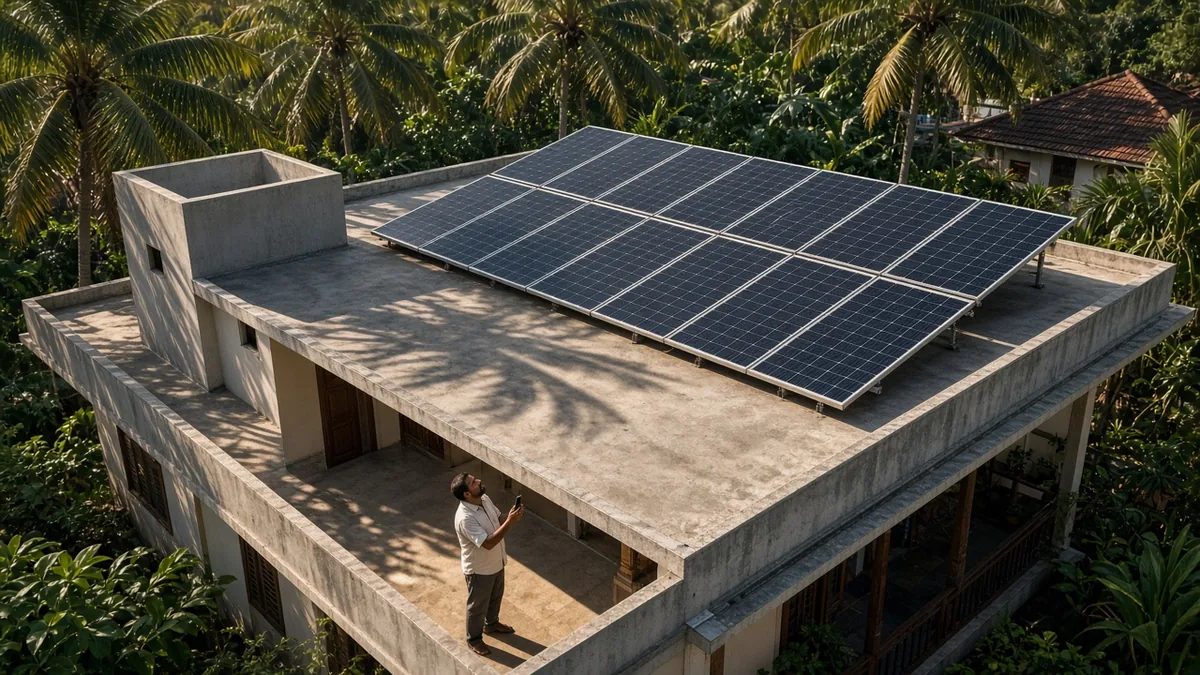
Quick answer: Compare your monthly readings with earlier years and photograph the panels from the ground in the morning, at midday and in the afternoon. If a tree, tank or new building now shades them, trim or move what you safely can, report trees near KSEB lines to KSEB, and ask your installer for a written plan to rearrange panels.
Why solar panel shading appears years after installation
- New shade usually arrives slowly, so it is easy to miss until generation has been low for months.
- You can spot most of it from the ground, with a phone camera and your own monthly readings.
- Ask your installer for any shade survey made before the plant was fitted.
- Trees near KSEB lines are a job for KSEB, never for you or a hired climber.
- If the shade cannot be removed, rearranging the panels is often the fix, and the rule on that is explained below.
- Get any rearrangement of the panels priced and explained in writing before work starts.
Kerala compounds change quickly after commissioning. A coconut palm adds new fronds every season, mango, jackfruit and rubber trees spread wider, and a neighbour may add an upper floor or a staircase room. On your own terrace, a new water tank, a dish antenna, a sheet roof over the stairs or a clothes-drying frame can throw a shadow you never planned for. The sun also sits lower in the sky in the cooler months, so shadows that missed the panels in April can reach them by December.
Shade matters more than its size suggests. Panels are wired together, so a shadow over part of the array can pull down more output than the shaded area alone would explain. How much depends on how your panels and inverter are set up, which your installer can explain for your own plant. The practical point is simple: a small, regular shadow across one corner of the array every afternoon is worth fixing, not ignoring.
How to spot new shade on your roof from the ground
- Pick one safe spot in the compound, or on a terrace with a proper parapet or railing, where you can see the whole array.
- Look at the panels in the early morning, around midday and in the late afternoon on a clear day, and take a photo from the same spot each time.
- Repeat the photos every month, and again after the monsoon, when trees have put on the most growth.
- Note what each shadow comes from: a palm frond, a branch, the edge of a building, a tank, a pole or a cable.
- Write the shadow notes beside your readings, as in a simple monthly solar generation log.
- If you are not sure which figure is generation, see how to read your net meter display.
Readings tell you when to look harder. If output keeps slipping month after month in clear weather, and a good cleaning does not bring it back, new shade is one of the first things to rule out. Dust, bird droppings and moss can look like shade in the readings, so follow your manual or the steps for routine solar panel cleaning and servicing before you blame a tree. A wet, cloudy spell is different again: it lowers every day for a while and then lifts.
Stay safe while you check. Never climb onto a wet, mossy or sloping roof, and never walk on the panels or step over the cables. Do not touch the panels, connectors or DC cables, even when the inverter is off. If a close look is needed, ask your installer to do it with proper safety gear.
What your installer had to check about shade before fitting the panels
For plants under PM Surya Ghar, MNRE's model consumer-vendor agreement puts the site survey on the vendor. The survey includes a feasibility study of the roof, the strength of the roof and the shadow-free area (Annexure 2, clause 2). MNRE's minimum technical specifications add that the mounting structure should be set at an angle that takes maximum sunlight and gives complete shadow-free operation during generation hours. The angle may be reduced to fit more capacity only until the plant still meets the specified performance ratio (Annexure 3, clause 3.5).
The same specifications say a shadow analysis report, made with an instrument such as Solar Pathfinder or with professional shadow analysis software, should be provided for each site. The consumer should be educated to install the system only in shadow-free space, and lower performance of the system due to shadow effect is liable for a penalty (Annexure 3, clause 11.3). That report is your starting picture of the roof, so ask the vendor for a copy if it is not in your file. For the other terms vendors sign up to, see what the PM Surya Ghar vendor agreement covers.
Check your own signed agreement as well. MNRE calls the Annexure 2 agreement a suggested sample and says the actual agreement may vary on a case-to-case basis (Section 6(d)). Separately, MNRE's model agreement sets a performance ratio test for the plant; that rule is explained in our guide to checking solar generation per day.
Shade that grows in long after commissioning is not the same as a faulty panel or inverter. Do not assume your maintenance contract covers trimming trees or rearranging panels. Ask the vendor in writing what they will do and charge.
How to deal with trees, palms and water tanks safely
- For your own trees, hire a trained climber or tree worker, and agree beforehand where cut fronds and branches will fall so nothing lands on the panels.
- Never trim from the roof beside the array, and never rest a ladder against the panels or their frame.
- Plan big trimming before the monsoon, when a weak branch is most likely to come down; see how solar behaves in the Kerala monsoon.
- If your own tank, dish or a new shed casts the shadow, ask your plumber or installer whether it can be moved, lowered or turned.
- When you compare installers for any rework, the checks in how to choose a solar company in Kerala still apply.
A tree near or touching a KSEB line is a different matter. Do not cut it, climb it or send a worker up it yourself. Report it to KSEB. KSEB's website lists 1912 as its toll-free number and 9496010101 for emergencies and accidents.
A neighbour's new building is harder, because you cannot change what they build. Talk early, show your photos and readings, and ask whether a tank could sit a little differently. If nothing can change on their side, the answer usually lies on your own roof, in how the panels are arranged.
Can your installer move or add panels to get out of the shade?
Often, yes, and an existing net-metered home does not lose its status just because panels are replaced or added. KSERC keeps existing net-metering prosumers on net metering until one of a few events happens, and one of them is enhancement of the plant's capacity. The regulation then says that replacing or adding solar panels, or replacing the inverter with a new inverter or hybrid inverter within plus or minus 10% of the original inverter capacity, is not considered enhancement of capacity (Regulation 2.3(iii)).
This works because KSERC counts a solar plant's capacity as the nominal capacity on the AC side of the inverter, in kW (Regulation 3(73)). Panels that are shifted or added behind the same inverter do not change that figure. For the full explanation, read how plant capacity is counted in inverter kW.
Rework costs extra, so get it in writing first. Even at installation, MNRE's model agreement treats extra work that the site or building needs as a separate estimate and a separate invoice including GST, paid directly to the vendor (Annexure 2, clause 2). Ask for the same clarity now: what will be moved, why, and the price.
Before you agree, ask the installer to show on a sketch where each panel will go and where the shadow falls now. Ask whether the panel and inverter makers' warranty terms allow the change, whether the cable routes stay protected, and whether any paperwork with your section office is needed.
A Kerala example: a growing palm and a neighbour's new floor
Picture a two-storey house in Thrissur with panels on a flat concrete terrace. For the first couple of years, the monthly log looks steady. Then, after one monsoon, the dry-season readings stay lower than in earlier years, even after a careful cleaning. The owner takes photos from the gate in the morning, at midday and late in the afternoon. The midday photo is clear, but the afternoon photo shows two shadows: fronds from a coconut palm on the west side, and the edge of the neighbour's new upper floor creeping over the last row of panels.
The family has the palm cleaned and trimmed by a climber, with the fronds lowered away from the terrace. That clears one shadow. The building edge cannot move, so they ask the installer to visit. The installer checks the shade on site, suggests moving the last row to the open east side of the terrace behind the same inverter, and gives a written estimate.
Checklist: what to do this week about new shade
- Take morning, midday and late-afternoon photos of the panels from one safe spot.
- Compare this month's readings with the same month in an earlier year.
- List every shadow you can see and what casts it.
- Book a trained climber for your own trees, and report any tree near a KSEB line to KSEB.
- Find your shadow analysis report and agreement, or ask the vendor for copies.
- If shade cannot be removed, ask your installer for a written plan and estimate to rearrange the panels.
- Keep everyone off wet or sloping roofs, and leave the panels and cables to the installer.
Check this against your bill
FGE Solar can review your latest KSEB bill and tell you which system size is worth pricing.
Frequently Asked Questions
How do I know if shade is reducing my solar output?
Compare each month's readings with the same month in an earlier year, and look at the panels from the ground in the morning, at midday and in the afternoon. A steady drop in clear weather that cleaning does not fix often points to new shade. Ask your installer to confirm it on site.
What is a shadow analysis report for rooftop solar?
It is a record of where shadows fall on the roof through the day. MNRE's PM Surya Ghar specifications ask for one per site, prepared with an instrument such as Solar Pathfinder or with professional software (Annexure 3, clause 11.3). Keep it, because it shows what the roof looked like before new shade arrived.
Can I cut a tree branch that is touching the KSEB line?
No. Do not cut it, climb the tree or send a worker up. Report it to KSEB instead, on 1912, the toll-free number on KSEB's website, or on 9496010101, which the site lists for emergencies and accidents.
Will adding more panels change my net metering status in Kerala?
Not on its own, if your home is already on net metering. Extra panels behind the same inverter do not end that status, because KSERC does not count them as a capacity increase (Regulation 2.3(iii)). An inverter change beyond plus or minus 10% of the old capacity is different, so ask first. More on the scheme is in KSEB net metering for homes.
Is it safe to go up on the roof to check for shade?
Only if the roof is flat, dry and has a proper parapet or railing. Never climb a wet, mossy or sloping roof, and never walk on the panels. Most shade checks work better from the ground anyway.
When is the best time to trim trees near solar panels?
Before the monsoon is a good time, because weak branches and old fronds are most likely to fall in the wind. Check again after the monsoon, when trees have grown the most. Use a trained climber and keep cut branches away from the panels.
Official Sources and Accuracy Note
- 01MNRE Guidelines for PM-Surya Ghar: Muft Bijli Yojana (CFA to Residential Consumers), including Annexures 2 and 3
Annexure 2 clause 2: vendor site survey covers roof feasibility, roof strength and shadow-free area. Annexure 3 clause 3.5: mounting angle for shadow-free generation hours. Annexure 3 clause 11.3: per-site shadow analysis report (Solar Pathfinder or professional software) and penalty for shadow-related low performance. Section 6(d): Annexure 2 is a suggested sample.
govt source · opened 2026-10-21 - 02KSERC (Renewable Energy and Related Matters) Regulations, 2025 (final PDF)
Regulation 2.3(iii) proviso: replacing or adding solar panels, or replacing the inverter within ±10% of original capacity, is not enhancement of capacity. Regulation 3(73): plant capacity is the nominal AC-side inverter capacity in kW.
govt source · opened 2026-10-21 - 03KSEB Ltd official website (home page contact strip)
Home page contact strip lists 1912 as the toll-free number and 9496010101 for emergencies and accidents, the numbers to use if a tree is near or on a KSEB line.
govt source · opened 2026-10-21
Accuracy note: This guide is built from government pages, regulator orders, and news sources on the web. Rules and amounts change. Some details may be outdated or wrong. Check the official links below before you pay, apply, or complain to KSEB.