Solar Panel Maintenance Guide: How to Clean and Maintain Your Solar System in Kerala
Solar panels are often sold as a fit and forget investment. They are not. They are low maintenance, which is a very different thing. In Kerala especially, where you get red laterite dust in summer, algae and moss growth in the monsoon, salt deposits along the coast and bird droppings all year, a neglected array can quietly lose 15 to 25 percent of its output within a couple of years.
The good news is that solar panel maintenance is simple, cheap and mostly preventive. This guide covers how often to clean solar panels in Kerala, how to do it safely, what a professional service should include, realistic solar panel maintenance cost, and how to spot problems before they become expensive.
Key Takeaways
- Clean solar panels every four to six weeks in dry months and inspect them more often during and after the monsoon.
- Dust, moss and bird droppings can cut rooftop solar output by 15 to 25 percent, and partial shading from droppings hurts more than a thin, even layer of dust.
- Use only soft brushes, plain water and mild soap. Never use detergent with abrasives, pressure washers or metal scrapers.
- Clean early morning or late evening. Cold water on hot glass risks thermal stress and micro cracks.
- A typical solar AMC in Kerala costs roughly Rs. 2,000 to Rs. 8,000 per year depending on system size and visit frequency.
- Solar inverter maintenance, earthing checks and monitoring reviews matter as much as panel cleaning, and are the parts most homeowners skip.
Why Solar System Maintenance Matters More in Kerala
Kerala presents a specific combination of conditions that few other Indian states do. High humidity all year, an extended monsoon, coastal salt exposure across a long shoreline, heavy tree cover in most residential plots, and a dry season that generates fine dust.
Each of these attacks the system differently. Humidity encourages moss and algae along panel frames. Salt corrodes mounting hardware and cable glands. Tree cover means leaf litter and bird activity. Dust reduces light transmission through the glass. And lightning, which Kerala sees plenty of, stresses surge protection devices that nobody checks until something fails.
A single bird dropping sitting on one cell can force that entire string of cells to underperform, which is why a small localised spot often costs you more generation than a uniform light film of dust across the whole panel.
How Often Should You Clean Solar Panels?
There is no single correct number, because it depends on your surroundings. Use this as a practical schedule for Kerala.
Dry Season, December to May
Clean every three to four weeks. Dust accumulation is highest in this period and there is no rain to help. Homes near construction sites, unpaved roads or industrial areas may need fortnightly cleaning.
Monsoon, June to September
Rain does a reasonable job of rinsing loose dust, so heavy cleaning is less necessary. What you do need is inspection. Look for moss or algae growth at panel edges, leaf and twig accumulation between rows, water pooling on the structure, and any signs of loosened clamps after strong wind.
Post Monsoon, October to November
This is the most important clean of the year. Rain leaves behind mineral deposits and organic residue that dry into a stubborn film. A thorough post monsoon clean typically restores several percentage points of output.
Coastal and Tree Heavy Locations
Properties within a few kilometres of the sea in districts such as Alappuzha, Kannur, Kasaragod and Thiruvananthapuram should clean more often, since salt film builds up quickly. Homes surrounded by mango, coconut or rubber trees need frequent removal of leaf litter and droppings.
How to Clean Solar Panels Safely
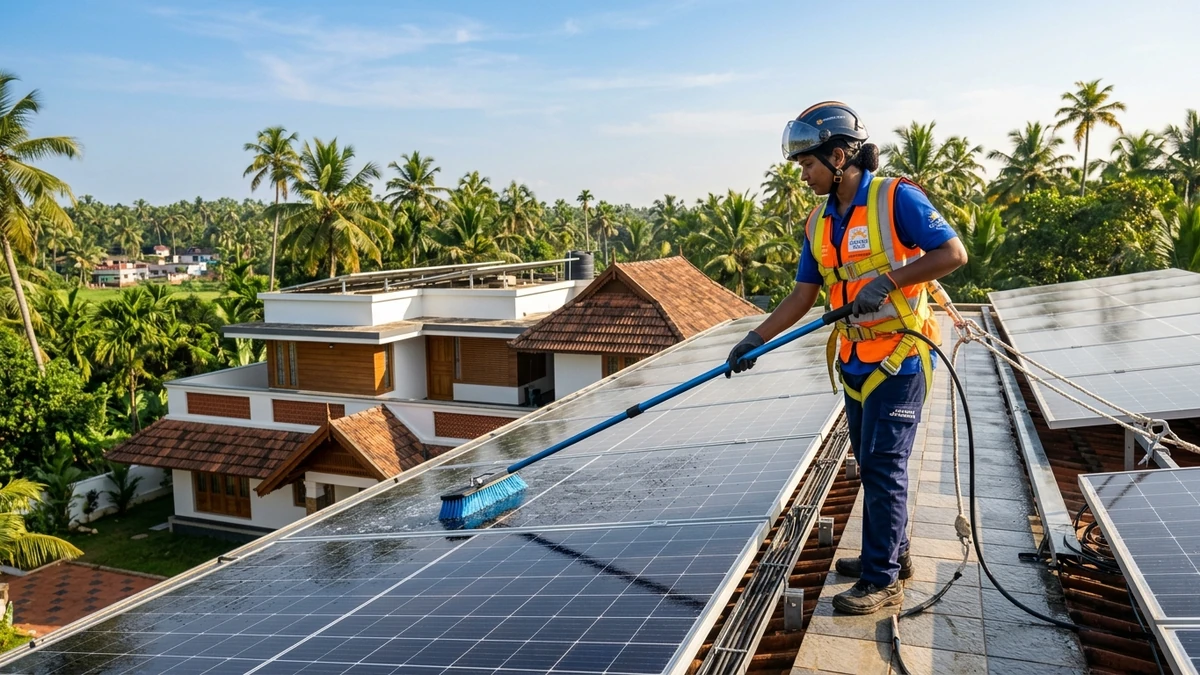
If your array is on a single storey roof with safe access, you can handle routine cleaning yourself. Anything on a steep tile roof, a two storey building or an elevated structure should be left to a professional solar panel cleaning service with proper harnesses.
Step by Step
- Choose the time. Early morning before 9 am or after 5 pm. Panels get extremely hot in the middle of the day and pouring water on hot glass can cause thermal shock.
- Switch off the system. Turn off the inverter and isolate the DC side before you start working on or near the array.
- Dry brush first. Use a soft bristle brush or microfibre pad to remove loose dust, leaves and debris.
- Rinse with plain water. A garden hose at normal pressure is sufficient. Do not use a pressure washer, as high pressure can force water past the frame seals.
- Wash stubborn spots. Mild soap in water, applied with a soft cloth or a telescopic soft brush, handles bird droppings and sap. Let it soak for a minute rather than scrubbing hard.
- Final rinse. Remove all soap residue, because dried soap film attracts more dust.
- Check the frame and structure. While you are up there, look at clamps, bolts, cable ties and conduit.
- Restart and verify. Turn the system back on and check that generation readings look normal.
What Never to Use
- Pressure washers or high pressure jets
- Abrasive scouring pads, steel wool or scrapers
- Harsh detergents, acids, solvents or bleaching agents
- Hard tap water with heavy mineral content, which leaves spots as it dries
- Cold water on panels that have been in full sun
Walking on solar panels, even briefly, can create micro cracks in the cells that are invisible to the eye but permanently reduce output. Always work from the roof surface or a stable platform, never from the modules themselves.
Beyond Cleaning: Complete Solar System Maintenance
Panel cleaning is the visible part of maintenance. The parts that actually cause system failures are usually elsewhere.
Solar Inverter Maintenance
The inverter is the component most likely to need attention during the life of your system. Keep its ventilation grilles free of dust and cobwebs, make sure it is not sitting in direct sun or in an unventilated corner, check the display or app for fault codes, and listen for unusual fan noise. Most string inverters last 8 to 12 years, less if they run hot continuously.
Wiring, Connectors and Earthing
MC4 connectors, junction boxes and conduit should be checked annually for water ingress, UV degradation and rodent damage. Kerala rodents are remarkably fond of DC cabling. Earthing resistance and surge protection devices should be tested at least once a year, particularly before the monsoon and lightning season.
Mounting Structure
Check for rust, especially on any mild steel components, and for loose fasteners after storms. Coastal installations should get anti corrosion treatment on exposed hardware.
Performance Monitoring
The cheapest maintenance tool you have is your own generation data. Compare this month against the same month last year. A sustained drop of more than 10 percent that cleaning does not fix usually points to a shading change, a failing string, a connector issue or an inverter problem.
Shading Review
Trees grow. A branch that cast no shadow in year one can clip the array by year three. Review shading every six months and trim accordingly.
Need Professional Solar Maintenance in Kerala?
FGE Solar offers comprehensive solar health checks, chemical-free module washing, and annual maintenance contracts across all 14 districts.
Solar Panel Maintenance Cost in Kerala
Costs depend on system size, roof accessibility and whether you buy per visit or under an annual contract. The figures below are indicative.
- One time professional cleaning for a residential 3kW to 5kW system: approximately Rs. 800 to Rs. 2,500 per visit
- Annual maintenance contract for a residential rooftop system: approximately Rs. 2,000 to Rs. 8,000 per year
- Commercial and industrial solar AMC in Kerala: usually quoted per kilowatt per year, with pricing scaling down as capacity increases
- Inverter repair or replacement outside warranty: varies widely by brand and rating
Against those numbers, consider that a 5kW system in Kerala generates roughly 6,500 to 7,500 units a year. Losing 15 percent of that to dirt is close to 1,000 units, which at prevailing KSEB domestic slab rates is a meaningful annual loss. Maintenance almost always pays for itself.
What a Good Solar AMC Should Include
Not all annual maintenance contracts are equal. Before signing, confirm the scope covers the following.
- A defined number of cleaning visits per year, with the schedule specified
- Full electrical inspection: connections, terminals, earthing, surge protection
- Inverter health check with error log review
- Structure and fastener inspection with tightening as needed
- Generation performance report comparing actual against expected output
- Priority response time for breakdowns, stated in hours or days
- Clarity on what is included versus chargeable, particularly spare parts
- Support with warranty claims on panels and inverter
Warning Signs That Need Professional Attention
- Generation drops noticeably and does not recover after cleaning
- The inverter displays repeated fault codes or shuts down intermittently
- Visible discolouration, browning or snail trail patterns on cells
- Cracked glass, delamination or moisture inside the module
- Burning smell, discoloured terminals or heat marks near junction boxes
- Frequent tripping of the solar breaker or the main MCB
- Water pooling on the structure or dripping near DC cabling
Do not attempt DIY repairs on any of these. Solar arrays carry high DC voltage even when the inverter is off, and unqualified work will also void your warranty.
Monsoon Specific Solar Maintenance
Before the monsoon, tighten all fasteners, verify earthing continuity, check that all cable entries are sealed, clear roof drainage paths and trim overhanging branches that could break in high wind.
During the monsoon, avoid roof access in wet conditions, monitor generation remotely, and note any unusual dips. After the monsoon, do a complete clean, remove moss and algae, inspect for water ingress in junction boxes and inverter enclosures, and check that no clamps have worked loose.
Frequently Asked Questions
How often should solar panels be cleaned in Kerala?
Every three to four weeks during the dry season from December to May, and less frequently during the monsoon when rain rinses the panels. A thorough professional clean immediately after the monsoon, around October or November, is the single most valuable cleaning of the year.
Does rain clean solar panels adequately?
Rain removes loose dust but not bird droppings, sap, algae or the mineral film left as water evaporates. In Kerala, rain also brings down leaf litter that lodges between panels. Relying on rain alone typically leaves you 5 to 10 percent below achievable output.
What is the annual solar panel maintenance cost for a home system?
A residential rooftop AMC in Kerala generally costs between Rs. 2,000 and Rs. 8,000 per year depending on system size, number of visits and the scope of electrical checks included. One time cleaning visits are usually Rs. 800 to Rs. 2,500.
Can I clean solar panels myself?
Yes, if the array is on a safely accessible single storey roof and you use only a soft brush, plain water and mild soap in the early morning or evening. For multi storey buildings, steep tiled roofs or elevated structures, use a professional solar panel cleaning service with proper fall protection.
Do solar panels need servicing like an air conditioner?
Panels themselves have no moving parts and need only cleaning and inspection. The rest of the system does need periodic servicing: inverter checks, connector and earthing inspection, structure tightening and performance review. An annual professional service covering these is the sensible minimum.
Will cleaning my panels void the warranty?
Routine cleaning with soft brushes and water does not void manufacturer warranties. Using pressure washers, abrasive tools, harsh chemicals, or walking on the modules can void coverage, since these cause damage that manufacturers explicitly exclude. Keep records of professional servicing where possible.
How long do solar panels last with proper maintenance?
Modern modules typically carry 25 to 30 year performance warranties and continue producing beyond that at reduced output. The inverter usually needs replacement once at around year 8 to 12. Good maintenance mainly protects annual output and prevents premature failure of the balance of system components.
Is solar panel maintenance covered under the installation warranty?
Product warranties cover manufacturing defects, not routine upkeep. Most installers offer a limited free service period after commissioning, after which maintenance moves to a paid AMC. Read your contract to see exactly what the free period includes and for how long.
Keep Your Solar System Producing at Full Capacity
Solar maintenance is not complicated, but it does need to happen on a schedule. The systems that still deliver near their original output after a decade are almost always the ones that were cleaned regularly, inspected annually and monitored month to month.
FGE Solar provides solar panel cleaning, inverter servicing and annual maintenance contracts across Kerala, for systems we installed and for systems installed by others. Contact us to discuss a maintenance plan sized to your system and location.
Official Sources and Accuracy Note
-
01
Ministry of New and Renewable Energy (MNRE)
Best practices for solar PV installation, operations, and balance of system standards in India. -
02
Kerala State Electricity Board (KSEB)
Safety standards, earthing rules, and net-metering interconnection guidelines for solar prosumers.
Accuracy Note: Cleaning frequencies, generation estimates, and pricing figures are indicative for Kerala climatic conditions and subject to local dust levels, tree density, and site layout. Always consult certified solar engineers before conducting electrical maintenance on rooftop solar arrays.