KSEB Tariff Slabs 2026: Current Domestic Rates, Fixed Charges & Bill Calculation
Your KSEB bill can rise much faster than your electricity use. The reason is not simply a higher “per-unit price”: Kerala domestic accounts move through telescopic slabs up to 250 monthly units, then switch to non-telescopic billing above that level.
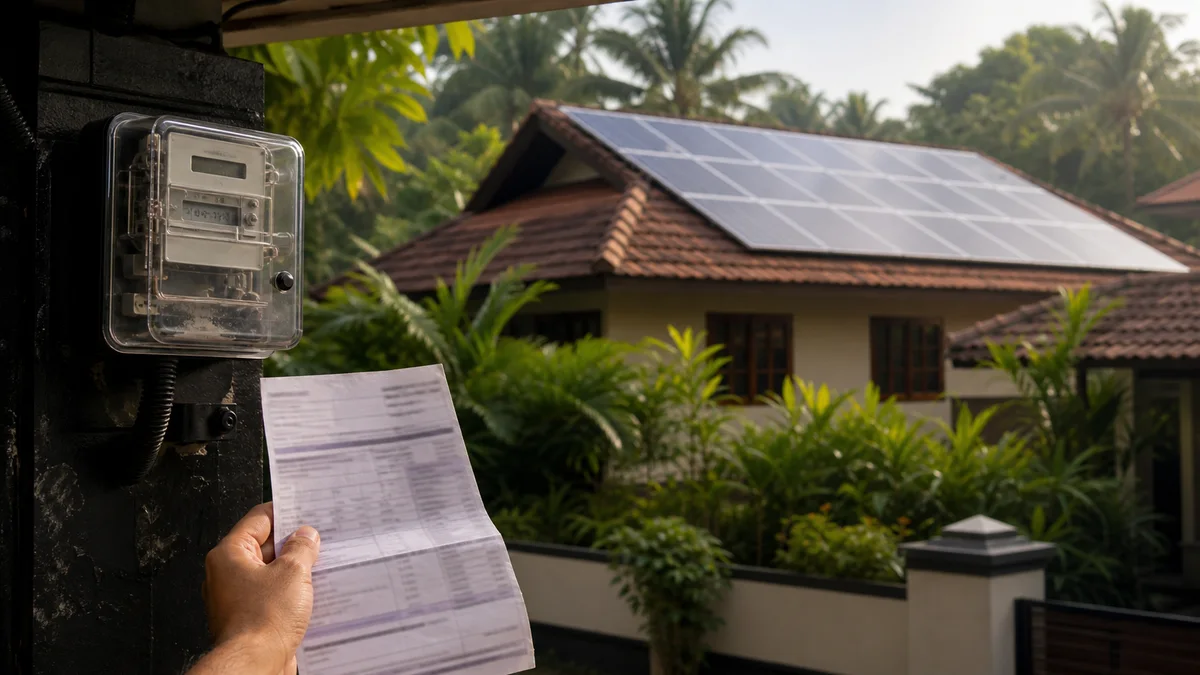
Quick answer: For ordinary LT-I domestic consumers, the current KSERC schedule uses telescopic energy rates of ₹3.35 to ₹8.50 per unit up to 250 monthly units. Above 250 units, a non-telescopic rate of ₹6.75 to ₹9.20 applies to every unit in the relevant consumption band. Fixed charges and other bill items are additional.
Current KSEB Domestic Tariff Slabs for 2026
The rates below come from the LT-I Domestic schedule in the Kerala State Electricity Regulatory Commission tariff order dated 5 December 2024. This column of the order applies from 1 April 2025 through 31 March 2027.
Telescopic tariff: monthly consumption up to 250 units
| Monthly slab | Energy charge | How it is applied |
|---|---|---|
| 0–50 units | ₹3.35/unit | First 50 units |
| 51–100 units | ₹4.25/unit | Next 50 units |
| 101–150 units | ₹5.35/unit | Next 50 units |
| 151–200 units | ₹7.20/unit | Next 50 units |
| 201–250 units | ₹8.50/unit | Units in this block |
Separate BPL rate: Eligible BPL households with connected load up to 1,000 watts and monthly consumption up to 40 units are billed at ₹1.50 per unit with no fixed charge. That concession has specific eligibility conditions and should not be treated as the ordinary first slab.
Non-telescopic tariff: monthly consumption above 250 units
| Total monthly use | Rate applied to all units | Billing mode |
|---|---|---|
| 251–300 units | ₹6.75/unit | Non-telescopic |
| 301–350 units | ₹7.60/unit | Non-telescopic |
| 351–400 units | ₹7.95/unit | Non-telescopic |
| 401–500 units | ₹8.25/unit | Non-telescopic |
| Above 500 units | ₹9.20/unit | Non-telescopic |
The official table labels these bands “0–300,” “0–350,” and so on. In plain language, once consumption exceeds 250 monthly units, the single rate for the relevant total-consumption band applies to the entire consumption.
What “Telescopic” and “Non-Telescopic” Mean
Telescopic billing
Each block is charged at its own rate. Moving into a higher slab does not change the rate already applied to earlier blocks.
Non-telescopic billing
One rate from the relevant total-use band is applied to every unit. This threshold effect can make a modest consumption increase produce a noticeably larger base bill.
This difference is the most important concept in KSEB domestic bill calculation. It is also why advice such as “your last few units cost only the highest slab rate” becomes misleading after monthly consumption crosses 250 units.
KSEB Bill Calculation Example for 200 Monthly Units
At 200 units, telescopic billing applies. The energy charge is calculated block by block:
200 units under LT-I Domestic
A three-phase connection in the same 151–200 unit band has a ₹215 monthly fixed charge, making the corresponding tariff subtotal ₹1,222.50. These figures are before duty, meter rent, fuel surcharge, arrears, rebates and other applicable adjustments.
If your meter-reading period is not exactly one month, do not apply this example directly to the total units printed on the bill. The KSERC table is expressed in monthly-consumption slabs, while KSEB billing periods can differ. Use the slab treatment shown on your actual bill or KSEB’s live calculation channel.
Why a KSEB Bill Can Jump Above 250 Units
For a household close to the threshold, an air-conditioner, water heater, induction cooker or EV charger can do more than add extra units. It can change the billing method for the entire monthly consumption. The fixed-charge band also changes, and three-phase domestic users above 250 units can be affected by Time-of-Day billing.
Important correction: There is no approved ₹0.10-per-unit “summer tariff” in this schedule. KSEB proposed one, but KSERC rejected that proposal in the same tariff order. Do not add a generic summer surcharge to your calculation unless it appears under a separately valid order.
KSEB Fixed Charges and Time-of-Day Rates
The energy charge is only one part of an LT-I domestic bill. Fixed charge depends on monthly consumption and whether the service is single-phase or three-phase.
| Monthly consumption | Single phase | Three phase |
|---|---|---|
| 0–50 units | ₹50/month | ₹130/month |
| 51–100 units | ₹85/month | ₹175/month |
| 101–150 units | ₹105/month | ₹205/month |
| 151–200 units | ₹140/month | ₹215/month |
| 201–250 units | ₹160/month | ₹235/month |
| 251–300 units | ₹220/month | ₹240/month |
| 301–350 units | ₹240/month | ₹250/month |
| 351–400 units | ₹260/month | ₹260/month |
| 401–500 units | ₹285/month | ₹285/month |
| Above 500 units | ₹310/month | ₹310/month |
Time-of-Day treatment for higher-use three-phase homes
The tariff order makes ToD billing applicable to LT-I domestic consumers on three-phase supply with monthly consumption above 250 units. The ruling-rate multipliers are:
- 6:00 am–6:00 pm: 90% of the normal ruling energy rate
- 6:00 pm–10:00 pm: 125% of the normal ruling energy rate
- 10:00 pm–6:00 am: 100% of the normal ruling energy rate
Check the time-zone rows on your own bill because meter capability and billing implementation affect the final calculation. These retail ToD periods should also not be confused with the separate time-zone accounting used for renewable-energy prosumers.
Other items that can change the payable amount
- electricity duty or another statutory levy;
- meter rent, where applicable;
- fuel surcharge approved through a separate proceeding;
- arrears, delayed-payment charges or previous adjustments;
- rebates, subsidies or account credits; and
- solar/prosumer import-export accounting, where applicable.
Fuel surcharge is deliberately not hard-coded in this guide because it can change independently of the base tariff schedule. The safest number is the one shown on your latest bill under the applicable current order.
Why Your Electricity Bill May Be Rising Even When Base Rates Have Not Changed
The current base LT-I schedule is published through 31 March 2027, so it is inaccurate to say KSEB automatically raises every slab each year. A higher bill can instead come from:
- Higher monthly use: ACs, water heating, pumps, induction cooking and EV charging can materially change consumption.
- Crossing 250 units: the account moves from telescopic to non-telescopic billing.
- A higher fixed-charge band: fixed charge rises with consumption and differs by phase.
- Peak-hour consumption: applicable three-phase ToD billing can raise the effective rate during 6:00 pm–10:00 pm.
- Variable bill lines: duty, meter rent, fuel surcharge, arrears or adjustments can change the payable amount.
- A longer reading period or estimate correction: compare current and previous meter readings and billing dates before assuming the unit rate changed.
How to Read Your KSEB Bill Before Comparing Quotes
Use the bill as a data sheet, not just a payable amount. Check these fields first:
- tariff category: usually LT-I for an ordinary residence;
- billing period and units consumed;
- single-phase or three-phase service;
- energy charge and fixed charge separately;
- ToD or zone-wise entries, if present;
- fuel surcharge, duty, meter rent and adjustments; and
- import, export and banked-energy entries for a solar prosumer.
A solar proposal based only on the rupee total can be misleading. A proper assessment should examine at least 12 months of units, daytime use, seasonal peaks, roof conditions and future loads such as an EV or additional AC.
How Rooftop Solar Changes the KSEB Bill Maths
Rooftop solar first helps by serving part of the home’s consumption while the system is generating. That can reduce electricity imported from KSEB and may reduce exposure to higher consumption bands. The financial result depends on when the home uses electricity, how the system is sized and the metering arrangement approved for that connection.
Under the final KSERC Renewable Energy and Related Matters Regulations, 2025, new domestic applicants can opt for net metering from 1 kW up to 20 kW, subject to connected-load and other conditions. The often-repeated “3 kW maximum” is not the general domestic net-metering cap; 3 kW is normally the single-phase inverter limit.
Energy accounting for prosumers is also more detailed than a simple “imports minus exports” promise. From 1 January 2026, the final regulations use time-zone accounting and provide for a 2% monthly banking charge on remaining banked units. They specify year-end settlement at ₹3.08 per kWh for existing prosumers and ₹2.79 per kWh for new solar prosumers. Fixed charge, meter rent, duty, surcharge and other applicable items can still remain, so a solar system should not be sold with a guaranteed zero-bill claim.
Want a bill review based on your actual units—not a generic savings promise?
Send FGE Solar your recent bill history. We can map the consumption bands, daytime load and practical rooftop size before you request a final quotation.
KSEB Tariff Slabs 2026: Frequently Asked Questions
What is the KSEB domestic unit rate in 2026?
There is no single domestic rate. Up to 250 monthly units, telescopic block rates run from ₹3.35 to ₹8.50 per unit. Above 250 units, non-telescopic all-units rates run from ₹6.75 to ₹9.20 depending on total monthly use.
What does telescopic tariff mean?
Each block of units is charged at its own rate. For example, a 200-unit monthly consumption is split across four 50-unit blocks rather than charging all 200 units at ₹7.20.
What changes after 250 monthly units?
The account moves to a non-telescopic band, so one rate applies to every unit. Fixed charge also moves to the relevant band, and applicable three-phase domestic accounts can have Time-of-Day treatment.
Is the energy charge the final KSEB bill?
No. Fixed charge, duty, meter rent, fuel surcharge, ToD adjustment, arrears, rebates and other applicable items can change the final payable amount.
Will solar make my KSEB bill zero?
Solar can reduce imported energy, but fixed charges and other applicable bill items may remain. The result also depends on current prosumer accounting, your daytime consumption and system design.
Official Sources and Accuracy Note
-
01
KSERC OP No. 18/2023 tariff order dated 5 December 2024
See the LT-I Domestic schedule on printed page 128 and the ToD provisions in the order. -
02
KSERC Renewable Energy and Related Matters Regulations, 2025
Final Kerala Gazette—not the earlier draft. Energy accounting and settlement provisions took effect on 1 January 2026. -
03
KSEB Web Self Service
Use the live KSEB channel to inspect or pay the bill attached to your consumer account.
Accuracy note: Rates and rules were checked against official KSERC documents on 24 July 2026. This is an explanatory guide, not a KSEB bill or regulatory advice. Your bill can differ by billing period, phase, ToD profile, duty, meter rent, fuel surcharge, solar/prosumer accounting and adjustments. The applicable KSERC order and your KSEB bill prevail.