How to Read Solar Net Meter Displays in a Kerala Home
How to read solar net meter screens on a Kerala rooftop plant starts with two boxes: the bi-directional net meter at your service connection and the separate renewable generation meter on the solar side. This guide translates the import, export and generation figures those meters record into plain words, and shows what KSEB must print on your bill.
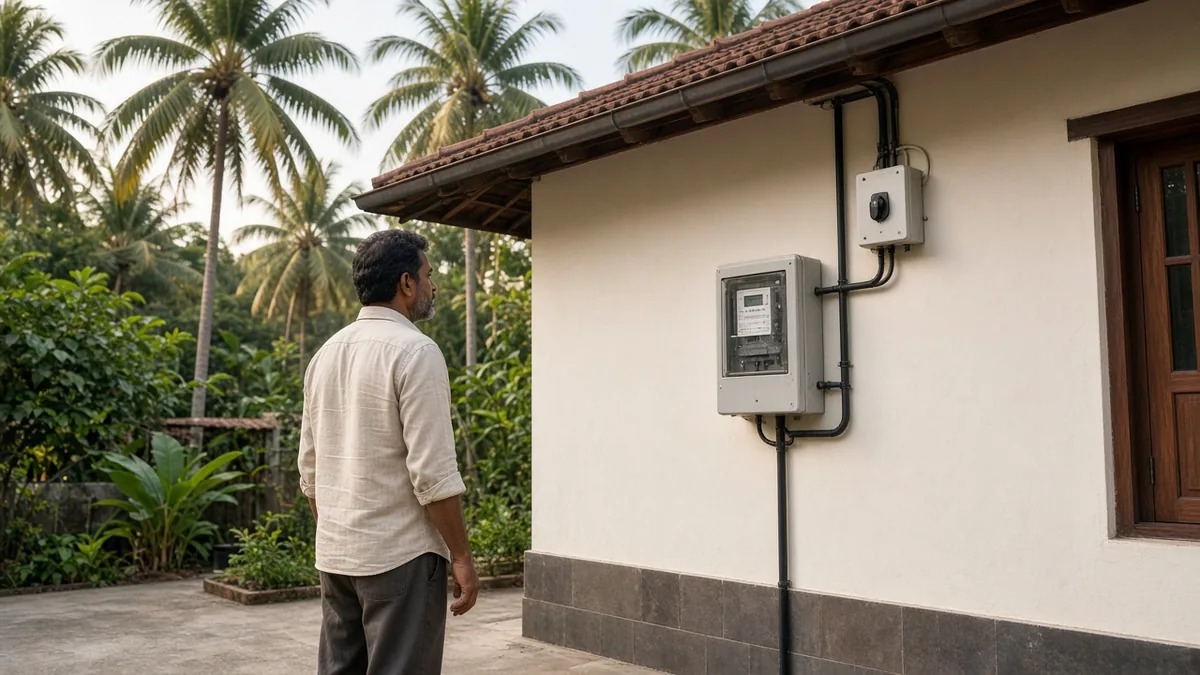
Quick answer: The net meter records zone-wise import and export with the grid. The generation meter records plant output. Your KSEB bill should show opening and closing readings for both, plus zone-wise import and export for the billing period.
Two meters, two jobs: net meter versus generation meter
KSERC defines a net meter as the bi-directional meter, with its allied metering equipment, that the licensee installs and maintains to read zone-wise total import, total export, and net import or net export of electrical energy between you and the distribution system. It is an integral part of both net metering and net billing.
A renewable generation meter (also called an RG meter) is different. It is the energy meter installed and used to measure renewable energy generation from the renewable energy system. Under Regulation 15.6, you must procure that meter at your own cost, get it tested at a NABL-accredited laboratory, and install it where KSEB can read it.
On most Kerala homes the two meters sit near each other at the service connection or on the solar AC board. If you are unsure which is which, look for the label your installer left, or ask the section office before you press buttons on an unfamiliar face. Never open the meter cover or touch the wiring behind it.
What import, export and net figures mean
Under net metering, surplus energy you export to the grid may be adjusted against energy you later import from the grid, as the regulations set out. The net meter is the instrument that records those export and import movements zone by zone.
For the domestic-scale net-metering classes covered by Regulation 28.4, energy generated is first offset against simultaneous consumption at the premises. Only the surplus is exported and banked for use in other time periods. The energy exported to the grid and the energy imported from the grid shall be recorded in the net meter under the three zone-wise time periods.
What each figure stands for when you look at the meters or the bill.
| Figure | What it means |
|---|---|
| Import (on the net meter) | Units drawn from the KSEB grid into your home in that zone or period |
| Export (on the net meter) | Surplus units sent from your plant to the grid in that zone or period |
| Net import / net export | The net meter's combined reading of whether you drew more than you sent, or the reverse, for the period |
| Generation (on the RG meter) | Units produced by your rooftop plant, measured on the solar side |
How to read solar net meter registers safely
Stand in front of the sealed meter. Use only the front push-button or scroll key to move through the display pages. Do not loosen screws, remove the terminal cover, or poke the optical port with anything metallic. If the glass is fogged or the seal is broken, stop and call your installer or the KSEB section.
Many bi-directional meters cycle through cumulative import, cumulative export, and sometimes instantaneous power or voltage. Write down every screen in order, with the exact label shown on the display, rather than guessing which number is which. Meter brands differ, so treat the on-screen label as the source of truth for that box.
Regulation 15.1 requires every meter at the renewable energy generating system to comply with the Central Electricity Authority (Installation and Operation of Meters) Regulations, 2006 and later amendments. Regulation 15.2 adds that meters must have a communication port complying with applicable CEA standards. That is why homeowner reading is limited to the sealed display and why testing and maintenance stay with the licensee under Regulation 15.5.
Both the net meter and the renewable generation meter must sit where KSEB staff can reach them easily for meter reading (Regulation 15.7). If shrubs, a locked gate or a raised platform block the face, clear the path before the next billing cycle so the section can take the same opening and closing readings you are trying to follow.
What your KSEB bill must show each billing period
Regulation 28.2 says the distribution licensee shall undertake meter reading of both the renewable generation meter and the net meter according to the regular billing cycle. Accounting of electricity exported and imported becomes effective from the date the plant is connected to the distribution network (Regulation 28.1).
For each billing period, Regulation 28.3 requires the licensee to make these items available on the bill to the prosumer: the quantum of renewable energy generation recorded in the renewable generation meter, including opening and closing readings; the quantum of electricity exported and imported recorded in the net meter, zone wise, including opening and closing readings; the quantum of electricity units consumed by the consumer during the billing period; and the net quantum of energy to be billed or credited after the normalisation or energy-adjustment steps that apply.
When the bill arrives, lay it next to the notes you took from the meter faces. Match the opening and closing generation readings first, then the zone-wise import and export lines. If a line on the bill has no matching screen on either meter, ask the section which register they used before you dispute the amount.
Zone-wise readings and solar hours in plain words
Solar hours are defined as 08:00 to 18:00 on the same day where ABT meters, smart meters or ToD meters programmed for that time zone are installed. In all other cases, solar hours follow Zone 1 from 06:00 to 18:00. Non-solar hours are every other hour. Your net meter's zone-wise import and export registers follow those programmed windows.
Under Regulation 28.4(iii), exported energy in each time zone is first adjusted against imported energy in the same time zone. Surplus export after that step can move into banking and normalisation. Reading the zone-wise export and import figures on the net meter helps you see why a daytime export block and an evening import block are settled differently on the bill.
The solar-hour windows and banking factors are covered in more detail in our guide to using solar in the daytime and our solar banking and solar hours guide.
If your display shows separate day, peak and off-peak pages, copy each page with its label. Do not add the pages together yourself and treat that total as the bill figure. Let the bill's zone-wise lines be the official arithmetic, and use your notes only to check that the opening and closing digits look continuous.
When a reading looks wrong
A sudden jump, a frozen digit, a blank screen, or a seal that looks disturbed are reasons to stop scrolling and call for help. Photograph the face from a safe distance if you can do so without climbing, note the date and time, and contact your installer first for display faults, or the KSEB section for supply and billing disputes.
The distribution licensee remains responsible for testing, installation and maintenance of the metering equipment and for its adherence to applicable standards (Regulation 15.5). The licensee must also make a net meter available under Regulation 15.4, while you remain responsible for procuring the generation meter under Regulation 15.6. That split of duties is why homeowners should not attempt meter repairs themselves.
Keep a simple notebook or phone note with monthly closing readings for both meters. When something looks off, you will have your own trail to show the section alongside the bill's opening and closing columns.
Check this against your bill
FGE Solar can review your latest KSEB bill and tell you which system size is worth pricing.
Frequently Asked Questions
What is the difference between the net meter and the generation meter?
The net meter is the bi-directional meter that records zone-wise import and export with the grid. The renewable generation meter records how many units your plant produced. KSERC defines both roles and requires KSEB to read both each billing cycle.
Which reading on the bill is my plant's generation?
Look for the renewable energy generation lines that show opening and closing readings from the renewable generation meter. Those are separate from the net meter's import and export lines. Regulation 28.3 requires both sets on the prosumer bill.
Why does my net meter show both import and export?
Because it is bi-directional. Import is energy drawn from the grid; export is surplus energy sent to the grid. Regulation 28.4 says both are recorded under the three zone-wise time periods for the domestic-scale net-metering classes it covers.
Do solar hours change what the meter stores?
Yes. Solar hours are usually 08:00 to 18:00 on programmed ABT, smart or ToD meters, or 06:00 to 18:00 (Zone 1) otherwise. Zone-wise import and export registers follow those windows, which later affect same-zone offset and banking on the bill.
Can I open the meter to fix a wrong display?
No. Testing, installation and maintenance of the metering equipment are the licensee's responsibility under Regulation 15.5. Use only the sealed front display, photograph a fault from a safe place if needed, and call your installer or the KSEB section.
Official Sources and Accuracy Note
- 01KSERC (Renewable Energy and Related Matters) Regulations, 2025 (gazette PDF)
Net meter and renewable generation meter definitions, CEA meter standards, dual meter reading each billing cycle, and the opening and closing figures KSEB must print (Reg 3(61), 3(82), 15, 28).
govt source · opened 2026-10-13
Accuracy note: This guide is built from government pages, regulator orders, and news sources on the web. Rules and amounts change. Some details may be outdated or wrong. Check the official links below before you pay, apply, or complain to KSEB.