Best Time to Use Appliances With Solar in a Kerala Home
The best time to use appliances with solar in Kerala is during the solar hours of 8 am to 6 pm, when your plant is producing. Power your home uses at that moment comes straight from your roof, while only the surplus is exported and banked by KSEB.
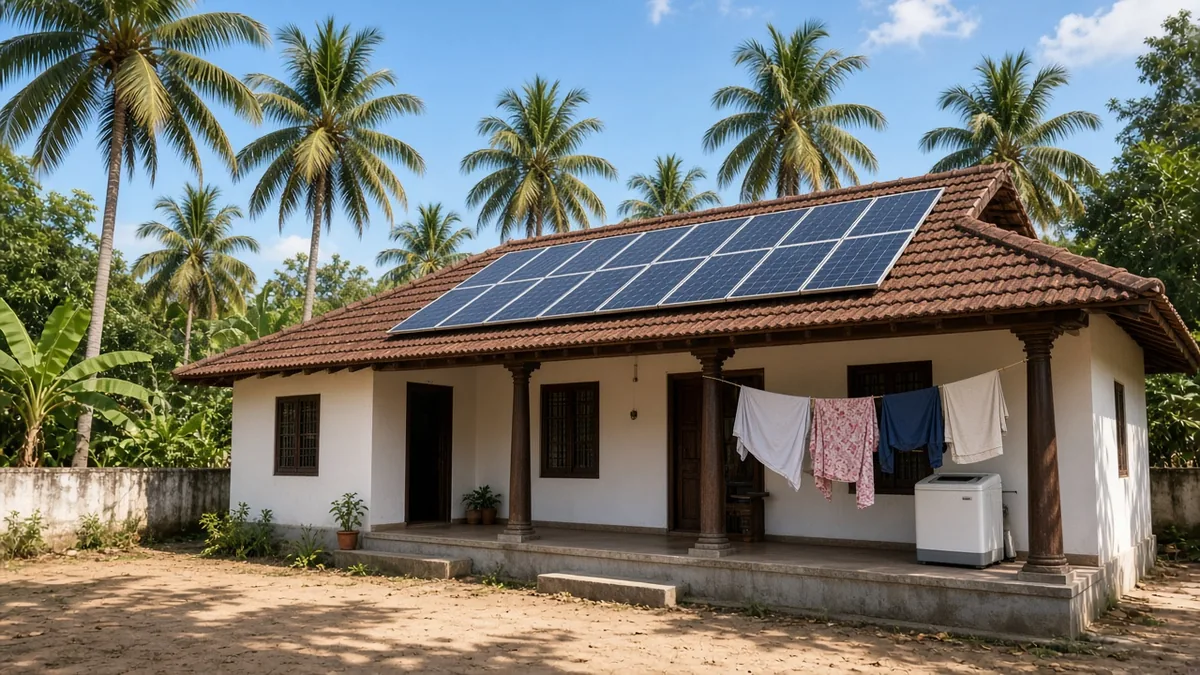
Quick answer: Move the jobs that can wait, such as the water pump, washing, ironing and charging, into the late morning and early afternoon. Run them one after another, not all at once. Keep evening use for what cannot move, and never overload a socket.
Best time to use appliances with solar: the short answer
Kerala's electricity regulator, KSERC, defines solar hours as 8:00 am to 6:00 pm on the same day. Every other hour is a non-solar hour. That definition applies where ABT, smart or ToD meters programmed for that time zone are installed. With any other meter, solar hours follow Zone 1, which runs from 6:00 am to 6:00 pm. This is Regulation 3(91).
Your plant's output is first used by whatever is running in your home at that moment. Only the surplus goes out to the grid and is banked for use in other time periods. So a load that runs while the panels are producing is met straight from your roof, before anything is counted as an export (Regulation 28.4(i)).
For most homes the practical habit is simple: move the heavy jobs that can wait into the bright middle part of the day, and keep the evening for lights, fans, the television and cooking that cannot move. Think of your roof as working best while you can see clear shadows on the ground.
How KSEB counts units in each time zone
The net meter records the units you export and the units you import separately for three time zones. Units exported in a zone are first set against units imported in that same zone. Any import left over in that zone after this step is billed at your normal retail tariff, under Regulation 28.4(iii).
The time zones written into Regulation 3(103).
| Time zone | Clock hours |
|---|---|
| Solar hours | 8:00 am to 6:00 pm |
| Non-solar peak hours | 6:00 pm to 11:30 pm |
| Non-solar off-peak hours | 11:30 pm to 8:00 am |
| Zone 1 | 6:00 am to 6:00 pm |
| Zone 2 | 6:00 pm to 10:00 pm |
| Zone 3 | 10:00 pm to 6:00 am |
Surplus that is left after the same-zone step is turned into banked units using a normalisation factor. When banked units are later drawn back, a second factor applies. For a domestic plant, units banked in solar hours and drawn back in peak hours count at 0.75, and in off-peak hours at 0.85. For example, 4 banked units used in the evening peak offset 3 units of import. For net-metered plants up to and including 2 kW, the factor is 1 in every time zone. These factors are in Table 3 of Regulation 28.4(v).
4 banked units used in the evening peak
Banked units are used first against leftover import in solar hours, then against off-peak import and last against peak import. Whatever import is still left is billed at the retail tariff. KSERC may revise these factors as part of a later ToD tariff revision (Regulation 28.4(v)).
The banking rules, including the 2% monthly charge, are covered in more detail in our solar banking and solar hours guide.
Which loads to move into the daytime
Good candidates are jobs where the timing is yours to choose: filling the overhead water tank with the motor, running the washing machine, ironing a batch of clothes, heating water for the family if you use an electric geyser, charging power tools or an electric scooter, and running a mixer-grinder for the day's batter. A simple daytime routine many Kerala homes can follow is below.
- Start the water pump after the sun is well up instead of first thing at dawn.
- Wash and iron clothes late in the morning or around midday.
- Charge phones, laptops and an electric two-wheeler before evening.
- Grind batter and do bulk cooking prep during the day where it fits your routine.
- Keep the evening for lights, fans, the television and the dinner you cannot move.
Run big loads one after another rather than all together. Starting the pump, the washing machine and the iron at the same moment can draw more than your roof is producing at that minute, and the shortfall comes from the grid. Spreading them across the late morning and early afternoon keeps more of the demand inside what the panels are making.
Monsoon and cloudy days in Kerala
On heavy monsoon days output can drop sharply and change from hour to hour. Do not force every job into the daytime on a dark, rainy day; the plant may simply not be producing enough. Use the brighter breaks when they come, and on a fully overcast day run only what you need.
If your inverter has a monitoring app or a display, glance at the live output before you start a heavy load. Over a few weeks you will learn which hours your roof does best in each season, because shade from trees, a neighbour's building or a water tank can shift the best window in your own home.
Why evening use still matters on your bill
Grid support charges are collected from net-metered prosumers on energy drawn from the grid in non-solar hours, up to the units adjusted against banked energy. For now, existing and new domestic prosumers with plants up to and including 10 kW are exempt. Plants above 5 kW that seek feasibility from 1 April 2027 must pay. The interim rates are 50 paise per unit for the first 300 units a month and Re 1 per unit after that. This is Regulation 28.7.
At the end of each billing period, units left after the required offset are carried forward after a monthly banking charge of 2% of the balance units. This carry-forward runs until the end of the financial year, under Regulation 28.4(vi).
The plain lesson: units you use at the moment your panels make them never go through banking at all. Banking is useful for the hours when the sun is down, but it is not the same as using your own power directly.
Safety when you run heavy loads
Do not plug a pump, geyser, iron and washing machine into one extension board or multi-plug. Heavy appliances should be on the sockets and wiring meant for them. If a plug, socket or switch feels warm, smells of burning or sparks, stop using it and call a licensed electrician.
Never open the inverter, touch the DC cables on the roof or climb onto a wet or sloping roof to check the panels. For an inverter fault or error message, follow the manual and call your installer. For a problem with the KSEB meter or supply, contact KSEB.
A timer on the pump or washing machine can help you shift loads without remembering every day. Have an electrician fit any timer or changeover on fixed wiring, and keep the pump's own dry-run and overload protection in place.
Check this against your bill
FGE Solar can review your latest KSEB bill and tell you which system size is worth pricing.
Frequently Asked Questions
What are solar hours in Kerala?
It depends on your meter. A smart or ToD meter set up for the solar zone counts the window from morning 8 to evening 6. Any other meter uses the wider Zone 1 window, starting at 6 in the morning.
Does using appliances in the daytime change how KSEB bills me?
Yes, in how units are counted. Power your home uses while the plant is producing is set against your own generation first. Only the surplus is exported and banked for later.
Are banked units worth less if I use them at night?
For a home plant bigger than 2 kW, yes. A banked unit offsets less than one unit of import after sunset, and least of all in the evening peak. Small plants of 2 kW or less are not affected by this.
Do I pay grid support charges on evening use?
Most homes do not pay it today, because domestic plants up to 10 kW are exempt for now. A new home plant bigger than 5 kW that applies for feasibility in April 2027 or later will pay. It only counts night-time draw that uses banked units.
What should I do on a cloudy monsoon day?
Use the bright spells for the loads that can wait, and run only what you need when it stays dark. If you have a monitoring app, check live output before starting the pump or washing machine.
Official Sources and Accuracy Note
- 01KSERC Renewable Energy and Related Matters Regulations, 2025 (gazette PDF)
Solar hours, time zones, same-zone offset, Table 3 banking factors, 2% monthly banking charge, and grid support charges (Reg 3(91), 3(103), 28.4, 28.7).
govt source · opened 2026-10-10
Accuracy note: This guide is built from government pages, regulator orders, and news sources on the web. Rules and amounts change. Some details may be outdated or wrong. Check the official links below before you pay, apply, or complain to KSEB.