Microinverter vs String Inverter: Which Suits Your Kerala Roof?
Your installer has quoted one inverter box, but a friend says panel-level units cope better with the coconut tree shading half your roof. Choosing between a microinverter vs string inverter design, or a dual MPPT box in between, decides how your plant behaves in shade, how it is serviced and what it costs upfront. This guide compares all three for Kerala roofs.
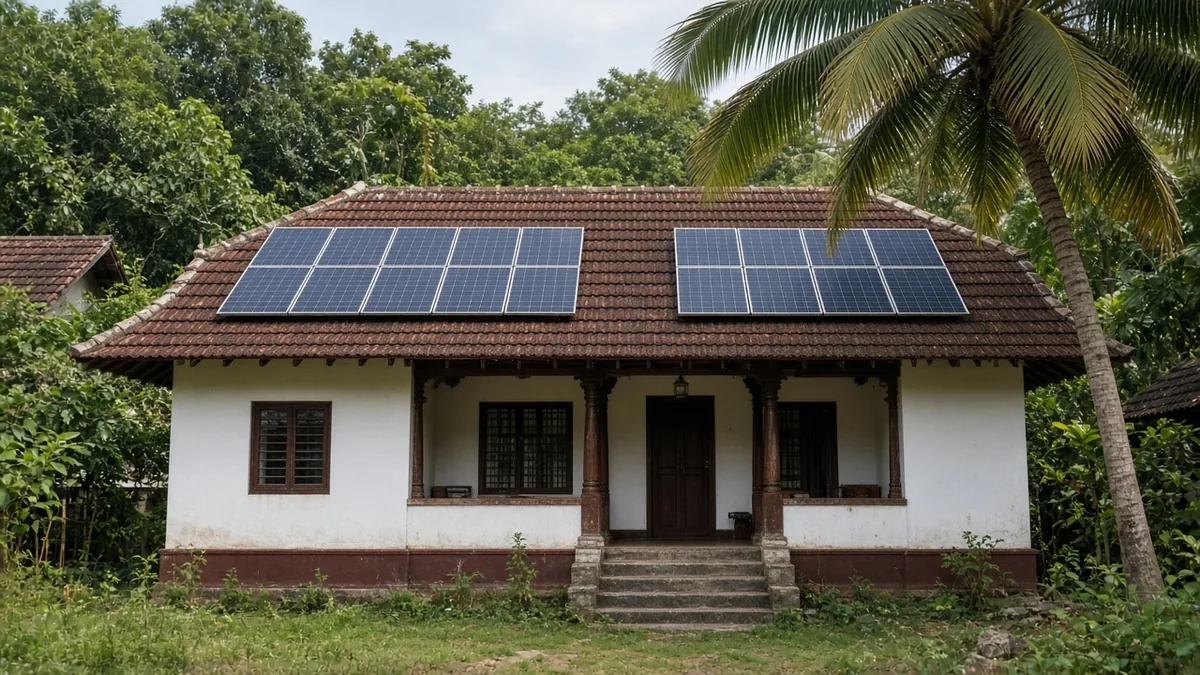
Quick answer: Pick by roof, not by brand. A single-tracker inverter suits panels that all face one way in clear sun. A dual MPPT inverter suits a roof with two faces. Panel-level units suit patchy shade or many small faces, at a higher upfront cost. KSEB rules and the subsidy treat all three the same way.
What are the three inverter set-ups on a Kerala roof?
- A string inverter takes a whole row of panels wired in series and turns their DC into AC in one box.
- A dual MPPT string inverter is one box with two separate inputs, so two groups of panels are tuned on their own.
- A microinverter sits behind each panel and turns that panel's DC into AC right there on the roof.
- Shade or a fault on one panel pulls down the whole string on a plain string inverter, but not the other panels on microinverters.
- Panel-level electronics usually cost more at the start, and their maker warranties are usually longer.
- KSEB counts your plant by inverter AC kW whichever type you choose, and the PM Surya Ghar subsidy follows panel kWp.
Every rooftop plant needs an inverter, because panels make direct current (DC) and your home runs on alternating current (AC). A string inverter connects a set of panels, called a string, to one inverter, which converts the power of the entire string to AC. Microinverters are smaller inverters placed on every panel, so each panel feeds AC into the house wiring on its own (US Department of Energy, inverter basics).
Inside the inverter sits a maximum power point tracker, or MPPT. MNRE's minimum specification for PM Surya Ghar plants says the MPPT shall be integrated in the inverter to maximise the energy drawn from the array (Annexure 3, clause 2.4). A dual MPPT inverter simply has two trackers, so two strings, for example one on the east slope and one on the west slope, are each tuned separately.
Microinverter vs string inverter: which handles shade better?
Shade is the main reason to compare the two. On a string inverter, if one panel is shaded by a coconut frond, a water tank or a neighbour's new floor, the power production of the whole string drops. With microinverters, shading or damage to one panel does not affect the power that can be drawn from the others (US Department of Energy, inverter basics). The trade-off the same page names is cost: microinverters can be more expensive.
How much of the shade loss can panel-level electronics win back? A 2015 US Department of Energy case study on microinverters and DC power optimisers lists recovery of 20% to 35% of the energy lost to partial shading of modules, and about 100% of the loss caused by panels facing different directions. Those were US test results, not a promise for your roof. The point for you is the direction: the more uneven the shade, the more a panel-level design helps.
There is also a middle path. A DC power optimiser is fitted to each panel and does panel-level MPPT, then sends DC to a central inverter. The same case study notes that multiple input string inverters can also give some reduction in mismatch loss, while microinverters can improve output when a plant has to sit on more than one roof plane or the panels are unevenly shaded. If shade on your roof is new, first read what to check when shade appears after installation before blaming the inverter.
When does a dual MPPT inverter make sense on an east-west roof?
Many Kerala houses have sloped roofs that face two ways, or a terrace split by a staircase cabin. Panels facing different directions do not get their best sun at the same time. If both groups sit on one tracker, the tracker has to settle on a compromise for panels that are behaving differently. Two trackers let each group run at its own best point, which is the reduced mismatch the US Department of Energy case study credits to multiple input string inverters.
Illustrative example: one Kerala roof, three ways to wire 8 panels. No prices or generation figures are claimed; the behaviour in each row comes from the US Department of Energy pages opened for this guide.
| Situation | Single MPPT string inverter | Dual MPPT string inverter | Microinverters |
|---|---|---|---|
| 4 panels east, 4 panels west | All 8 on one tracker, so the two faces pull against each other | 4 east on tracker 1, 4 west on tracker 2 | Each of the 8 panels tracked on its own |
| Water tank shades 1 panel at 3 pm | That string's output drops | Only the string with the shaded panel drops | Only the shaded panel drops |
| One panel fails | The string it sits in is affected | The string it sits in is affected | The other 7 keep working |
| Where the electronics sit | One box, away from the panels | One box | 8 small units on the roof under the panels |
Use the table as a way to read your own roof. If every panel faces the same way and the roof gets clear sun from mid-morning to mid-afternoon, a single string is usually enough. If there are two faces, ask for a dual MPPT design. If the roof is broken up by tanks, trees or several small faces, ask the installer to show you a design with panel-level electronics as well, and compare them on paper.
How do cost, service and warranty compare?
Upfront price is where a central inverter usually wins. The US Department of Energy notes that a single inverter is generally less expensive and can be more easily cooled and serviced, while microinverters allow each panel to work independently. Its case study adds that first costs of systems with panel-level electronics tend to be higher, but these products usually come with web-based monitoring of every panel and warranties that are typically longer than central or string inverters.
Plan for replacement whichever way you go. The US Department of Energy expects inverters to need replacing at least once in the 25-year life of a solar array. With one string inverter, that is one box on a wall. With microinverters, a single unit can fail on its own, and replacing it means someone working on the roof under the panels. Ask who does that work, how fast, and whether labour is covered. Our solar panel maintenance guide for Kerala covers the routine servicing side.
Whatever the design, the inverter in a PM Surya Ghar plant must meet the same floor. It must comply with the Quality Control Order of 30 August 2017 for solar inverters, have an enclosure of at least IP-65 if installed outdoors and IP-54 indoors, and should have built-in data communication through a SIM or dongle (MNRE Annexure 3, clauses 2.1 and 2.7). It must also switch off when the grid fails so it does not feed a dead line where linemen are working (clause 2.11).
Does the inverter type change KSEB rules or subsidy?
KSEB measures your plant by the inverter, not the panels. Plant capacity is the nominal capacity on the AC side of the inverter in kW (KSERC Renewable Energy Regulations 2025, Regulation 3(73)). Panel kWp may be designed around that, as long as the inverter's AC output never exceeds its rated capacity at any time (Regulation 16.6). The difference between kW and kWp is explained in our guide to inverter kW vs panel kWp.
Phase matters more than inverter type. The maximum plant capacity through a single-phase inverter is 3 kW, and plants above 3 kW need three-phase inverters, with a narrow proviso up to and including 5 kW where no three-phase network exists, for feasibility sought till 31 March 2027 (Regulation 16.5). If your home is single-phase, read the single-phase 3 kW inverter cap before choosing any design.
The subsidy is neutral too. MNRE says CFA is irrespective of the size of inverter installed and is calculated on the rated DC capacity of the module system, provided the inverter meets the scheme specification (guideline clause 5(k)). The amounts are on our PM Surya Ghar Kerala guide. The scheme's list of system components names inverters and micro inverters side by side (guideline clause 9).
Replacing an inverter later does not reopen your KSEB status if you stay close to the original size. Replacing the inverter with a new inverter or hybrid inverter within plus or minus 10% of the original inverter capacity is not an enhancement of capacity (proviso to Regulation 2.3(iii)). If you may add a battery later, check hybrid inverter battery rules in Kerala now, because that choice affects which inverter you buy today.
What to ask your installer this week
- Mark on a roof sketch where shade falls in the morning, at midday and in the afternoon, and which panels it touches.
- Ask how many trackers the quoted inverter has and which panels go on each one.
- If the roof has two faces or patchy shade, ask for a second design with panel-level electronics and compare both on paper.
- Ask who replaces a failed unit, how quickly, and whether roof labour is covered by the warranty.
- Ask whether the inverter has monitoring you can open on your phone, and whether it shows each panel or only the total.
- Check the inverter phase and AC rating against your KSEB connection before you sign.
Once the plant runs, the monitoring app is how you spot a weak string or panel early. Compare its daily numbers with how much a Kerala plant should generate per day, and keep the design drawing that shows which panel sits on which input.
If you are still choosing between companies, our guide to choosing a solar company in Kerala lists what a fair quote should spell out. FGE Solar can also do a free site survey and show both designs for your roof.
Check this against your bill
FGE Solar can review your latest KSEB bill and tell you which system size is worth pricing.
Frequently Asked Questions
Are microinverters worth it for a Kerala home?
They earn their place on roofs with patchy shade or panels facing several directions. The US Department of Energy says shade on one panel does not affect the others with microinverters, but they can cost more. On a clear, single-direction roof a string design is usually simpler.
What does dual MPPT mean on a solar quote?
It means the inverter has two independent trackers, so two groups of panels are tuned separately. That suits an east-west roof or two strings of different lengths. MNRE requires an MPPT in every scheme inverter; dual MPPT is that feature twice.
Do microinverters get the PM Surya Ghar subsidy?
The subsidy does not depend on inverter type. MNRE calculates CFA on the panels' rated DC capacity whatever inverter is fitted, and its component list names micro inverters. The inverter must still meet the scheme's technical specification.
How long does a solar inverter last?
Expect to replace it at least once over the life of the panels. The US Department of Energy expects at least one inverter replacement in a 25-year array life. Put the replacement plan and warranty terms in writing at purchase.
Can I switch from a string inverter to microinverters later?
Yes, it is an inverter replacement. If the new total stays within plus or minus 10% of the original inverter capacity, KSERC does not treat it as a capacity enhancement. A bigger change goes back through KSEB as an enhancement.
Which option is easier to service in a monsoon?
The US Department of Energy notes a single inverter is generally easier to cool and service. Microinverters sit under each panel, so their enclosures must be rated for outdoor use. MNRE asks for IP-65 at minimum for outdoor inverters.
Official Sources and Accuracy Note
- 01US Department of Energy: Solar Integration, Inverters and Grid Services Basics
Key takeaways, string and microinverter bullets: DOE basics page defines both and says shade on one panel reduces the string.
govt source · opened 2026-10-28 - 02US Department of Energy, Building America case study: PV Systems with Module-Level Power Electronics (DOE/GO-102015-4755, PDF)
Key takeaways, dual input and warranty bullets: DOE case study notes multiple input string inverters reduce mismatch and MLPE warranties are typically longer.
govt source · opened 2026-10-28 - 03KSERC (Renewable Energy and Related Matters) Regulations, 2025 (gazette PDF)
Key takeaways, KSEB bullet: Regulation 3(73) defines plant capacity as the inverter's nominal AC kW.
govt source · opened 2026-10-28 - 04MNRE Guidelines for PM-Surya Ghar: Muft Bijli Yojana, CFA to Residential Consumers (PDF)
Key takeaways, subsidy bullet: guideline clause 5(k) says CFA is on module DC capacity irrespective of inverter size.
govt source · opened 2026-10-28 - 05US Department of Energy: Solar Photovoltaic System Design Basics
b10: DOE design basics page line that a single inverter is generally less expensive and more easily cooled and serviced.
govt source · opened 2026-10-28
Accuracy note: This guide is built from government pages, regulator orders, and news sources on the web. Rules and amounts change. Some details may be outdated or wrong. Check the official links below before you pay, apply, or complain to KSEB.