How Does Rooftop Solar Work? From Your Roof to the KSEB Meter
You see panels on the roof and a box on the wall, but what happens in between is usually a mystery. If you have ever asked how does rooftop solar work in a real Kerala house, this guide walks the power from the panels through each box to your switchboard, your meters and the KSEB grid, and explains what each part does, what happens at night and in a power cut, and what you can check yourself.
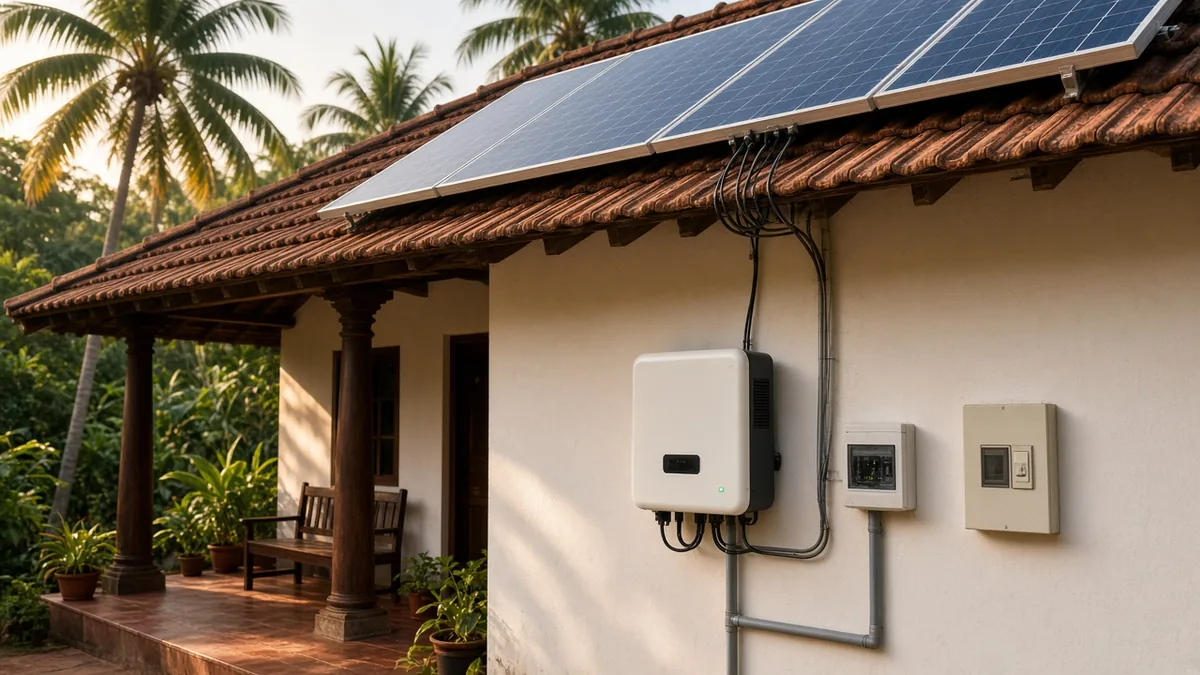
Quick answer: Panels turn sunlight into DC power. The inverter changes it to AC, and the AC box feeds it into your home's mains, so running appliances use solar first. Any surplus flows to the KSEB grid through the net meter, while a separate generation meter counts all the units the plant makes. In a power cut the inverter switches off.
Key points before you look at your own plant
- Sunlight on the panels makes direct current (DC); the inverter turns it into the alternating current (AC) your home uses.
- Between the roof and your switchboard the power passes through junction boxes, a DC box (on bigger plants), the inverter and an AC box.
- The AC box joins the solar supply to your home's mains, so your fans and lights use solar power while the sun is up.
- Only the surplus your home does not use goes out to the KSEB grid, and the bi-directional net meter records both directions.
- A separate generation meter records everything the plant makes.
How does rooftop solar work, step by step?
Follow the power from the roof down. The panels turn sunlight into DC electricity. Their cables end in array junction boxes fixed on the mounting structure. From there the DC travels to a DC distribution box and on to the inverter, which has a built-in maximum power point tracker (MPPT) that keeps drawing the most energy the panels can give at that moment. The inverter's AC output then goes to an AC distribution box, which links it to your home's mains. For how one central inverter compares with small ones fitted under each panel, see microinverters against a string inverter.
Here is the same path as a table, from the roof to the grid:
| Part | What it does | Where you will find it |
|---|---|---|
| Solar panels (modules) | Turn sunlight into DC electricity | On the roof or terrace, on the mounting structure |
| Array junction boxes | Join and end the panel cables | Mounted on the panel mounting structure |
| DC distribution box (DCDB) | Receives the DC from the array and feeds the inverter; small plants may not need one if the inverter has the arrangement | Between the panels and the inverter |
| Inverter | Changes DC into AC, with an MPPT to draw the most energy | Indoors or outdoors, with a protection rating to suit |
| AC distribution box (ACDB) | Controls the inverter's AC output and joins it to the home mains | Between the inverter and the home mains |
| Net meter | Records the units you import from and export to the grid | Where KSEB can read it easily |
| Generation meter | Records the total units the plant generates | Also where KSEB can read it easily |
You do not need to touch any of these boxes to run the plant. Knowing their names helps when you read a quote, follow an installer's explanation or describe a fault on the phone. If the plant is on-grid, it works with KSEB supply; the differences with battery-backed systems are set out in on-grid, off-grid and hybrid systems compared.
What does each box on the wall do?
The DC distribution box is the switch and safety point for the panel side. MNRE's specification asks for it to be dust and vermin proof with IP 65 or better protection, with circuit breakers that control the DC going into the inverter and surge arrestors inside. It uses an MCB for currents up to 63 amperes and an MCCB above that. On a small home plant it may not be needed at all, if the inverter itself has a suitable arrangement, so do not worry if your plant has no separate DC box.
The inverter runs itself. MNRE's specification says it must work fully automatically, waking up, matching the grid and shutting down without anyone pressing a button. It should also have a built-in way to send plant data through a SIM card or dongle, and it may also support Wi-Fi, so the plant's data can be sent out and viewed away from the box. Its label must carry the maker's name, model, serial number, input ratings and protection rating. Note the serial number for your records. The inverter's AC rating is also what sets your plant size, explained in inverter kW and panel kWp for plant capacity.
The AC distribution box is where solar meets your house wiring. It controls the AC power coming out of the inverter and connects it to the mains, and it carries an MCB or MCCB on the inverter output. If the inverter does not have its own earth fault or residual current protection, the specification asks for an RCCB as well. An indoor AC box should have at least IP 54 protection and an outdoor one at least IP 65. Earthing, the lightning arrester and surge devices are a separate topic, covered in lightning and surge protection for rooftop solar.
Treat these boxes as the installer's territory. Keep them closed, dry and clear of stored items, and keep pets and children away from them. If a breaker trips again and again or a box feels hot or smells of burning, switch off only as your installer has shown you and call the installer.
Where does your solar power go: home first, then the grid?
Because the AC box joins solar to your mains, the appliances running in your home at that moment use the solar power first. Only the surplus your home cannot use flows out to the KSEB grid. KSERC's net metering rule is built on exactly this: surplus energy you export is adjusted against the energy you import. The net meter is a bi-directional meter, installed and maintained by KSEB, that reads total import, total export and the net figure, zone by zone. To read those screens yourself, see how to read your net meter display.
The second meter, the renewable generation meter, counts everything the plant produces, whether you use it at home or export it. Both meters must be placed where KSEB can reach them easily, and for a net-metered home KSEB reads both in each regular billing cycle. Who supplies each meter and what rent applies is explained in net meter and generation meter rules.
The two meters together tell you how much solar your home used directly. As an example, if the generation meter shows 20 units for a day and the net meter shows 12 units exported, your home used the other 8 units straight from the panels. These figures are only an illustration; your own readings will differ with weather and habits. How these lines appear on the bill is covered in import, export and banked units on a solar bill.
The more of your daytime work you move into sunny hours, the more of the plant's output your home uses directly. Pumping water, laundry and ironing are easy tasks to move. A room-by-room plan is in timing heavy appliances in solar hours.
What happens at night and during a power cut?
After sunset the panels stop producing, so your home draws all its power from the KSEB grid and the net meter records it as import. During a power cut, an on-grid plant also stops, even on a sunny day. MNRE's specification requires the inverter to switch off quickly when grid supply fails, so it does not feed a line that KSEB staff may be repairing. When supply returns, the inverter matches the grid again and restarts on its own. Messages such as grid fault or no grid are explained in what a solar inverter grid fault means.
If you want lights and fans during power cuts, that needs a battery-backed setup, which is a different design. Do not connect solar panels to an old home inverter on your own. The options are explained in connecting solar panels to a home inverter and battery.
A Kerala example: one sunny day on a Palakkad roof
Here is one example home in Palakkad with a 3 kW on-grid plant, followed through a sunny day. It is an illustration, not a real customer's data:
| Time of day | What happens | Which part is working |
|---|---|---|
| Early morning | Light reaches the panels; the inverter wakes up and matches the grid by itself | Panels and inverter |
| Late morning | The pump and washing machine run on solar power through the AC box | Inverter, MPPT and AC box |
| Midday | The home needs less than the plant makes, so the surplus flows out to the grid | Net meter records export; generation meter keeps counting |
| Afternoon, short power cut | The inverter switches off quickly and restarts by itself when supply returns | Inverter islanding protection |
| Evening | No sunlight; lights, fans and the TV run on power from the grid | Net meter records import |
By looking at the two meters at the end of a week, this family can see how much solar they used at home and how much they sent out. They also keep the inverter's app open on a phone, so a sudden drop on a clear day is noticed early and reported to the installer.
Checklist: what to check on your plant and quote this week
- Find each part on your own plant: panels, junction boxes, inverter, AC box and both meters.
- On a new quote, ask the installer to list every component, including the DC and AC boxes, cables and protection.
- Note the inverter's model and serial number from its label and keep them with your papers.
- Check that the inverter app or display shows daily generation, and set it up on your phone.
- Read both meters on the same day each week and keep a short note.
- Keep the boxes closed and dry, and never open the inverter, junction boxes or DC box yourself.
- Call your installer for faults, and KSEB for meter or supply problems.
Check this against your bill
FGE Solar can review your latest KSEB bill and tell you which system size is worth pricing.
Frequently Asked Questions
Does solar power go to my home first or to the KSEB grid?
To your home first. The solar supply joins your mains through the AC box, so appliances running at that moment use it. Only the surplus goes to the grid, and KSERC's net metering adjusts that export against what you import.
Why does my rooftop solar stop when the power goes off?
An on-grid inverter must switch off quickly when grid supply fails. This protects KSEB workers repairing the line and avoids damage to equipment. It restarts by itself once supply is back.
Do small home solar plants need a DC distribution box?
Not always. MNRE's specification says a separate DC distribution box may not be needed for small plants if the inverter has a suitable arrangement built in. Your installer can show you where the DC side is switched and protected.
What is MPPT in a solar inverter?
MPPT stands for maximum power point tracker. It is built into the inverter and keeps adjusting so the panels give the most energy they can as sunlight changes. You do not need to set it.
Can I check my solar generation on my phone?
The inverter is built for it. MNRE's specification asks for a built-in way to send plant data through a SIM card or dongle, and allows Wi-Fi as well. Ask your installer at handover how to view that data on your phone.
Which meter shows how much my solar plant made?
The renewable generation meter. It counts all the energy the plant produces. The net meter shows only what crossed to and from the grid, so you need both readings to see your own use.
Official Sources and Accuracy Note
- 01MNRE Guidelines for PM-Surya Ghar: Muft Bijli Yojana, Central Financial Assistance to Residential Consumers, Annexure 3 minimum technical specifications (PDF)
Component list and technical clauses used for the power path: array junction boxes, DCDB, inverter/PCU with MPPT, ACDB interconnection at the LT bus bar, islanding protection, and generation/net meters.
govt source · opened 2026-10-30 - 02KSERC (Renewable Energy and Related Matters) Regulations, 2025 (final PDF)
Reg 2(61) net meter, Reg 2(62) net metering surplus export, Reg 2(82) RG meter, Reg 15.7 meter location, Reg 28.2 reading both meters each billing cycle.
govt source · opened 2026-10-30
Accuracy note: This guide is built from government pages, regulator orders, and news sources on the web. Rules and amounts change. Some details may be outdated or wrong. Check the official links below before you pay, apply, or complain to KSEB.