Do Solar Panels Work in Hot Weather? What Heat Does to Output
On Kerala's hottest summer days, many owners notice the noon reading on the inverter is lower than they expected. So do solar panels work in hot weather? They do, but heat trims what the same sunlight can give. This guide explains why, shows you the one datasheet line that tells you how much, and lists what you can check on your own plant without climbing onto the roof.
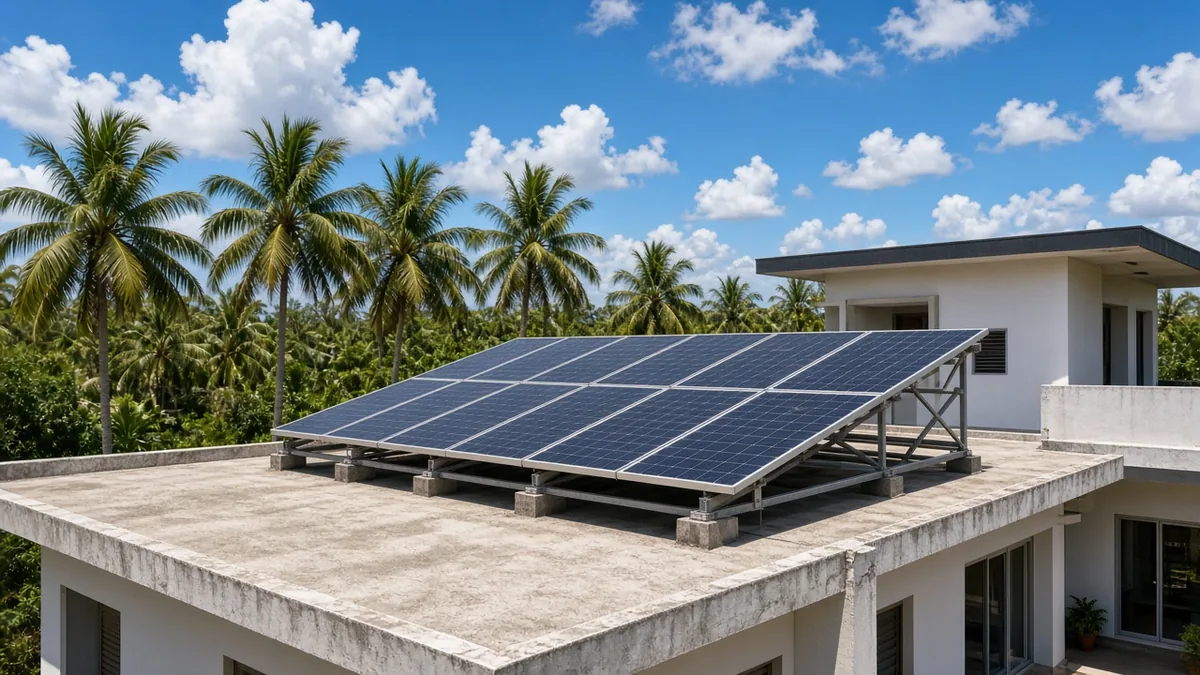
Quick answer: Panels keep working in the heat, but their power falls as the modules get hotter than the 25°C used to rate them. The datasheet's temperature coefficient shows how much per degree; MNRE allows no worse than -0.4%/°C for crystalline panels. Airflow under the panels and a shaded inverter help.
Key points for a hot Kerala afternoon
- The watt rating on a panel label is measured at a module temperature of 25°C under standard test conditions, so a panel running hotter than that gives less than its label figure in the same sunlight.
- Panels still make power in the heat. The hotter the module, the lower its output at the same sunlight, and the units (kWh) your meter counts follow that output.
- For subsidised home plants, MNRE requires a temperature coefficient of power of -0.4% per °C or better for crystalline panels and -0.3% per °C or better for thin-film panels.
- MNRE's mounting rules leave a slight gap at the top and bottom edges of each module so air can cool it.
- Inverters for these plants are specified for an ambient temperature range of -20°C to 60°C, so where the inverter sits matters too.
Do solar panels work in hot weather, and why does output dip?
Your panel's watt rating is a laboratory number. Indian standards require the module's maximum power on the nameplate to be stated at Standard Test Conditions (STC): sunlight of 1,000 W per square metre, a module temperature of 25°C and a standard light spectrum called AM1.5 (BIS IS 14286, clause 5.1). The National Institute of Solar Energy, MNRE's testing institute, measures module performance at that same 25°C module temperature. Any time the cells are hotter than that, the panel is working away from the point its label describes.
How much the heat costs is written on the panel's datasheet as the temperature coefficient of maximum power, given in percent per degree Celsius (%/°C) and measured against the 25°C test point (BIS IS 14286, clause 5.2.2 and test MQT 04). The figure is negative because power falls as the module warms. A coefficient of -0.4%/°C means about 0.4% less power for every degree the module runs above 25°C, and about 0.4% more for every degree below it.
On a sunny Kerala roof in the hot months, the glass and cells sit far from a cool laboratory bench. The sun is still the fuel, though. A hot, clear day can give a good day's units, because bright sunlight matters more than the heat that comes with it. What you lose is the extra the same light would have made on a cooler panel. Haze, dust and cloud cut output in a different way, by reducing the light itself, which is why output across the year follows the weather more than the thermometer; the season-by-season picture is in how Kerala's monsoon changes solar output.
How to read the temperature coefficient on a panel datasheet
These are the lines to look for on the module datasheet or nameplate your installer gives you.
| Datasheet line | What it tells you |
|---|---|
| Maximum power (Pmax) at STC, with tolerance | The label wattage, measured at a 25°C module temperature |
| Temperature coefficient of Pmax (%/°C) | How much power changes for each degree the module is hotter or cooler than 25°C |
| Temperature coefficient of Voc (%/°C) | How the panel's open-circuit voltage changes with temperature |
| Temperature coefficient of Isc (%/°C) | How the short-circuit current changes with temperature |
| Performance at low irradiance | Output in weak light, such as early morning or a cloudy day |
| NOCT or performance at NOCT | A rating under a second test condition; NISE lists NOCT measurement and performance at NOCT among its module tests |
For a plant built under PM Surya Ghar, MNRE's minimum technical specification sets a limit: the temperature coefficient of power must be -0.4%/°C or better for crystalline panels, and -0.3%/°C or better for thin-film panels (Annexure 3, clause 1.6). Better means closer to zero. A panel at -0.30%/°C loses less in the heat than one at -0.40%/°C, and a crystalline panel at -0.45%/°C would not meet the limit.
Ask your installer for the datasheet of the exact panel model on your quote, not a brochure for the brand. Find the power temperature coefficient line and write it next to the panel wattage on your quote page. When you compare two panels, compare this line along with efficiency and warranty; the wider buying picture, including technology types, is in our guide to choosing solar panels for Kerala.
If you are applying for the subsidy, the panel also has to satisfy the domestic-content and approved-list conditions, which are explained in DCR and non-DCR panels and the approved list. A good temperature coefficient does not replace those conditions.
A Kerala example: how much a hot panel gives up
For example, take a 3 kWp array of crystalline panels exactly at MNRE's -0.4%/°C limit, in full test-level sunlight. The module temperatures below are illustrations, not measurements from a Kerala roof.
| Module temperature (example) | Degrees above 25°C | Power below label (x 0.4%) | 3 kWp array DC output at that moment |
|---|---|---|---|
| 35°C | 10 | 4% | about 2.88 kW |
| 45°C | 20 | 8% | about 2.76 kW |
| 55°C | 30 | 12% | about 2.64 kW |
| 65°C | 40 | 16% | about 2.52 kW |
The coefficient makes a visible difference. At a module temperature of 45°C, which is 20 degrees above the test point, a panel at -0.4%/°C gives about 8% less than its label (20 x 0.4), while a panel with a coefficient of -0.3%/°C gives about 6% less (20 x 0.3). These are moment-by-moment figures for the panels alone.
Wiring, dust, shade and the inverter take their own share on top, and mornings and evenings are lower simply because there is less light. So a hot noon reading below the label does not mean the plant is faulty. The useful test is the day's or the month's total units compared with similar weather, which how to check your daily solar generation walks through.
Remember too that the inverter's own rating caps what reaches your home, whatever the panels make, a point covered in inverter kW versus panel kWp.
How mounting, airflow and inverter placement help in the heat
MNRE's mounting rules are written partly with heat in mind. The upper edge of each module gets a wind shield so wind does not build up underneath, but a slight clearance is left at both the upper and lower edges to let air through for cooling (Annexure 3, clause 3.7). Ballast frames on a flat terrace also have a minimum height above the roof for the same reason; that height and the other structure rules for terrace, sheet and raised frames are in how mounting legs should be fixed to a Kerala roof.
The inverter has its own heat limit. MNRE's specification lists an ambient temperature range of -20°C to 60°C among the typical technical features of a rooftop solar inverter (Annexure 3, clause 2.7). Where the inverter sits in the power path is shown in how rooftop solar reaches your switchboard.
Keep the gap under the panels open. Do not store sheets, pipes or old furniture under the frames, and do not let creepers or plastic covers close the edges. An inverter in afternoon sun on a west wall, or in a closed and airless corner, has a harder time than one in shade with space around it. Keep its vents free of dust and cobwebs, and do not hang clothes or stack boxes against it. If you plan a shade net, a sheet roof or a water tank near the array, ask your installer first, because anything that blocks air or casts shade changes how the plant runs.
Heat, ageing or a fault: how to tell the difference
Summer heat gives a dip that comes and goes with the weather: lower around hot middle hours, back up on a cooler bright day. Ageing is slow and steady across years. A fault usually shows as a sudden drop that stays, one string or panel behaving differently, or an error on the inverter display. Compare months with the same season from last year, not a hot afternoon with a cool morning. These signs point to something other than heat:
- A new tree branch, a neighbour's wall or a water tank shading part of the array: see shade that appears after installation.
- Brown or burnt-looking marks on a cell, cracked glass or a melted smell near a junction box: call your installer and stay off the roof.
- An inverter that shows an error or switches off in the afternoon heat: note the message and call the installer rather than opening it.
- Output that stays low on cool, clear days as well: ask for a service visit, because heat alone does not explain that.
Checklist: what to do before and during the hot months
- Get the datasheet for your panel model and note its power temperature coefficient.
- If you are still choosing panels, compare that line on each quote, along with efficiency and warranty.
- Check from the ground that the space under the panels is open and clear of stored items.
- Make sure the inverter is in shade, with its vents clean and nothing stacked against it.
- Track your generation by the day and by the month, and compare like with like.
- Do not spray water on hot panels to cool them; clean only at the times your installer advises, as explained in safe panel cleaning and maintenance.
- Stay off the roof in the midday heat. Panel glass, frames and metal structures get very hot, and DC cables are never for homeowners to touch.
- Call your installer for errors, burnt marks or a drop that does not recover; call KSEB only for meter or supply faults.
Check this against your bill
FGE Solar can review your latest KSEB bill and tell you which system size is worth pricing.
Frequently Asked Questions
Why does my solar output drop on very hot afternoons?
Panels are rated at a module temperature of 25°C, and their power falls as they get hotter than that. The temperature coefficient on the datasheet tells you by how much for each degree. The plant is still working; it is simply less efficient while the cells are hot.
What temperature coefficient should a solar panel have in India?
Under PM Surya Ghar, a crystalline panel's power coefficient must not be worse than -0.4%/°C, and a thin-film panel's not worse than -0.3%/°C. The nearer the figure is to zero, the less the panel loses as it heats up. Read the value from the datasheet of the exact model on your quote.
What does STC mean on a solar panel label?
STC stands for Standard Test Conditions. Indian standards define them as sunlight of 1,000 W per square metre, a 25°C module temperature and the AM1.5 light spectrum. The label wattage is measured under these conditions, so it is a reference, not a promise of rooftop output.
Can high summer temperatures damage my solar inverter?
Inverters for these plants are specified for an ambient temperature of -20°C to 60°C, meaning the air around the box. If yours shows a fault or shuts down in the heat, note the message and call your installer rather than opening it.
Is there supposed to be a gap between the panels and the roof?
Yes. MNRE's mounting rules leave a slight clearance at the upper and lower edges of each module so air can pass and cool the panels. Ballast frames on a flat terrace also need a minimum height above the roof under the same specification.
Should I spray water on my panels to cool them in summer?
No. Pouring water on hot glass is not a cooling method, and climbing up in the midday heat is a safety risk. Clean only when and how your installer advises, and leave cooling to the airflow under the panels.
Does lower output in April mean my panels are getting old?
Not on its own. Heat lowers output while it lasts, and it comes back on cooler bright days. Compare the same month with last year, and ask your installer to check if a drop does not recover.
Official Sources and Accuracy Note
- 01Bureau of Indian Standards, test report form for IS 14286 Series:2023, Terrestrial photovoltaic (PV) modules: design qualification and type approval (PDF)
Clause 5.1 nameplate data at STC (1,000 W/m2, 25°C, AM1.5); clause 5.2.2 temperature coefficients for Voc, Pmax and Isc; Table 07 MQT 04.
govt source · opened 2026-10-31 - 02MNRE Guidelines for PM-Surya Ghar: Muft Bijli Yojana, Central Financial Assistance to Residential Consumers, Annexure 3 minimum technical specifications (PDF)
Clause 1.6 power temperature coefficient limits; clause 2.7(iv) inverter ambient temperature; clause 3.7 edge clearance for cooling air; clause 3.12(i)(b) ballast-frame roof clearance.
govt source · opened 2026-10-31 - 03National Institute of Solar Energy (MNRE), PV Module, Systems and BOS Testing department page
Module performance measured at 25°C module temperature and AM 1.5 spectrum per IEC 60904-3.
govt source · opened 2026-10-31 - 04National Institute of Solar Energy, testing service: Testing of solar PV modules
NISE module tests include STC performance, temperature coefficient, NOCT measurement and performance at NOCT.
govt source · opened 2026-10-31
Accuracy note: This guide is built from government pages, regulator orders, and news sources on the web. Rules and amounts change. Some details may be outdated or wrong. Check the official links below before you pay, apply, or complain to KSEB.