Solar Panel Roof Leakage: Find the Cause and Fix It Safely
A damp patch on the ceiling a few months after the panels went up is a worrying sight. Solar panel roof leakage in Kerala usually comes from a few places: anchor holes in the slab, concrete blocks that trap water, blocked drains and open cable entries. This guide shows how to find the real entry point from safe places, what MNRE's specification expects from the installer, and how to re-waterproof without damaging the plant.
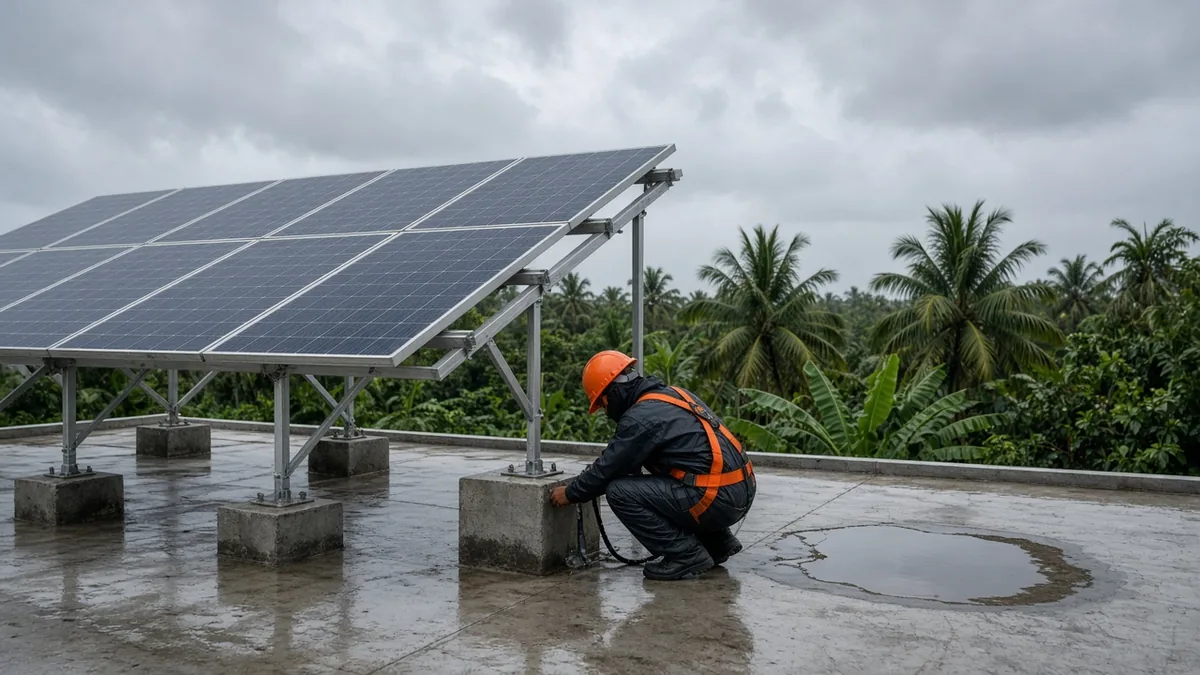
Quick answer: Mark each damp patch and match it to the mounting legs, blocks and cable entries on your structure drawing. Look only from safe spots, never on the panels. If the leak lines up with the installer's work, write to them with photos. Plan any full terrace waterproofing for a dry spell, with the installer handling the panels.
Why a terrace can start leaking after solar goes up
A rooftop plant puts metal legs, concrete blocks, bolts and cables on a roof that was built only to shed rain. Trouble starts when one of them gives water a path into the slab, or stops it draining away. Kerala's long monsoon finds that path quickly, and the first sign is usually a damp patch on the ceiling of the room below.
- Anchor holes drilled into the slab for the legs, with cracked or missing sealant.
- Concrete blocks that have pulled away from the roof, letting water creep underneath.
- Blocks or cable trays placed across the slope, so rain ponds instead of draining.
- Drain outlets choked with leaves, moss or debris that collect behind the blocks and under the panels.
- Cable holes through a parapet or wall left open or badly packed.
- On sheet roofs, loose or rusted rivets through the sheet near the mounting base.
Not every leak under a plant is caused by the plant. An old terrace can fail on its own, so the first job is to find where the water actually enters. For general upkeep of the panels themselves, see our guide to routine solar panel maintenance in Kerala.
How should mounting legs be fixed to a Kerala roof?
For plants under PM Surya Ghar, MNRE's technical specifications describe how the structure should sit on each kind of roof. On a flat terrace with a ballast structure, the structure must be the non-invasive ballast type and any penetration of the roof is to be avoided. It should sit 70 to 150 mm above the roof level so air can cool the panels and the terrace can still be cleaned, and it is held down with reinforced concrete blocks made of M25 concrete (Annexure 3, clause 3.12(i)).
Raised RCC structures may use one of two foundations, chosen by roof condition, and sheet roofs have their own rules (Annexure 3):
| Roof or foundation type | What MNRE's specification says | Why it matters for leaks |
|---|---|---|
| Raised RCC structure, roof penetration allowed | Where the client allows roof penetration: anchor fasteners of at least 12 mm diameter and 100 mm length with proper chipping; RCC block at least 400 x 400 x 300 mm; concrete grade at least M20 (clause 3.12, item E(a)) | Each anchor is a hole in your slab that must be sealed |
| Raised RCC structure, no roof penetration | Foundation with J bolts (IS 5624), at least 12 mm diameter and 300 mm long; a bonding solution to adhere the block to the RCC roof (clause 3.12, item E(b)) | The bond between block and roof must stay intact |
| Tin or sheet roof | Structure follows the slope; base connected to the purlin with proper riveting; lowest point more than 100 mm above the sheet; members at least 2 mm thick (clause 3.12(ii)) | Rivets through the sheet are the likely leak points |
The structure also has to hold the plant down in strong wind. The specification says it must be designed for the wind zone of the location with a factor of safety of at least 1.5, and that fastening such as grouting should secure it against that wind speed (Annexure 3, clauses 3.6 and 3.8). This matters when a roof is repaired: whatever is lifted has to go back with the same hold-down, not just be set loosely on the slab.
Solar panel roof leakage: how to find where the water gets in
- Mark every damp patch on the ceiling below with a pencil line and a date, and photograph it after each heavy rain.
- Compare those marks with the legs, blocks and cable entries above, using your structure drawing.
- From a terrace with a proper parapet, look at each leg and block base on a dry day for cracked sealant, gaps, green stains or standing water.
- Check where water goes when it rains. Note any spot where it ponds behind a row of blocks or a cable tray instead of running to the drain.
- Look at the walls where cables come in. A damp streak running down from a cable hole points to the entry, not the slab.
Your installer should already have given you the drawings you need. Under MNRE's model consumer-vendor agreement, documents handed to the consumer include the layout and electrical single line diagram, the structure design and drawing, and the warranty cards of the panels and inverter (Annexure 2, clause 7).
Stay safe while you look. Never climb onto a wet, mossy or sloping roof, never walk on the panels and never step over or lift the cables. Do not touch the panels, connectors or DC cables, even when the inverter is off. If water is reaching a switchboard, a light fitting or the inverter area, keep away from it and call your installer or a licensed electrician; they will isolate the plant the way the manual describes. Keep the papers together, as in our solar documents checklist for Kerala homes.
If water has reached wiring, a meter or the supply side and you see sparking or smell burning, treat it as an electrical emergency. KSEB's website lists 1912 as its toll-free number and 9496010101 for emergencies and accidents.
Who fixes a leak caused by the solar installation?
For PM Surya Ghar plants, MNRE's guidelines say registered vendors shall provide repairs and maintenance of the plant free of cost for the 5-year Comprehensive Maintenance Contract (CMC) period from the date of commissioning, and replace or repair non-performing parts free of cost in that period (Section 7(d)).
The model agreement also puts the civil work on the vendor. It says the vendor carries out complete civil work, structure work and electrical work following all the safety and relevant BIS standards (Annexure 2, clause 6). The same agreement lists a site survey that includes a feasibility study of the roof and the strength of the roof (clause 2), and five years of comprehensive operation and maintenance, including regular checking of the health of the system (clause 12).
In practice, a leak at a bolt hole or a block that the installer made is a workmanship question about their civil work, so raise it with them first. Send photos, dates and the marked-up drawing in writing, and ask for a site visit. A leak from an old crack elsewhere is a building repair for a waterproofing contractor. What the agreement covers, and how consumer approval works, is set out in our page on the PM Surya Ghar vendor agreement.
How to re-waterproof a terrace that already has panels
- Plan the work for a dry spell, well before the monsoon.
- Get the solar installer and the waterproofing contractor to agree on the roof who does what.
- Let only the solar installer switch off, disconnect, lift or move panels, legs and cables. The waterproofing team should not unbolt anything.
- Keep coating and sealant off connectors, cable glands and junction boxes.
- Have every anchor hole and block base sealed properly as part of the job, and ask for photos of each base before the panels go back.
- After the first heavy rain, check the ceiling marks again.
MNRE's specification expects the plant to be serviceable. The structures shall be designed to allow easy replacement, repairing and cleaning of any module, and there must be adequate spacing between panels and rows for installation, cleaning and electrical maintenance (Annexure 3, clauses 3.9 and 3.10). It also says the structure should withstand operating conditions for at least 25 years (clause 3.11).
Ask the installer to check generation for a few days after the panels go back. Our guide to new shade and other output problems after installation explains how to compare readings over time.
Cable entries, junction boxes and drains: the other water paths
Water can also follow the cables. MNRE's specification asks for array junction boxes with a full dust, water and vermin proof arrangement, a hinged door with an EPDM rubber gasket to prevent water entry, and single or double compression cable glands (Annexure 3, clauses 5.1 and 5.2). Cables are to be routed in RPVC pipe or a GI cable tray with covers (clauses 9.9 and 9.10).
- Look for cable holes through walls or the parapet that are open, cracked around the edge or packed with paper or cloth.
- Note any junction box with a cracked lid, a missing gland or water marks below it, and ask the installer to replace it. Do not open it yourself.
- On coastal roofs, rust on fasteners near the base is a sign to call the installer early; see our notes on corrosion checks for coastal solar plants.
Earthing and surge protection share the same roof, so do not let anyone remove an earthing conductor or lightning arrester while working on waterproofing. Our solar lightning protection guide explains what those parts do.
A Kerala example: a damp ceiling under a terrace plant
Picture a two-storey house in Kottayam with a plant on the flat terrace. After the first heavy rains of the season, a brown patch appears on the bedroom ceiling. The owner marks it, waits for a dry day and looks from the parapet. The patch lines up with one row of legs on the structure drawing, and the sealant around two anchor bolts in that row has cracked. A second stain near the stairs lines up with nothing on the plant: an old crack in the terrace coating.
The owner writes to the installer with photos and the marked drawing, and the installer re-seals the two anchors. For the old crack, the owner books a waterproofing contractor for the dry months, with the installer handling the panels. Our page on how rooftop solar copes with Kerala's monsoon covers what to expect from the plant in that season.
Checklist: what to do before the next heavy rain
- Mark and date any damp patch on the ceiling below the plant, and photograph it.
- Keep your structure drawing, layout and warranty cards with the installer's contact details.
- From a safe spot, look at the base of each leg and block for cracks, gaps and green stains.
- Check that rain can reach every drain outlet.
- Plan any full terrace waterproofing for a dry spell, with the installer handling the panels.
- Never climb a wet or sloping roof, walk on panels or touch DC cables; call the installer, a licensed electrician or KSEB as needed.
Check this against your bill
FGE Solar can review your latest KSEB bill and tell you which system size is worth pricing.
Frequently Asked Questions
Can solar panels cause roof leakage in Kerala homes?
They can, if the installation gives water a path into the slab. The usual causes are badly sealed anchor holes, blocks that stop rain reaching the drain, and open cable entry holes. An old terrace can also leak on its own, so find the entry point first.
Do solar mounting structures need holes drilled in the roof?
Not always. MNRE's specification says a ballast structure on a flat terrace must be non-invasive, with roof penetration avoided (Annexure 3, clause 3.12(i)). Raised RCC structures may use drilled anchors only where the client allows it; otherwise a J-bolt foundation bonded to the roof is used.
Who pays for a leak caused by the solar installer?
Raise it with your installer first, in writing, with photos. For PM Surya Ghar plants, MNRE's guidelines require registered vendors to give free repairs and maintenance of the plant for the 5-year CMC period from commissioning (Section 7(d)). Civil and structure work is in the vendor's scope under the model agreement (Annexure 2, clause 6).
Can I waterproof my terrace without removing the solar panels?
Small repairs around a single base can sometimes be done in place, but a full new coat usually needs the panels lifted. Let only your solar installer disconnect and move them. Plan the job for a dry spell so the plant is back in service before the rains.
What should I do if rainwater reaches the inverter or a switchboard?
Keep away from the wet equipment and do not touch it. Call your installer or a licensed electrician to isolate the plant as the manual describes. If there is sparking on the supply side, use KSEB's emergency number 9496010101 listed on kseb.in.
Official Sources and Accuracy Note
- 01MNRE Guidelines for PM-Surya Ghar: Muft Bijli Yojana (CFA to Residential Consumers), including Annexures 2 and 3
Section 7(d): free repairs and maintenance for the 5-year CMC from commissioning. Annexure 2 clauses 2, 6, 7 and 12: roof survey, civil and structure work, drawings handed to the consumer, and five-year O&M. Annexure 3 clauses 3.6, 3.8 to 3.12, 5.1, 5.2, 9.9 and 9.10: wind hold-down, ballast vs penetrating foundations, spacing, waterproof junction boxes and covered cable routes.
govt source · opened 2026-10-22 - 02KSEB Ltd official website (home page contact strip)
Home page contact strip lists 1912 as the toll-free number and 9496010101 for emergencies and accidents, for use if water reaches live wiring or the supply side.
govt source · opened 2026-10-22
Accuracy note: This guide is built from government pages, regulator orders, and news sources on the web. Rules and amounts change. Some details may be outdated or wrong. Check the official links below before you pay, apply, or complain to KSEB.