Solar Panel Corrosion in Coastal Kerala: What Homeowners Should Check
Solar panel corrosion is a real concern for Kerala homes near the sea or backwaters, where salty, humid air works on bolts, clamps, junction boxes and cables year after year. Here is what MNRE's rooftop specification asks for, what you can safely check yourself, and when to call your installer.
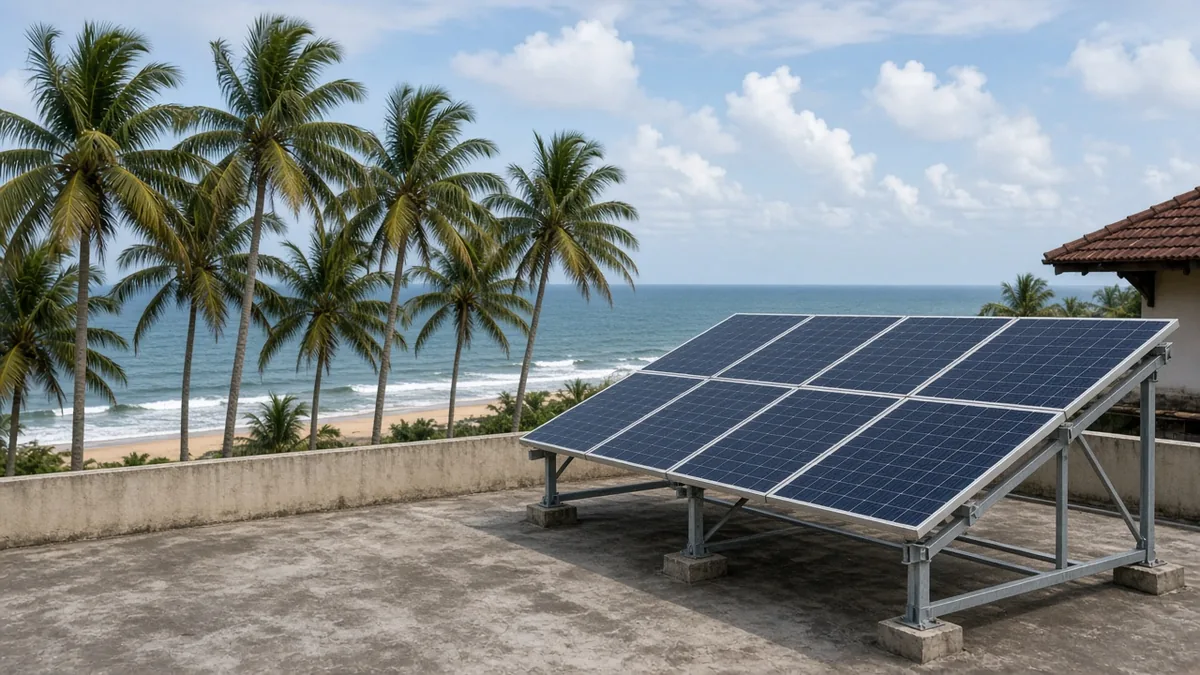
Quick answer: Near the coast, ask for panels with an IEC 61701 salt mist certificate, a galvanized or anodized structure, SS 304 or hot dip galvanized bolts, and IP 65 junction boxes. Check for rust only from a safe spot, never touch the wiring, and report problems to your installer during the warranty period.
Solar panel corrosion: why coastal Kerala homes need to look closer
Kerala's coast gives a rooftop solar plant a hard life. Sea breeze carries fine salt inland, the air stays humid for most of the year, and the monsoon keeps metal parts wet for weeks at a time. Salt and moisture together attack steel, loosen the protective coating on aluminium and creep into poorly sealed boxes. The panels themselves are built to face weather, but the bolts, clamps, junction boxes, cable glands and conduits around them need regular attention, especially in homes close to the sea or near backwaters.
MNRE's minimum technical specifications for rooftop solar under PM Surya Ghar deal with this directly. Panels that will be used in a highly corrosive atmosphere throughout their life must qualify to IEC 61701 / IS 61701, the salt mist corrosion test for solar modules. The same specifications list IEC 62716 / IS 16664, an ammonia corrosion test, for site conditions such as dairies and toilets. If your house is near the sea or has a cattle shed close to the roof, ask your installer for the module test certificate that shows these tests.
What MNRE's rooftop specification asks for, part by part
Corrosion-related requirements in MNRE's minimum technical specifications for rooftop solar.
| Part | What the specification says |
|---|---|
| Mounting structure material | Hot dip galvanized iron, aluminium or hot dip galvanized mild steel (3.2) |
| Steel and galvanizing | Steel as per IS 2062:2011; galvanizing as per IS 4759 (3.3) |
| Aluminium structure | AA6063 T6, with protection against rusting by coating or anodization (3.3) |
| Bolts, nuts and fasteners | Stainless steel grade SS 304 or hot dip galvanized (3.4) |
| Panel clamps | Aluminium, able to sustain adverse climatic conditions (3.4) |
| Structure life | Designed for operating conditions for at least 25 years (3.11) |
| Array junction boxes | GRP, FRP, powder coated or cast aluminium; dust, water and vermin proof; IP 65 or better with an EPDM rubber gasket on the hinged door (5.1, 5.2) |
| Outdoor electrical panels | IP 65 or better (7.6) |
| Cables | Armoured, with PVC type A or XLPE insulation for UV protection; routed in RPVC pipe or GI cable tray (9.3, 9.9) |
One line in section 3.4 matters a lot near the sea: structural material must be corrosion resistant and electrolytically compatible with the module frame and its fasteners, nuts and bolts. In plain words, metals that touch each other on your roof should be chosen so that one does not eat into the other when salt water sits between them. Ask your installer which metals are used for the rails, clamps and bolts on your roof, and how they are matched to the panel frame.
The specifications also say junction boxes should be mounted on the structure where they are easy to reach and protected from direct sunlight and harsh weather (section 5.5), and that cables and conduits are held with thermo-plastic clamps (section 9.11). Ask your installer to show you where each box sits so you can spot it from a safe place later.
A safe look-around: what to check without touching anything
Safety comes first. Look at the plant only from the ground, a window, or a flat terrace with a proper parapet. Never climb onto a sloped, tiled or sheet roof, and never go up when the roof is wet, mossy or windy. Do not touch panels, cables, connectors or junction boxes, and never open the inverter or any box on the roof. Solar panels make electricity whenever light falls on them, so the cables can be live even when the inverter is off.
Things worth noticing from a safe spot: orange or brown rust streaks running down from bolts or clamps; white powdery spots on aluminium rails or panel frames; bubbling or peeling paint on steel; a junction box door that sits open, has a cracked gasket or shows water marks; cracked, sagging or sun-faded conduit; loose cable ties letting wires hang or rub against metal edges; and any panel that looks shifted or tilted compared with its neighbours.
If you see any of these, take clear photos from where you stand and send them to your installer with the date. Do not try to tighten, scrape, paint or seal anything yourself. Rust treatment on a live solar array is work for a trained technician who knows how to isolate the system as the manufacturer describes. For anything to do with the KSEB meter or the service line, call KSEB instead.
Rinsing off salt film safely
MNRE's model vendor-consumer agreement, attached to the PM Surya Ghar guidelines, says the vendor shall educate the consumer on best practices for cleaning the modules and maintaining the system, and lists providing water for cleaning the panels among the consumer's tasks. The specifications add that the operation and maintenance manual supplied with the plant should include the dos and don'ts of the plant, with pictures showing the proper method of cleaning (section 10.3). Your cleaning method should follow that manual first.
Salt film shows up as a dull, hazy layer that rain alone does not always wash away near the coast. Rinse with plain clean water, ideally early in the morning or late in the evening when the glass is cool. Use only a soft brush or sponge on a long handle from a safe position, never by standing on the panels. Avoid abrasive powders, strong detergents, metal scrapers and high pressure jets unless your panel manual allows them, because they can damage the glass surface or push water into connectors.
If your panels cannot be reached safely from the ground or a flat terrace, leave cleaning to the installer during service visits. A fall from a roof is a far bigger risk than a little lost output from dusty or salty glass.
Who fixes rust under warranty and maintenance
Under MNRE's model vendor-consumer agreement, the complete system should be warranted for 5 years from the date of commissioning by the DISCOM, which is KSEB for most Kerala homes. Five years of comprehensive operation and maintenance, including overhauling, wear and tear and regular checking of the system, is in the vendor's scope. The consumer's part is to report any malfunctioning of the plant to the vendor during the warranty period.
Panels carry their own cover too. The specifications say the manufacturer should warrant modules against defects and failures due to manufacturing, quality of materials and faulty manufacturing or inspection, for not less than five years from commissioning, and that modules failing this warranty are replaced without any cost to the end consumer during that period (section 1.10). Individual component warranty documents from the manufacturer are to be handed to you, with the vendor helping you claim them.
Questions to ask your installer on a coastal roof
Before you sign, and again at handover, these questions help you check that the plant suits salty air. Each one comes from MNRE's minimum technical specifications.
- Do the panels have an IEC 61701 / IS 61701 salt mist test certificate?
- What is the mounting structure made of, and is it hot dip galvanized to IS 4759, or anodized or coated aluminium?
- Are all bolts, nuts and fasteners SS 304 stainless steel or hot dip galvanized, and are they compatible with the panel frame?
- Are the junction boxes IP 65 or better with an EPDM rubber gasket on the door?
- Are the cables armoured with UV-protected insulation and run in RPVC pipe or a GI tray?
Keep the structure drawing, the module and inverter warranty cards, the test reports and the installer's contact details together with your other solar papers. When a technician comes for service, these show what materials were agreed, so rust on a part that should not rust is easy to point out.
Check this on your roof
FGE Solar can review your rooftop layout and tell you what coastal-grade hardware to ask for.
Frequently Asked Questions
Do solar panels rust near the sea?
The glass and frame are built for outdoor use, but salty air is harder on them. MNRE's rooftop specification says panels used in a highly corrosive atmosphere must pass the IEC 61701 salt mist test. Ask your installer to show that certificate for your panel model.
Which bolts should a coastal solar structure use?
MNRE's specification asks for bolts, nuts and fasteners in SS 304 stainless steel or hot dip galvanized steel. Panel clamps should be aluminium. All of them must suit the metal of the panel frame so they do not corrode each other.
Is an aluminium mounting structure fine near the beach?
Aluminium is one of the three materials the specification allows. It should be grade AA6063 T6 and protected by coating or anodization. Bare, untreated aluminium is not what the specification describes.
Who handles rust that appears in the first few years?
Under MNRE's model agreement, the complete system is warranted for 5 years from commissioning by the DISCOM. Comprehensive maintenance for those years, including wear and tear, is the vendor's job. Report the problem to your vendor with photos and dates.
Can I wash salt off the panels myself?
Only if you can reach them safely from the ground or a flat terrace with a parapet. Use plain clean water and a soft brush when the glass is cool. Never stand on panels or climb a wet or sloped roof; leave that to your installer.
Official Sources and Accuracy Note
- 01MNRE Guidelines for PM-Surya Ghar: Muft Bijli Yojana (CFA to Residential Consumers), Annexure 3
Minimum technical specifications for salt-mist tested modules, galvanized or anodized structures, SS 304 or hot dip galvanized fasteners, IP 65 junction boxes and UV-protected cables.
govt source · opened 2026-10-12 - 02MNRE Guidelines for PM-Surya Ghar: Muft Bijli Yojana, Annexure 2 model vendor-consumer agreement
Five-year system warranty from DISCOM commissioning, comprehensive O&M including wear and tear, cleaning education, and the consumer's duty to report faults.
govt source · opened 2026-10-12
Accuracy note: This guide is built from government pages, regulator orders, and news sources on the web. Rules and amounts change. Some details may be outdated or wrong. Check the official links below before you pay, apply, or complain to KSEB.