Solar Panel Lightning Protection: A Kerala Homeowner's Guide
Solar panel lightning protection on a Kerala home rests on three things: proper earthing, a lightning arrester that covers the panels, and surge protection devices. Here is what MNRE's rooftop specification asks for, what to check with your installer, and how to stay safe when a thunderstorm comes.
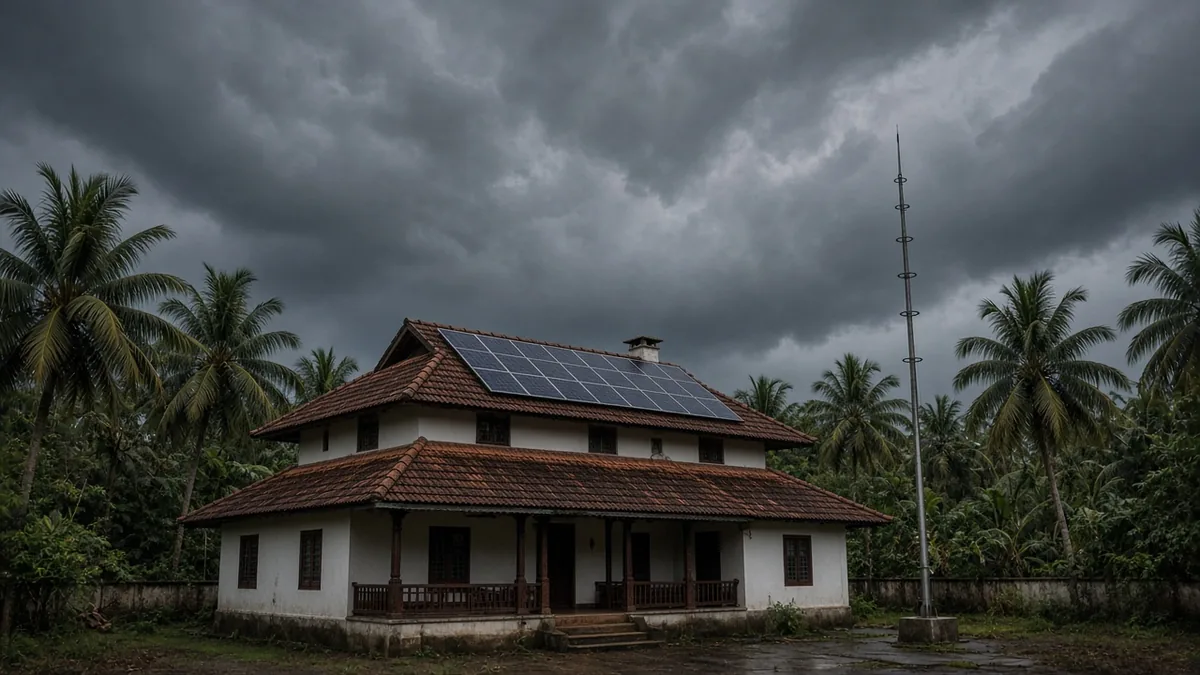
Quick answer: Your plant should have earthing with resistance never above 5 ohms, a lightning arrester that is not fixed to the panel frame, and surge protection devices. In a storm, stay off the roof and away from the panels. Afterwards, check from the ground and call your installer for any fault.
Solar panel lightning protection: what your plant should have
Lightning protection on a rooftop solar plant is a set of three things working together: earthing, a lightning arrester and surge protection. MNRE's minimum technical specifications for rooftop systems under PM Surya Ghar list "Protections – Earthing, Lightning, Surge" as one of the components every system should include, alongside the panels, inverter, meter, junction boxes, distribution boxes, cables and drawings.
The same specifications say what each part covers. Earthing connects the array structures, inverter, junction boxes and other electrical equipment to ground. Lightning arresters protect the whole space taken up by the panel array. Lightning and overvoltage protection aims to bring overvoltage down to a tolerable value before it reaches the panels or other parts, and internal surge protection devices, called SPDs, are added where required. The specifications name lightning and atmospheric disturbances as sources of that overvoltage (sections 8.1 to 8.3 of Annexure 3).
Think of it this way: the panels sit on the highest, most open part of your house, and they are joined by metal frames and long cables to equipment inside. Good protection gives a lightning surge an easy route into the ground instead of through your inverter, your wiring or the people in the house.
Earthing, lightning arrester and SPD rules in plain words
What MNRE's minimum technical specifications for rooftop solar say about protection.
| Item | What the specification says |
|---|---|
| Earthing standard | Array structures, inverter, junction boxes and all electrical equipment earthed as per IS 3043-2018 (8.1.2) |
| Earth resistance | As low as possible and never higher than 5 ohms (8.1.4) |
| Earth pits for 10 kW and above | Three separate pits: DC side, AC side and lightning arrester earthing (8.1.5) |
| Where the arrester goes | Not on the panel mounting structure (8.2.1) |
| Arrester standard | Array area protected as per NFC17-102:2011 / IEC 62305 (8.2.2) |
| Arrester earth wire | Run in its own separate pipe (8.2.4) |
| Surge protection | Where required, SPD type-II or MOV surge arresters from the +ve and -ve terminals to earth (8.3.1) |
Two of these points are easy for a homeowner to see on the roof. First, the arrester should stand apart from the frame that holds the panels, because the specification says it shall not be installed on the mounting structure. Second, the arrester's earth wire should run down in its own pipe, separate from other cables. The specification also asks that all metal casing of the plant be grounded and that the arrester be earthed inside the array area (section 8.1.3).
If your plant is 10 kW or larger, ask your installer to show you three separate earth pits, one each for the DC side, the AC side and the lightning arrester. For smaller home plants the specification does not fix a pit count, but the earth resistance limit of 5 ohms applies to every plant (sections 8.1.4 and 8.1.5).
What to do when a thunderstorm comes
India's weather office, IMD, says that if you hear thunder you are close enough to be struck by lightning. It recommends the 30/30 rule: go indoors if you cannot count to 30 between seeing lightning and hearing thunder, and stay indoors for 30 minutes after the last thunder.
IMD advises unplugging electronic equipment well before the storm arrives, and lists computers, televisions, washers, refrigerators and air conditioners among the appliances to unplug. It also suggests whole-house surge protectors for your appliances. During the storm it says to avoid baths, showers, washing dishes and running water, because lightning can travel through a building's plumbing and metal pipes, and to avoid corded phones. Cordless and mobile phones are safe to use indoors, according to the same advice.
For a solar home, the most important rule is simple: nobody goes up to the roof, the terrace or near the panels while a storm is building or going on. Leave the plant alone. Do not try to switch anything off at the panels or on the roof.
If your installer has shown you how to switch the plant off at the inverter and the AC isolator, and the manual says to do so before a storm, follow those exact steps only if you can reach them safely, with dry hands and dry feet, before the storm begins. If you are unsure, leave it as it is and stay indoors.
After the storm: safe checks for homeowners
Wait until the storm has fully passed. Then check from the ground or from inside the house. Look at the inverter display or the monitoring app and see whether the plant has come back on and is producing. Note any error message, a burning smell, scorch marks or a tripped breaker.
Do not open the inverter, do not touch the DC cables or connectors, and do not climb onto a wet or sloping roof to look at the panels. Do not reset a breaker that trips again. Photograph what you see and call your installer, and describe the error exactly as it appears on the screen.
IMD advises staying away from downed power lines and reporting them immediately. If a KSEB line, pole or service wire near your house is damaged, keep everyone away from it and report it to KSEB rather than touching it.
A meter that has gone blank, scorched or stopped after a storm is something to report to KSEB. A problem on the panel side or inside the inverter is a matter for your installer.
Kerala homes: coastal salt, rain and old earthing
Earth pits and earthing strips in Kerala live through heavy rain, humid air and, near the coast, salty wind. Over the years connections can loosen and corrode. Ask your installer to check the earthing during each service visit, and to show you the earth pit covers so you know where they are.
Keep the area around the earth pits clear. Do not cover them with concrete, plants or stored material, and tell anyone digging or building near the house where the pits and earth wires run.
MNRE's specification for PM Surya Ghar systems includes five years of comprehensive operation and maintenance of the rooftop plant as part of the system package. Ask your installer what the maintenance visits cover, and whether earthing and surge protection checks are part of them.
Questions to ask your installer
Before you sign, and again at handover, ask to see these points in the drawings and on the roof. Each one comes from MNRE's minimum technical specifications for rooftop solar.
- Where is the lightning arrester, and does it protect the whole panel area? It should not be fixed to the panel mounting structure.
- Does the arrester earth wire run in its own separate pipe?
- What earth resistance did you measure? The specification says it must never be higher than 5 ohms.
- For a plant of 10 kW or more: where are the three separate earth pits?
- Which surge protection devices are fitted, and where?
- Will I get the drawings and manuals for the system?
Keep the drawings, the handover papers and the installer's contact details together with your other solar documents, so that anyone servicing the plant later can see how it was earthed and protected.
Check this on your roof
FGE Solar can review your rooftop layout and tell you what lightning protection to ask for.
Frequently Asked Questions
Do rooftop solar panels attract lightning?
Panels sit on the highest open part of the roof and are joined to equipment inside by metal frames and cables. MNRE's rooftop specification asks for lightning arresters covering the array, earthing and surge protection. The aim is to bring lightning overvoltage down before it reaches the equipment.
Should I switch off my solar inverter during a thunderstorm?
Never go to the roof or panels during a storm. IMD advises unplugging electronic equipment well before a storm arrives. For the solar plant, follow only the switch-off steps in your manual or from your installer. Do this only if you can reach the switch safely before the storm.
What earth resistance should a solar plant have?
MNRE's specification says earth resistance should be as low as possible and never higher than 5 ohms. Ask your installer for the measured value at handover and at service visits.
Can the lightning arrester be fixed on the panel frame?
No. MNRE's specification says the lightning arrester shall not be installed on the mounting structure. Its earth wire should also run in a separate pipe.
Is it safe to help someone struck by lightning?
Yes. IMD says people struck by lightning carry no electrical charge and can be handled safely. Call the helpline number 1078, check breathing and pulse, start CPR if needed, and take the person to a hospital.
Official Sources and Accuracy Note
- 01MNRE Guidelines for PM-Surya Ghar: Muft Bijli Yojana (CFA to Residential Consumers), Annexure 3
Minimum technical specifications for earthing, lightning arresters and surge protection (sections 8.1 to 8.3), and five years of comprehensive O&M in the system package.
govt source · opened 2026-10-11 - 02India Meteorological Department: Thunderstorm & Lightning — Dos and Don'ts
30/30 rule, indoor unplugging and plumbing advice, downed-line warning, and first aid including helpline 1078.
govt source · opened 2026-10-11
Accuracy note: This guide is built from government pages, regulator orders, and news sources on the web. Rules and amounts change. Some details may be outdated or wrong. Check the official links below before you pay, apply, or complain to KSEB.