Solar Inverter Grid Fault: 7 Safe Checks Before You Call
Your rooftop plant was fine yesterday. Today the inverter screen says grid fault, the units have dropped, and it is a sunny day. A solar inverter grid fault is one of the most common messages on Kerala rooftops, and often the cause is outside your house. This guide gives seven safe checks you can do from the ground, the voltage KSEB must supply, and when to call the installer.
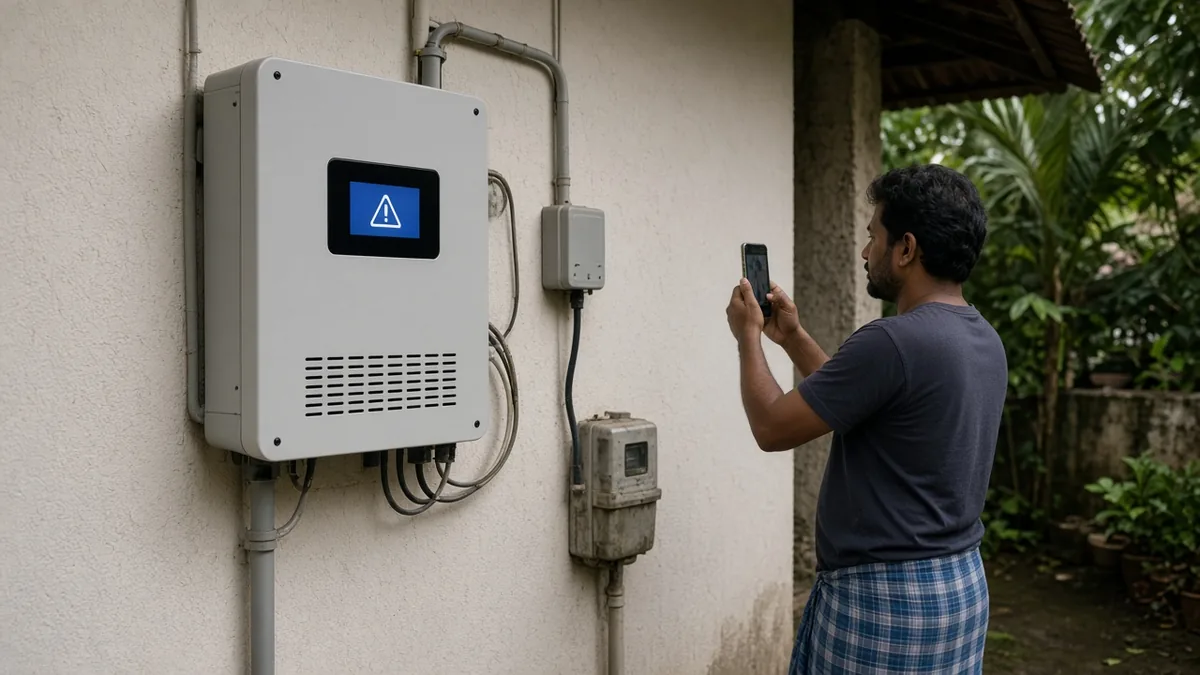
Quick answer: A grid fault message means your solar inverter stopped feeding power because KSEB supply is missing or out of range. Check the house supply, note the message and times, and look for midday patterns. If voltage is the cause, complain to KSEB; if supply is normal, call the installer. Never open the inverter.
What does a solar inverter grid fault mean?
- A grid fault message usually means the inverter has stopped feeding power because the KSEB supply is missing or outside the range it is set to accept.
- Every grid-connected plant must isolate itself when the grid fails (Regulation 14.4 of the KSERC RE Regulations 2025), so a stop during a power cut is normal.
- KSEB must keep single-phase supply at 240 V within six per cent either way (Regulation 4(8) of the Standards of Performance Regulations).
- If voltage stays outside that band, KSEB has seven days to correct it after your complaint when no network upgrade is needed.
- A PM Surya Ghar vendor must repair the plant free of cost during the 5-year maintenance contract (MNRE guideline clause 7(d)).
- Never open the inverter, junction box or DC isolator yourself; panels stay live in daylight.
Most messages that say grid fault, grid lost, no grid, AC voltage high or AC voltage low mean one thing: the inverter checked the KSEB supply, did not like what it saw, and switched itself off from the grid. That is a safety feature, not a breakdown. The MNRE technical specification for PM Surya Ghar plants says the inverter must turn off quickly when the grid fails, so it does not feed a dead line where a KSEB lineman may be working, and must also disconnect on under and over voltage (MNRE guideline, technical specification 2.11).
This is also why an on-grid plant gives no power during a power cut, even at noon. If you want backup, that needs a battery or hybrid setup; the on-grid vs off-grid vs hybrid guide explains the difference. A grid fault that clears on its own when the supply comes back is the system working as designed.
7 safe checks before you call the installer
Under the KSERC rules, you as the plant owner are responsible for safe operation and for getting defects fixed on your side of the inter-connection point, while KSEB is responsible beyond it, including the meter (Regulation 14.2). In practice that splits a grid fault into two questions: is the problem in the KSEB supply, or in your plant? The checks below help you answer that from the ground, without touching any wiring.
- Check one: look at the house supply. If lights and fans are off, or neighbours have no power too, the grid is down and the inverter will restart by itself after supply returns.
- Check two: read the inverter screen or app and write down the exact message, the date and the time. Take a photo. Do not press reset repeatedly.
- Check three: note when the fault happens. A fault only around midday on sunny days, when your plant exports most, is a reason to ask KSEB to measure the voltage at your meter.
- Check four: look at the solar AC breaker in the distribution board without opening the board cover. If it has tripped, leave it and call the installer rather than switching it on again and again.
- Check five: compare today's units with your normal days. The solar generation per day guide shows how to keep a simple log.
- Check six: from the ground, look for new shade from a tree, water tank or a neighbour's new floor. The solar panel shading guide covers what to do.
- Check seven: look for chewed cables or loose conduit near the inverter from a safe distance. The rodent protection guide explains the warning signs.
Stay off wet or sloped roofs. Do not open the inverter, the DC combiner box or the distribution board, and do not pull connectors. Panels keep producing DC power whenever there is daylight, even when the inverter shows a fault. If you smell burning, see smoke or hear crackling, switch nothing on, keep people away and call the installer and KSEB.
What voltage should a Kerala home get from KSEB?
The Kerala Electricity Supply Code fixes low-tension supply at 240 volts between phase and neutral for single-phase homes and 415 volts between phases for three-phase homes (Supply Code Regulation 6). Under Regulation 7, KSEB may let the voltage at your point of supply move up to six per cent above or below that without your written consent.
What six per cent means at your meter (arithmetic from the declared voltage):
| Connection | Declared voltage | Lowest allowed | Highest allowed |
|---|---|---|---|
| Single phase | 240 V | 225.6 V | 254.4 V |
| Three phase (between phases) | 415 V | 390.1 V | 439.9 V |
On a lightly loaded rural line with many solar homes, the voltage can rise in the middle of the day when everyone exports. Your inverter then sees the supply climb past its limit and disconnects, comes back, and disconnects again. You cannot fix this inside your house. It is a matter for KSEB's network, and it is the same local capacity question that the transformer hosting capacity guide covers for new applications.
How to complain to KSEB about high or low voltage
If your notes show the fault lines up with supply voltage, register a voltage complaint with your KSEB section office. Once KSEB receives a voltage complaint, it must check whether the variation is beyond the permitted limits and bring it back within them in seven days where no network upgrade or new substation is needed. Where the distribution system has to be upgraded, the limit is 120 days (Standards of Performance Regulation 4(8)(C)).
KSEB's website lists the 1912 customer care service and the number 9496001912 for complaints. Give the consumer number, say the plant trips on grid voltage, and share your dated list of fault times. Keep the complaint number.
If KSEB misses the deadline, Schedule I of the same regulations sets compensation of ₹200 for each week of default on voltage fluctuation complaints. Where compensation is not automatic, the application goes through the online portal within thirty days of the breach (Regulation 16). The KSEB compensation guide lists the other standards and how to claim.
A Kerala example: a plant that trips every sunny noon
Illustrative example, not a real case. A single-phase home in Palakkad notes that its inverter shows AC voltage high between about eleven and two on clear days, and the screen reads close to 256 V each time. That is above the 254.4 V ceiling worked out above. The owner registers a voltage complaint on day one. KSEB has seven days if no upgrade is needed. If the voltage is still out of range three weeks after the deadline, the compensation at ₹200 a week would be ₹600 for those three weeks of default (3 × ₹200).
Meanwhile the owner asks the installer to confirm the fault log and inspect the AC cable run from the inverter to the meter, so a problem on the house side is ruled out before KSEB visits. Any change to inverter grid settings is a job for the installer alone, within what KSEB has approved.
When to call the installer, and what it should cost you
Call the installer when the fault continues while the house has normal supply, when the AC breaker trips again, when the screen shows an isolation, earth or insulation fault, or when output stays low after the checks above. For PM Surya Ghar plants, the registered vendor must carry out repairs and maintenance free of cost for 5 years of the Comprehensive Maintenance Contract from commissioning, and replace or repair non-performing or under-performing parts free in that period (MNRE guideline clause 7(d)). The solar panel maintenance guide covers routine care after that.
After a thunderstorm, a fault that will not clear can mean a surge device has operated. That is a job for the installer, not for you; the lightning protection guide explains what is fitted and why.
Checklist: what to do this week if your inverter shows a grid fault
- Confirm whether the house and street have supply.
- Photograph the inverter message and note the date and time every time it appears.
- Compare generation with normal days using your meter; the net meter reading guide shows which display to note.
- Look for new shade and chewed cables from the ground only.
- If faults line up with midday sun, register a voltage complaint with KSEB and keep the number.
- If supply is normal and the fault stays, call your installer and ask for the fault log in writing.
- Book a free bill and transformer check if you are unsure whether the local line is the cause.
Check this against your bill
FGE Solar can review your latest KSEB bill and tell you which system size is worth pricing.
Frequently Asked Questions
Why does my solar inverter show grid fault?
It usually means the inverter has disconnected because KSEB supply is absent or outside its voltage or frequency limits. The MNRE specification requires islanding protection and under and over voltage disconnection, so the inverter stops rather than feeding an unsafe line.
Is it safe to reset the inverter myself?
Use only the restart steps printed in the manual or shown on the screen, once. Do not open the cover, pull DC connectors or switch a tripped breaker on repeatedly. Under the KSERC rules the owner must keep the plant safe on the house side, so leave repairs to the installer.
What is the normal voltage for a house in Kerala?
KSEB's declared single-phase supply is 240 V. The Supply Code allows six per cent either way, so about 225.6 V to 254.4 V at your point of supply. Three-phase supply is 415 V between phases, with the same band.
How long does KSEB have to fix high voltage?
Seven days from your complaint when no network upgrade is needed, and 120 days when the distribution system must be upgraded. Miss either, and the Standards of Performance schedule sets ₹200 for each week of default.
Will my installer charge for fixing a grid fault?
On a PM Surya Ghar plant, repairs and replacement of under-performing parts are free during the five-year maintenance contract that starts at commissioning. After that, the component warranties from the makers apply, and labour depends on your service agreement.
Can KSEB disconnect my solar plant for a fault?
Yes. KSEB may disconnect a plant that threatens safety or damage to its network, after notice under the Supply Code. It may also ask you to fix the defect within a reasonable time, and reconnects only after that.
Official Sources and Accuracy Note
- 01KSERC (Renewable Energy and Related Matters) Regulations, 2025 (gazette PDF)
Takeaways: Reg 14.4 isolation on supply failure, Reg 14.2 owner responsibility up to the inter-connection point.
govt source · opened 2026-10-28 - 02KSERC (Standards of Performance of Distribution Licensees) Regulations, 2015, consolidated text (final PDF)
Takeaways: SoP Reg 4(8)(B)(i) six per cent LT band and 4(8)(C) seven-day voltage complaint timeline.
govt source · opened 2026-10-28 - 03MNRE Guidelines for PM-Surya Ghar: Muft Bijli Yojana, CFA to Residential Consumers (PDF)
Takeaways: MNRE clause 7(d) free repairs for the 5-year CMC on PM Surya Ghar plants.
govt source · opened 2026-10-28 - 04Kerala Electricity Supply Code, 2014, consolidated text updated as on 14-10-2025 (KSERC final PDF)
b7: Supply Code Reg 6(1)(a) declares LT supply as single phase 240 V and three phase 415 V; Reg 7 proviso allows six per cent variation for LT.
govt source · opened 2026-10-28 - 05KSEB Ltd official website (home page contact strip)
b11: kseb.in home page lists the 1912 toll-free customer care service and the 9496001912 IVR number.
govt source · opened 2026-10-28
Accuracy note: This guide is built from government pages, regulator orders, and news sources on the web. Rules and amounts change. Some details may be outdated or wrong. Check the official links below before you pay, apply, or complain to KSEB.