Can I Connect Solar Panels to Home Inverter and Battery Setups?
Many Kerala homes already have an inverter and battery for power cuts, so the obvious question is whether you can simply connect solar panels to home inverter wiring and skip a new machine. The short answer is no for net metering and the subsidy. This guide shows what your old inverter can still do, and what a rooftop plant needs.
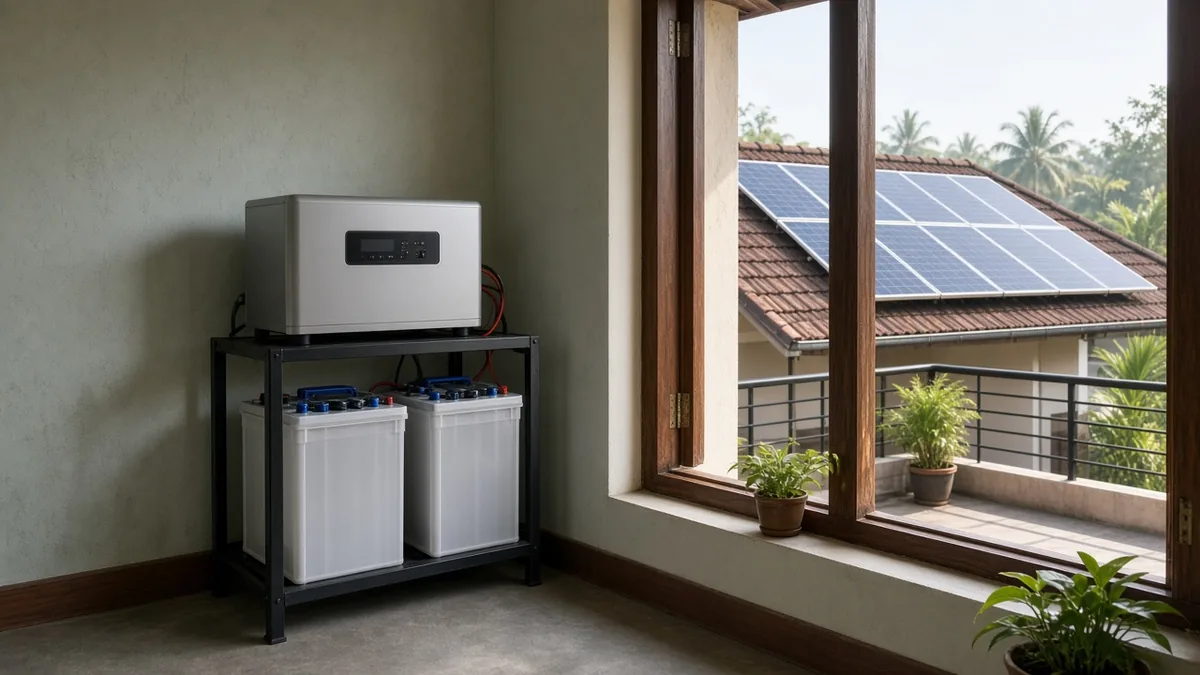
Quick answer: Your home inverter cannot run rooftop panels for net metering or the PM Surya Ghar subsidy. Those need a separate grid connected solar inverter with MPPT that syncs with KSEB supply. Keep the old inverter and battery for fans and lights in a cut, or move to a hybrid inverter later.
Key points before you rewire anything
- A home inverter or UPS is built to charge its own battery from the KSEB supply. It is not designed to take power straight from rooftop solar panels.
- Rooftop solar needs its own solar inverter. Under the PM Surya Ghar technical specifications, that inverter must have a built-in maximum power point tracker (MPPT) to draw the most energy from the panels.
- Only a grid connected rooftop plant tagged to your residential KSEB connection is eligible for PM Surya Ghar central financial assistance. Off-grid installations are not eligible.
- A grid connected plant must isolate itself automatically when KSEB supply fails, so it does not feed a dead line. That is why it stops during a power cut.
- You can keep your old inverter and battery for fans and lights. If you later swap to a hybrid inverter within plus or minus 10% of the original inverter capacity, KSERC does not count it as a capacity increase.
The rest of this guide explains why the two machines do different jobs, which setups qualify for net metering and the subsidy, what a separate solar charging kit can and cannot do, and how to keep your old backup working next to a new plant.
Why can't a home inverter take rooftop solar power directly?
Think of your home inverter as a battery charger with a backup switch. When KSEB supply is on, it tops up a low-voltage battery bank. When supply fails, it turns that stored energy back into AC for a few fans, lights and a router. It was never designed to manage a string of rooftop panels, whose voltage and current change with every cloud.
A rooftop solar inverter does three jobs your home inverter does not. It tracks the best operating point of the panels through the day, converts their DC output to AC at the grid's 50 Hz frequency, and matches the KSEB supply before it shares power with it (PM Surya Ghar technical specifications, Annexure 3, clauses 2.4 and 2.7). For how inverter size relates to panel size, see how inverter kW and panel kWp differ.
KSERC rules say every grid connected solar plant must have a synchronisation device, and an inverter with one built in is enough (KSERC RE Regulations 2025, Regulation 14.5). The connection must also meet the Central Electricity Authority connectivity standards listed in Regulation 14.1. A home inverter wired to panels meets none of this.
So the honest answer is that the panels need their own solar inverter. Your old home inverter can stay in the house, but it keeps doing its old job: backup for essential loads during a cut. For the three main system types side by side, read on-grid vs off-grid vs hybrid solar for Kerala homes.
Which solar setups get net metering and the PM Surya Ghar subsidy?
The subsidy follows the grid connection. MNRE's scheme guidelines define an eligible plant as a grid connected solar system tagged to a residential connection of the local distribution company, fixed on a roof, terrace, balcony or elevated structure (PM Surya Ghar guidelines, Section 5(b)). For the application steps, read the PM Surya Ghar guide for Kerala homes.
Two other cases are spelt out in the same guidelines. Grid connected systems that do not export, such as behind-the-meter or battery hybrid setups, can get the subsidy subject to approval by the state regulator, after the distribution company inspects the reverse power relay. Off-grid installations are not eligible at all (Section 5(o)). For the Kerala rules on a no-export plant, see behind the meter solar rules for Kerala homes.
Net metering in Kerala is also a grid connected arrangement. Domestic consumers who seek feasibility for a new plant can opt for it for plant capacities from 1 kW to 20 kW (KSERC RE Regulations 2025, Regulation 6.1). A kit that only charges a battery inside the house never connects to the KSEB network, so there is nothing for the net meter to record.
Can you connect solar panels to home inverter batteries with a charge controller?
Some sellers offer a solar charge controller or a solar-ready inverter that lets panels top up the existing inverter battery. This is a small off-grid setup. It can reduce how much the battery draws from the mains on sunny days, but it does not export anything, does not show on a KSEB net meter and does not qualify for the subsidy described above.
Size limits come from the battery, not the roof. A battery that is already full cannot take more energy, so extra panels on such a kit give little benefit. Ask the seller for the usable battery capacity in kWh, not only the ampere-hour figure, before you judge what it can run. For the wider picture of battery-only systems, read what an off-grid solar system in Kerala involves.
Safety matters more than the wiring diagram. Do not open the inverter, the battery box or the distribution board yourself, and never join panel cables to an inverter that was not designed for solar input. Battery rooms need ventilation and dry floors. Leave every connection to a licensed electrician or a registered solar vendor, and switch off only as the manufacturer's manual describes.
What should you do with your old inverter and battery?
In most homes the simplest plan is to keep both. The new rooftop plant runs your daytime load and sends the surplus to the grid. The old inverter keeps powering a few fans, lights and the router when KSEB supply fails. Ask your installer to keep the two circuits clearly separate and labelled, so nobody mixes them up during service.
Expect the rooftop plant itself to go quiet in a power cut. KSERC requires an automatic and a manual isolation switch so the plant does not feed the grid when supply fails, and you are responsible for safe operation of your side up to the connection point (KSERC RE Regulations 2025, Regulations 14.2 and 14.4).
If you want solar to keep running in a cut later, you can move to a hybrid inverter with a battery. For a home already on net metering, replacing the inverter with a hybrid inverter within plus or minus 10% of the original inverter capacity is not treated as a capacity enhancement (KSERC RE Regulations 2025, Regulation 2.3(iii)). The battery sizing rules are in hybrid inverter battery rules for Kerala homes.
Larger homes have a fixed rule. Domestic plants above 10 kW up to 15 kW must use hybrid inverters with storage of at least 10% of the plant's generation potential, and above 15 kW up to 20 kW at least 20%. Plants above 5 kW up to 10 kW that seek feasibility from 1 April 2027 need at least 10% (Regulation 6.3).
Example: a new grid connected plant next to an old home inverter
For example, take a Kerala home that keeps its old inverter for backup and adds a 3 kWp grid connected rooftop plant. The central assistance works out as below, using the rates in the PM Surya Ghar guidelines (Section 5(h)), as of 28 October 2026.
| Item | Rule used | Amount |
|---|---|---|
| First 2 kWp of panels | ₹30,000 per kWp | ₹60,000 |
| Next 1 kWp of panels | ₹18,000 per kWp | ₹18,000 |
| Total central assistance for 3 kWp | Sum of the two rows | ₹78,000 |
| Battery added to the plant | Assistance counts panel capacity only (Section 5(l)) | ₹0 |
| Panels wired only to the old home inverter battery | Off-grid installation (Section 5(o)) | Not eligible |
The example shows the pattern, not your final price. Your quote, any battery you add and your net cost depend on the installer and the equipment. Keep the old inverter on its own circuit and the new plant on the KSEB application, and ask your installer for both figures in writing. For what to expect after you sign, see the KSEB solar application timeline from feasibility to meter.
Checklist: what to ask your installer this week
- Will the rooftop plant use its own grid connected solar inverter, separate from my home inverter?
- Which loads stay on my old inverter for power cuts, and are those circuits labelled?
- Is the plant being registered with KSEB for net metering, and who files the subsidy application?
- Do you quote a hybrid inverter option, and what usable battery capacity in kWh would it include?
- Where will the isolation switch be, and how do we shut down safely as the manual describes?
- Who services the plant, and who should I call for an inverter fault or a meter fault?
- Is the earthing and lightning protection included? Compare with lightning protection for rooftop solar.
Use the answers to compare quotes on the same terms. For the wider questions to ask any installer, read how to choose a solar company in Kerala.
If you are not sure what your home needs, send us your latest KSEB bill for a free bill and transformer check, or book a free site survey. We will tell you what can stay on your old inverter and what a grid connected plant can cover.
Check this against your bill
FGE Solar can review your latest KSEB bill and tell you which system size is worth pricing.
Frequently Asked Questions
Can I use my existing UPS with solar panels?
Not as the main solar inverter. The scheme's technical rules need a solar inverter with built-in MPPT that works at the grid's 50 Hz frequency. Your UPS can stay for backup on separate circuits.
Does an off-grid solar kit get the PM Surya Ghar subsidy?
No. MNRE's guidelines say off-grid installations are not eligible for central financial assistance. Only grid connected rooftop systems tagged to a residential connection qualify.
Why does my on-grid solar stop when KSEB supply goes off?
KSERC requires an automatic isolation switch so the plant does not feed a dead line. It protects people working on the network. A hybrid inverter with a battery can keep chosen loads running.
Will a battery increase my subsidy amount?
No. The guidelines allow battery storage as part of the plant. The assistance is still worked out only on the capacity of the solar panels.
Is switching to a hybrid inverter later counted as an upgrade?
Not if the new inverter is within plus or minus 10% of the original capacity. KSERC says such a replacement is not a capacity enhancement, so your net metering status stays.
How big can a home solar plant be on net metering in Kerala?
Domestic consumers can opt for net metering from 1 kW to 20 kW. The plant also cannot exceed your connected load in kW. Larger domestic plants above 10 kW need hybrid inverters with storage.
Official Sources and Accuracy Note
- 01Guidelines for PM-Surya Ghar: Muft Bijli Yojana, Central Financial Assistance to Residential Consumers (MNRE, mnre.gov.in)
Takeaway items 1, 2 and 3: Section 5(b) (CFA only for a grid connected rooftop system tagged to a residential DISCOM connection), Section 5(o) (off-grid installations not eligible for CFA) and Annexure 3 clause 2.4 (MPPT integrated in the inverter/PCU).
govt source · opened 2026-10-28 - 02KSERC (Renewable Energy and Related Matters) Regulations, 2025, Notification No. 3228/Con.Engg/2023/KSERC dated 5 November 2025 (Kerala Gazette, erckerala.org document storage)
Takeaway items 4 and 5: Regulation 14.4 (automatic and manual isolation so the plant does not feed the grid when supply fails) and Regulation 2.3(iii) (inverter or hybrid inverter replacement within plus or minus 10% is not a capacity enhancement).
govt source · opened 2026-10-28
Accuracy note: This guide is built from government pages, regulator orders, and news sources on the web. Rules and amounts change. Some details may be outdated or wrong. Check the official links below before you pay, apply, or complain to KSEB.