Behind the Meter Solar Kerala Rules for Homes 2026
Behind-the-meter solar is a plant that serves only loads inside your premises, with no intended export to KSEB’s grid. Regulation 9 of the KSERC Renewable Energy Regulations, 2025 lets every consumer choose this path — with prior notice, a connected-load cap, and a reverse-power relay.
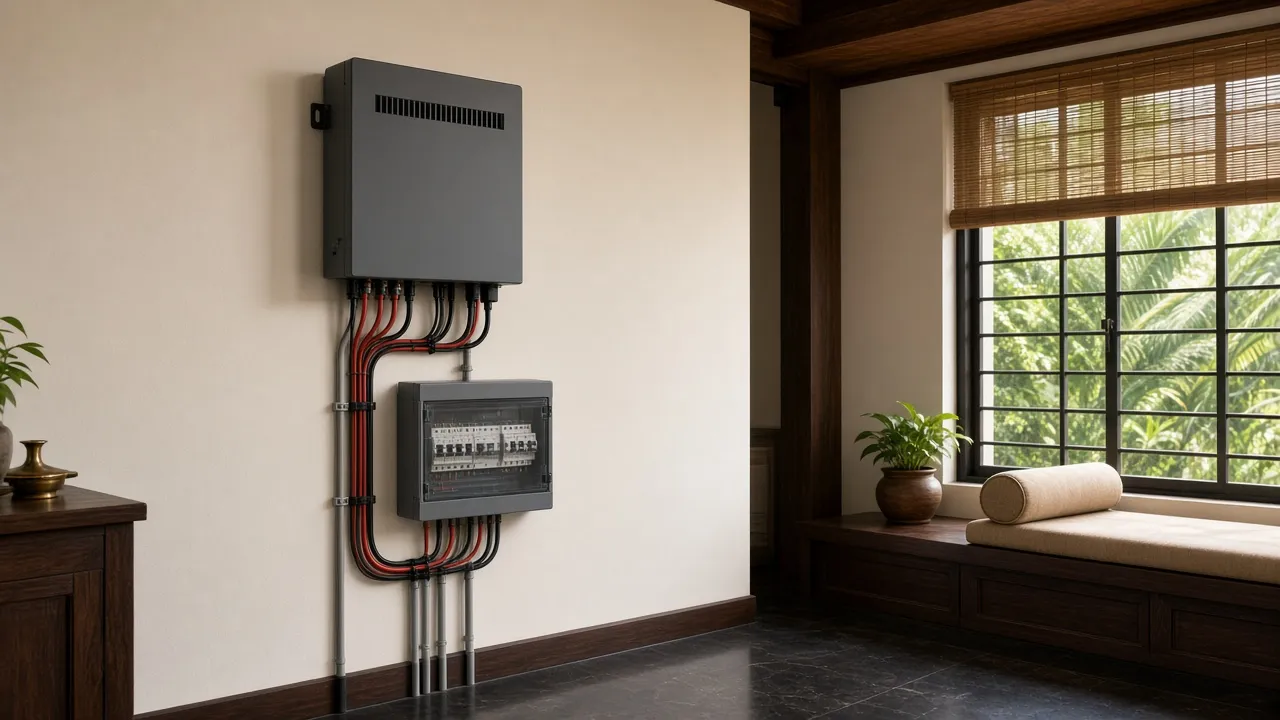
Quick answer: You may install behind-the-meter solar only after prior written intimation to KSEB (Annexure 3 form). Capacity cannot exceed your connected load or contract demand. You must fit a reverse power flow relay so no energy is injected into the grid. Installing without notice can bring disconnection after a 24-hour notice.
What behind the meter solar Kerala means on your bill
The regulations define Behind the Meter (BtM) as an arrangement where the distributed renewable energy system is connected on the consumer’s side of the meter for self-consumption, without injecting energy into the distribution system. It is one of the billing-system choices listed alongside net metering, net billing, and gross metering.
Regulation 9.1 states that all consumers and prosumers are eligible to opt for the Behind the Meter system. You do not need a special tariff category — but you do need to follow the notice and technical conditions in the rest of Regulation 9.
Under BtM, daytime generation is meant to cut the units you draw through your service meter while the plant is producing. There is no intended surplus export for banking. If you want banked credits and year-end settlement, net metering or another Chapter II option is the path — not BtM.
Think of this option as a self-use arrangement bolted to your existing service connection. Daytime generation should reduce the units recorded as import while the inverter is producing. It is not a shortcut around KSEB paperwork, and it is not the same as a silent illegal parallel connection.
You must tell KSEB before you connect
Regulation 9.2 says the consumer shall connect the behind-the-meter system only after prior intimation to the respective distribution licensee. The model form for that intimation is Annexure 3 of the regulations. Keep a copy of what you submitted and any acknowledgement from the KSEB section.
If KSEB finds a behind-the-meter system connected without prior intimation, Regulation 9.3 allows the licensee to disconnect that system after serving a notice of 24 hours. Fix the paperwork before the plant is energised — not after a surprise inspection.
Do not label every battery-backed rooftop as Behind the Meter. The Regulation 9.3 proviso keeps independently operating off-grid renewable generating systems outside the BtM category. If your plant never parallels the grid, use the off-grid path instead of Annexure 3 BtM intimation.
Size limit: connected load or contract demand
Regulation 9.4 caps the maximum permissible capacity of a renewable energy generating system installed behind the consumer’s meter at the connected load (in kW) for connected-load-based billing consumers, or the contract demand for demand-based consumers. Oversizing past that figure is not allowed under BtM.
Connected load means the load in kW or kVA entered in your service connection agreement (or deemed agreement) under the Supply Code. Check the connected load on your latest bill or connection documents before you finalise inverter size for a BtM plant.
Across these regulations, plant capacity of a solar generation system means the nominal AC capacity of the inverter in kW (Regulation 3(73)). For BtM sizing against connected load, use that inverter AC figure, not only the panel kilowatt-peak printed on the modules.
Reverse power relay: no export to the grid
Regulation 9.5 requires the consumer to ensure that no energy is injected into the grid from a behind-the-meter renewable generating system. You must install a reverse power flow relay for that purpose. Export credits, banking, and APPC settlement do not apply to a compliant BtM plant because nothing is supposed to leave the premises.
Regulation 9.6 lets the distribution licensee inspect and verify the behind-the-meter installation as and when required. Keep inverter settings, relay test reports, and single-line diagrams ready for that visit.
Ask your installer to document the reverse-power relay model, trip settings, and a functional test at commissioning. That paperwork supports Regulation 9.5 compliance and speeds a Regulation 9.6 inspection if the KSEB section asks for proof that export is blocked.
Because Regulation 9.5 forbids injection, a compliant behind-the-meter plant does not build a banked-energy balance for night-time set-off. If your household load is low when the sun is strong, generation may simply curtail or sit unused behind the relay — that is expected for BtM, not a billing error.
When BtM fits a Kerala home — and when it does not
- Choose BtM when you want daytime self-use only and do not want a net-metering agreement or export settlement.
- Choose net metering when you want surplus daytime units banked against later imports under Chapter III rules.
- BtM still needs KSEB intimation — it is not an informal DIY exemption.
- BtM capacity cannot exceed connected load; net-metered domestic plants also face the Regulation 6.3 20 kW category cap and Regulation 6.6 connected-load ceiling.
- Independent off-grid plants are outside BtM; read the off-grid guide if you will never parallel with the grid.
Even for BtM, Regulation 14.3 gives the licensee the right to disconnect a renewable energy generating system if there is a threat of safety, accident, or damage to the distribution system, after notice under the Supply Code. Isolation switches and anti-islanding protections in Regulation 14 still matter whenever your inverter can parallel with the grid.
Steps to stay compliant before you switch on
- Fill Annexure 3 and submit prior intimation to your KSEB section before connecting the plant.
- Size the inverter AC capacity at or below your connected load (or contract demand).
- Specify and commission a reverse power flow relay that blocks export.
- Keep test reports and drawings for Regulation 9.6 inspections.
- Do not treat a silent install as off-grid unless the plant truly operates independently of the grid.
Check this against your bill
FGE Solar can review your latest KSEB bill and tell you which system size is worth pricing.
Frequently Asked Questions
Can I install rooftop solar in Kerala without net metering?
Yes, by choosing Behind the Meter under Regulation 9. You must still give prior intimation to KSEB, stay within connected load, and prevent any export with a reverse power flow relay.
What happens if I connect behind-the-meter solar without telling KSEB?
Regulation 9.3 lets the licensee disconnect a BtM system found connected without prior intimation after serving a 24-hour notice. Submit Annexure 3 before energising.
Is off-grid solar the same as behind the meter?
They are treated differently in the regulations. A behind-the-meter plant still parallels your service in a controlled way and needs prior intimation under Regulation 9. An off-grid plant that runs independently is excluded from the BtM definition by the Regulation 9.3 proviso.
How large can a behind-the-meter plant be on a domestic connection?
Regulation 9.4 limits BtM capacity to your connected load in kW (or contract demand for demand-based consumers). Check the connected load on your service documents before ordering the inverter.
Do I get paid for surplus units under behind the meter?
No. Regulation 9.5 requires zero injection into the grid and a reverse power flow relay. Without export, there is no banking or APPC payment on a compliant BtM plant.
Official Sources and Accuracy Note
- 01KSERC (Renewable Energy and Related Matters) Regulations, 2025
Reg 3(9) — Behind the Meter means DRE on consumer side without injection into the distribution system.
govt source · opened 2026-10-04
Accuracy note: This guide is built from government pages, regulator orders, and news sources on the web. Rules and amounts change. Some details may be outdated or wrong. Check the official links below before you pay, apply, or complain to KSEB.