Solar for Apartments in Kerala: Approvals and Checklist
Your apartment's common meter pays for the lift, pumps and corridor lights, and the bill lands on every owner's maintenance charge. Getting solar for apartments in Kerala means a committee decision, not one person's quote. This guide shows the routes KSERC allows, what the PM Surya Ghar subsidy gives an association, and the checklist your committee needs before it votes.
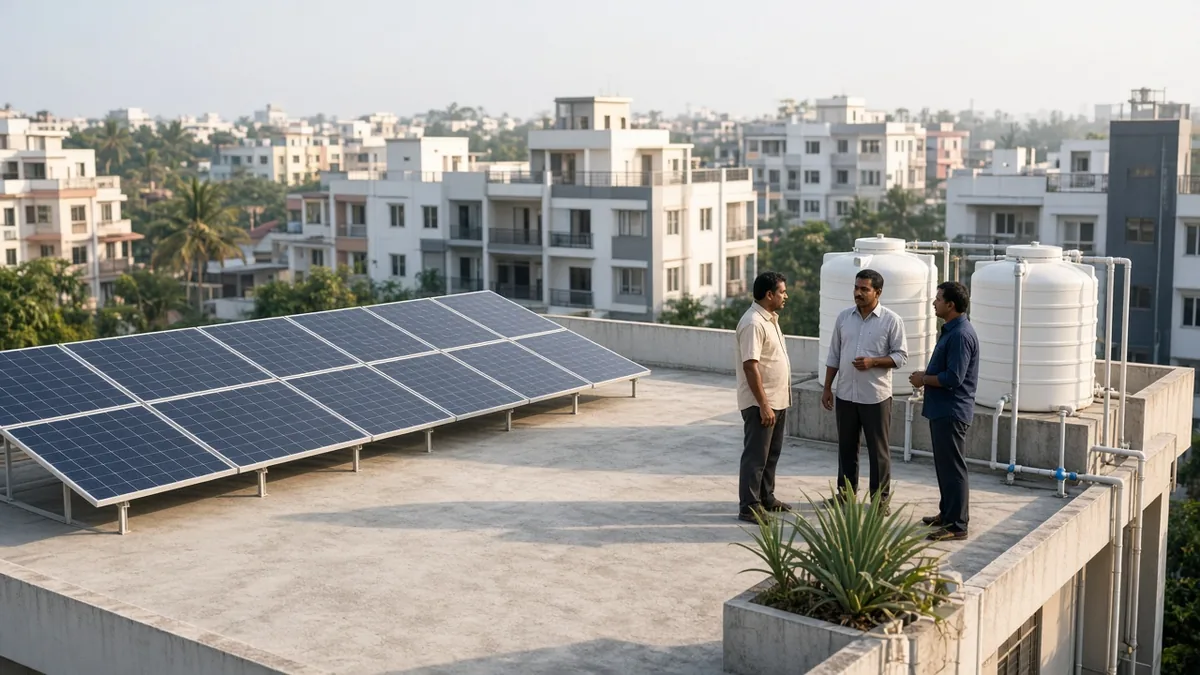
Quick answer: Kerala apartments can put solar on the common-area connection under net metering, from 1 kW up to the connected load, with storage needed above 25 kW. PM Surya Ghar gives a registered association ₹18,000 per kWp for common facilities, at 3 kWp per house. Flats wanting their own share use virtual net metering.
Can you get solar for apartments in Kerala?
- The common-area connection of a residential high-rise or residential colony can use net metering, from 1 kW to 500 kW.
- That plant cannot be bigger than the common connection's connected load in kW.
- Flats that want a share of one shared plant use virtual net metering, a separate route with its own conditions.
- PM Surya Ghar gives an association ₹18,000 per kWp for common facilities, up to 500 kWp, at 3 kWp per house.
- The subsidised common connection must serve only common facilities, not supply to individual flats.
- A registered owners' or residents' association is the body that applies and signs.
Meaning first: most apartment buildings start with the common meter, the connection that runs the lift, pumps, corridor lights and gate. KSERC lets common area service connections of residential high-rise or multi-storied buildings and residential colonies opt for net metering for plants of 1 kW to 500 kW (Regulation 6.1(iv), with the 500 kW ceiling in Regulation 6.5). As for any net-metered plant, the plant capacity cannot exceed that connection's connected load in kW (Regulation 6.6).
Sizing has one more trigger worth knowing early. For common area connections, a plant above 25 kW and up to and including 100 kW must use a hybrid inverter with storage of at least 10% of the plant's energy generation potential (first proviso to Regulation 6.5). A committee can keep the plant at or below 25 kW to avoid batteries, or plan the storage cost from the start. Our guide to hybrid inverter battery rules explains how storage is worked out.
Common-area solar or a share for each flat?
Three ways a Kerala apartment can use rooftop solar (rules from the KSERC 2025 regulations and MNRE guidelines).
| Option | Who it benefits | Key rule |
|---|---|---|
| Common-area plant on the common connection | Lift, pumps, lights and other shared loads | Net metering, 1 kW to 500 kW (Regulation 6.1(iv)) |
| Virtual net metering for several flats | Participating flats get units in agreed shares | Storage of at least 20% and a Lead person (Regulation 10.1(i)) |
| A flat owner's own plant on an allotted roof area | Only that flat's domestic connection | Domestic net metering, 1 kW to 20 kW (Regulation 6.1(i)) |
The shared-plant route is covered in depth in our guide to virtual net metering for apartments and flats, including how units are split between flats. In short, Regulation 10.1(i) allows domestic consumers in multi-storied buildings, residential complexes or Residents' Association areas to set up a plant with energy storage of at least 20% of its generation potential, through a Lead person, and the common amenities connection can join as a participant.
Do not confuse this with group net metering. That route lets one consumer send surplus from a plant at one premises to their own other connections, which is why it suits a family with two houses more than a building of separate owners. Our group net metering guide explains where it fits.
A single flat owner installing on their own share of the terrace is a normal domestic case, but the roof belongs to all owners. Get the association's written consent and an allotted roof area before any installer starts. The KSEB application still runs on that flat's own connection.
What subsidy can an apartment association get?
Under PM Surya Ghar, Group Housing Societies and Residential Welfare Associations can get central financial assistance (CFA) of ₹18,000 per kWp for common facilities, including EV charging, up to 500 kWp, counted at 3 kWp per house (clause 5(h), table row 4). The cap is the lower of the plant size and 3 kWp times the number of houses. The capacity limit also includes any rooftop plants that individual residents have already installed (note below clause 5(e)).
Two conditions decide whether your building qualifies. The connection getting CFA must be dedicated only to common facilities and must not be used to supply electricity to individual flats (clause 5(f)). The CFA goes to the body that residents set up to maintain common facilities, which may be called an Apartment Owners' Association or a Cooperative Housing Society (clause 5(f)(i)). The panels must also be domestically made modules with domestic cells, or the plant is not eligible (clause 5(m)); see our DCR vs non-DCR panels guide.
For KSEB purposes, a Residents' Association means a body registered under the Travancore Cochin Literary, Scientific and Charitable Societies Registration Act, 1955, the Societies Registration Act, 1860, or another applicable law. An association registered by the owners, or owners and residents, of an apartment complex, housing colony or gated community also counts (Regulation 3(88)). Keep the registration certificate ready, because the committee will be asked who signs for the building.
Kerala example: a 24-flat building
Illustrative example: a 24-flat building in Kochi plans a 20 kW plant on the common-area connection, and the common connection has a connected load of at least 20 kW. The CFA cap is the lower of 24 × 3 = 72 kWp and the 20 kWp installed, so 20 kWp counts. At ₹18,000 per kWp under clause 5(h), the association's CFA works out to ₹3,60,000. MNRE's own example uses the same rule: 100 kW with 20 households gets ₹18,000 × 60 kW, or ₹10,80,000.
Because 20 kW is below the 25 kW trigger in Regulation 6.5, no battery is needed in this example. If the same building chose 30 kW, it would need a hybrid inverter with at least 10% storage, and its connected load would also have to be 30 kW or more. Check whether the local transformer has room before you settle the size; our page on KSEB feasibility and transformer hosting capacity shows how that is decided.
Committee checklist: steps to a decision
- Collect a year of bills for every common connection and list the loads each one runs.
- Get a roof survey that shows usable, shade-free space and what water tanks and lift rooms block.
- Decide the route: common-area plant, virtual net metering, or individual flat plants.
- Put the proposal, cost sharing and maintenance plan to the general body and record the resolution.
- Confirm who signs for the association and keep its registration papers ready.
- Compare registered vendors and agree on the design, warranty and service terms in writing.
The subsidy application follows the PM Surya Ghar process. An eligible consumer with a valid consumer account number applies on the national portal, which gives an application ID (clause 6(a) and (b)). The consumer then chooses a vendor registered on the portal and agrees the rates with them; there is no tendering by the DISCOM (clause 6(c)). For an association, that is the consumer account number of the dedicated common-area connection. Our PM Surya Ghar guide walks through the portal stages.
What the proposal pack should show
- Which connection the plant feeds, its consumer number and its connected load.
- Proposed plant size, and whether it stays at or below 25 kW or needs storage.
- Roof layout, shade report and structure type, with tanks and walkways marked.
- Expected CFA worked at ₹18,000 per kWp on the lower of plant size and 3 kWp per house.
- Confirmation that the modules are DCR and the connection serves common loads only.
- Vendor warranty, five-year maintenance terms and who residents call for faults.
If the building also plans EV charging in the parking area, include that load in the proposal, since common EV charging is part of the facilities CFA can cover; our EV charging sizing guide helps estimate it.
For the paperwork, our solar documents checklist lists what to keep ready. Want help with the proposal? FGE Solar offers a free bill and transformer check for the common meter, and a free site survey of the terrace, so your committee can vote on real numbers.
Check this against your bill
FGE Solar can review your latest KSEB bill and tell you which system size is worth pricing.
Frequently Asked Questions
Can an apartment association in Kerala get the PM Surya Ghar subsidy?
Yes, for the common-facilities connection. Clause 5(h) of the MNRE guidelines gives Group Housing Societies and Residential Welfare Associations ₹18,000 per kWp, up to 500 kWp, at 3 kWp per house.
How much solar can we put on our apartment common meter?
Between 1 kW and 500 kW under Regulation 6.1(iv), but never more than the common connection's connected load in kW (Regulation 6.6). Above 25 kW a hybrid inverter with storage is required.
Can the common-area solar supply power to individual flats?
Not if you take CFA for it. Clause 5(f) says the RWA connection must be dedicated to common facilities only and not used to supply residential consumers in the society. Flats that want solar units use virtual net metering or their own plants instead.
Do individual flat owners lose their own subsidy if the association installs solar?
The association's cap counts plants residents already have. MNRE says the GHS or RWA capacity limit includes individual rooftop plants installed by residents. So existing flat plants reduce the room left for the common plant.
Does our association need to be registered?
Yes. Regulation 3(88) defines a Residents' Association as one registered under the 1955 Travancore Cochin Act, the 1860 Societies Registration Act or another applicable law. Owners' associations of apartment complexes are included.
Is the solar subsidy for a housing society different from a house?
Yes. A house gets ₹30,000 per kWp for the first 2 kWp and ₹18,000 for the third (clause 5(h)). A GHS or RWA gets a flat ₹18,000 per kWp on common facilities. The society rate is spread over many more kWp.
Official Sources and Accuracy Note
- 01KSERC (Renewable Energy and Related Matters) Regulations, 2025 (gazette PDF)
Key takeaways, KSEB bullets: Reg 6.1(iv) common-area net metering band, Reg 6.6 connected-load ceiling, Reg 10.1(i) VNM route, Reg 3(88) Residents' Association.
govt source · opened 2026-10-28 - 02MNRE Guidelines for PM-Surya Ghar: Muft Bijli Yojana, CFA to Residential Consumers (PDF)
Key takeaways, subsidy bullets: clause 5(e) table row 4 and clause 5(h) rate for GHS/RWA, clause 5(f) dedicated common connection.
govt source · opened 2026-10-28
Accuracy note: This guide is built from government pages, regulator orders, and news sources on the web. Rules and amounts change. Some details may be outdated or wrong. Check the official links below before you pay, apply, or complain to KSEB.