Kerala Virtual Net Metering for Apartment Homes 2026
Kerala virtual net metering lets flat owners in one building or residents' association share a single solar plant and split its units on their own KSEB bills. Under Regulations 10 and 31 of the KSERC Renewable Energy and Related Matters Regulations, 2025, the plant needs storage of at least 20% of its generation potential, one resident acts as Lead Person, and each flat's share is capped at 10 kW or its connected load.
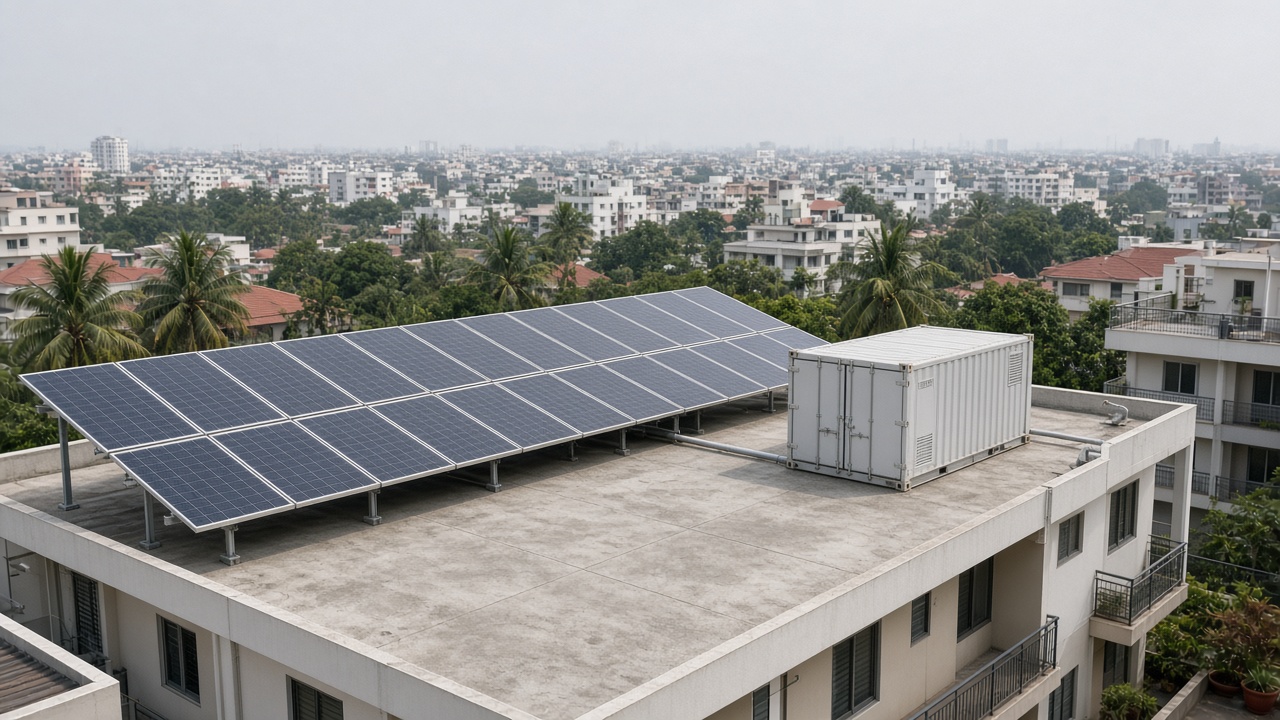
Quick answer: Eligible: domestic consumers in multi-storied buildings, residential complexes or residents' association areas, plus the common-amenities connection. Plant size: 10 kW to 1000 kW. Each flat gets units in the ratio written in the connectivity agreement, set first against its own use in the same time zone.
Who can use Kerala virtual net metering
Regulation 10.1(i) opens virtual net metering to domestic consumers living in multi-storied residential buildings, residential complexes or residents' association areas. They set up the plant through a Lead Person or a RESCO (a renewable energy service company) in the same KSEB supply area. The plant must include energy storage of not less than 20% of its energy generation potential, and the connection that powers common amenities such as lifts and pumps can join as a participant.
Plant size and each flat's share
Regulation 10.3 sets the plant between 10 kW and the lowest of three limits: 1000 kW, the total connected load or contract demand of all participants, or their total maximum shares. Under Regulation 31.2(ii), the capacity a flat receives cannot exceed 10 kW or its connected load, whichever is lower.
The Lead Person takes a separate grid connection for the plant and pays its cost, including any upgrade or transformer work (Regulation 10.2). If the plant connects at low tension and is 50 kW or more, or the local transformer lacks hosting capacity, KSEB may grant feasibility by enlarging the transformer or adding a new one. A plant above 100 kW also needs an extra check meter (Regulation 31.3).
How the solar units are split between flats
Each billing cycle, the plant's output, including energy from the battery, is credited to the flats in a fixed ratio. That ratio is written into a schedule of the connectivity agreement listing every participant, starting with the Lead Person: name, consumer number, sharing ratio in percent and shared capacity in kW, adding up to 100% (Regulation 31.2(i)).
A generation meter at the plant records units in three time zones: solar hours, peak hours and off-peak hours. Each flat's share in each zone, after losses where they apply, is first set against that flat's own use in the same zone (Regulation 31.2(iv) and (v)). Any use left over is billed at the normal KSEB tariff.
Units a flat does not use are converted into banked units with the factors in the table below (Regulation 31.2(vii)). Banked units then cover the flat's extra use in solar hours first, then off-peak hours, then peak hours. Units carried to the next month lose a 2% banking charge (Regulation 31.2(viii)). At the end of the financial year the leftover units are paid for before 30 April, unless the flat applies to carry the credit forward (Regulation 31.2(ix)).
Rates and charges for participating flats
| Item (domestic flat) | Value |
|---|---|
| Banking factor for surplus: solar / peak / off-peak hours | 1.0 / 1.33 / 1.17 |
| Factor when banked units are used: solar / peak / off-peak hours | 1.0 / 0.75 / 0.85 |
| Banking charge on units carried forward | 2% a month |
| Settlement rate for surplus banked units (solar) | ₹2.79 per unit |
| Grid support charge, per flat each month | 50 paise per unit for the first 300 units, ₹1 per unit after |
The grid support charge applies to power a flat draws in non-solar hours, up to the banked units set against it; the exemption in Regulation 31.2(xi) covers only low-income and agricultural groups, not apartments. If the plant and all flats sit on the same distribution transformer, no transmission or wheeling charges or losses apply. On different transformers within one electrical division, wheeling charges and distribution losses apply. No cross-subsidy surcharge applies under Regulation 31.2(xiii).
What the association should prepare
- The other participants' nomination of the Lead Person, who must also be a participant (Regulation 31.1(i)).
- The sharing schedule: each flat's consumer number, sharing ratio and shared kW, totalling 100% (Regulation 31.2(i)).
- Each flat's connected load, so no share goes above 10 kW or that load (Regulation 31.2(ii)).
- A battery design showing storage of at least 20% of generation potential (Regulation 10.1(i)).
- A budget for the plant's own grid connection and any transformer work (Regulation 10.2).
- Panel models on MNRE's ALMM List-I, since MNRE treats virtual net metering as net metering.
Planning shared solar for your building?
FGE Solar can help your association size the plant, storage, and sharing schedule before you approach KSEB.
Frequently Asked Questions
Can our apartment association use virtual net metering?
Yes. Flat owners who are domestic consumers in a multi-storied building, residential complex or residents' association area are eligible. The shared plant must carry a battery of 20% or more of its generation potential.
Who deals with KSEB for the building?
The Lead Person, a participating consumer nominated by the others, signs the connectivity agreement and handles all correspondence. Any change of Lead Person is reported in writing with every participant's approval. The Lead Person, directly or through a RESCO, runs and maintains the plant.
Can we change each flat's share later?
Yes, once in a financial year. The flats give KSEB two months' advance notice through the Lead Person.
Is virtual net metering the same as group net metering?
No. Group net metering under Regulation 11 sends surplus from one of your premises to another of your premises that is eligible for net metering. Virtual net metering under Regulation 10 shares one plant among several consumers through a Lead Person.
Official Sources and Accuracy Note
- 01KSERC (Renewable Energy and Related Matters) Regulations, 2025
Regs 10 and 31: virtual net metering eligibility, plant limits, Lead Person, credit splitting, banking and charges.
govt source · opened 2026-09-27 - 02MNRE O.M. No. 283/54/2026-GRID SOLAR dated 4 August 2026
Para 1(b): virtual net metering counts as net metering for ALMM List-I panels.
govt source · opened 2026-09-27
Accuracy note: This guide is built from government pages, regulator orders, and news sources on the web. Rules and amounts change. Some details may be outdated or wrong. Check the official links below before you pay, apply, or complain to KSEB.