Electrical Safety During Monsoon: Floods, Wet Boards and Fallen Lines
Kerala's rains do not stop in August. The northeast monsoon brings evening thunderstorms, uprooted trees and flooded yards well into the year. Good electrical safety during monsoon comes down to a few habits: knowing where your switches are, what to do when water comes in, how to treat a fallen line, and whom to call.
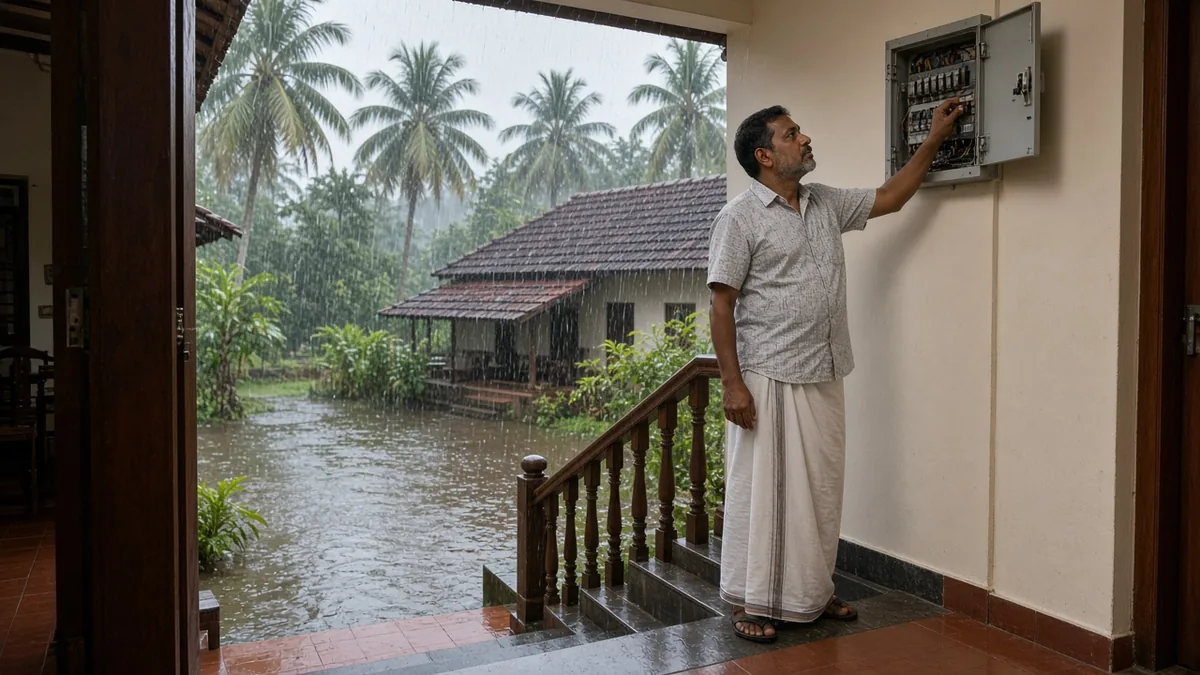
Quick answer: Find your main switch now, while the house is dry. If water starts coming in, switch off at the main only from a dry spot, and never touch a wet board or a fallen line. Keep KSEB's emergency number saved, and let a licensed electrician test the wiring before power goes back on.
Key points to keep in mind this rainy season
- To report an electrical accident or a dangerous situation, such as a snapped line, KSEB lists a separate emergency number: 9496010101.
- For a power failure or other supply complaint, KSEB's toll-free number is 1912. It also lists 9496001912 for its IVR service and a landline, 0471-2555544.
- The safety regulations say electrical equipment should be installed above the highest flood level, and where that is not possible, protected so that there is no seepage, leakage or water logging (CEA safety regulations, Reg 14(4)).
- For testing or other work on its system, KSEB may switch off supply after giving affected consumers at least 24 hours' notice, but in an emergency no such notice is given (Reg 41(4)).
Electrical safety during monsoon: what to do if water enters the house
Rainwater reaches electricity in more places than people expect: a board on a damp outer wall, a pump switch in the open, an extension board on a wet floor. The first job is to know where your switches are, so you never reach for one in a hurry.
There are two sets of switches to find. KSEB has to provide a switch on each live conductor of your service line, inside your premises, in an accessible position and in a fireproof enclosure (CEA safety regulations, Reg 16(1)). Every other line in the house must be protected by switchgear provided by its owner, which is you: that is the main switch and the breakers in your own distribution board (Reg 16(2)). A solar home has one more isolating switch for the plant, shown in how rooftop solar reaches your switchboard.
- Before water comes in: if your area is flooding and you can reach the main switch from a dry spot with dry hands, switch it off, then unplug what you can and lift small appliances, chargers and extension boards off the floor.
- Once water is inside: do not touch the board, any switch or any plugged-in appliance while you are standing in water or on a wet floor. Leave the house by the driest route if you are told to move.
- If the board is sparking, smoking or already under water: keep away from it and call KSEB from a safe place. Do not try to switch it off.
- After the water goes down: do not switch the supply back on yourself, even if the walls look dry. Wiring, sockets and the board need to be dried and tested first.
- Home inverter and battery: leave it off and get its service technician to inspect it before use. Do not open it or touch the battery terminals.
Testing a flooded house is a job for a licensed electrician, not a quick look. How that testing is done, and who is allowed to do it, is explained in checking old house wiring for warning signs. Keep the electrician's written results with your house papers.
Fallen or sagging lines, trees and wet poles: what should you do?
- Treat every fallen or low-hanging line as live, even if the lights in the house are off.
- Keep well away, and keep children, pets and passers-by away too.
- Do not move a branch that is touching a line, and do not try to lift the line with a stick, a rope or anything else.
- Do not touch the pole, its stay wire, or a metal fence or gate that a line has fallen on.
- Do not walk or drive through water where a line has fallen.
- Call KSEB's emergency number from a safe distance and stay there, if you can, to warn others until help arrives.
Many rainy-season line faults start with a tree. The safety regulations say trees must not be grown below or near bare overhead lines in breach of the clearance rules, and that material, earth or farm produce must not be dumped or stored there (CEA safety regulations, Reg 66(3)). Rods, pipes and similar material must not be taken below or near bare overhead lines (Reg 66(1)). Flammable material must not be stored under a line, and no fire is allowed below one, so do not burn leaves under it (Reg 66(4) and (5)).
If a coconut palm, mango tree or bamboo clump in your compound leans towards the line, do not climb it or cut it yourself. Tell the KSEB section office and leave the work near the line to trained hands. Storms also bring lightning; protection for a rooftop plant is covered in lightning protection for a rooftop solar plant.
How close can a line run to your house, and who looks after it?
For the ordinary low-voltage lines that feed homes (up to 650 V), the safety regulations set these minimum clearances from any point of the building a person can reach, measured with the line at its maximum sag.
| Part of the building | Line passes above it | Line passes beside it |
|---|---|---|
| Flat roof (terrace), open balcony, verandah roof or lean-to roof | 2.5 metre vertical clearance from the highest point | 1.2 metre horizontal clearance from the nearest point |
| Pitched (sloping) roof | 2.5 metre vertical clearance immediately under the line | 1.2 metre horizontal clearance |
Two points matter in the monsoon. The horizontal clearance is measured with the line blown to its furthest point by the wind, not hanging still (Reg 62(4)). And a line should not cross over an existing building as far as possible, while no building may be put up under an existing overhead line, which includes a temporary structure such as a sheet shed (Reg 62(1) and the Explanation). Where a conductor is closer than these clearances, it must be replaced with Aerial Bunched Cable, an insulated bundled cable carried on an earthed bearer wire (Reg 62(3)). If a line runs too close to your terrace, write to the section office.
Up to the point where supply enters your premises, the service line, wires, fittings and apparatus that belong to KSEB are its job to keep safe and fit for use (Reg 15(1)), and a service line that is underground or within reach must be insulated and protected by KSEB (Reg 15(2)). Your part is to take reasonable care of KSEB's equipment on your premises, such as the meter (Reg 15(3)). So a sagging service wire or water inside the meter box is something to report, not to fix. If a storm leaves you without supply for long, see what KSEB owes you for power cuts and delays.
Someone got an electric shock: what KSEB's first-aid steps say
- Make sure you and others are safe first. If live wires are exposed, do not go near the person until the power is off or trained help has arrived.
- Call for help at once, using KSEB's emergency number given in the key points above.
- Do not touch the person until the power is off or the source is isolated. Touching someone who is still in contact with electricity can make you a second victim.
- If you can, switch off at the main circuit breaker or fuse box. If you cannot reach it without going close to the person, use something that does not conduct electricity, such as a wooden stick or a dry cloth.
- Once it is safe to go near, check for breathing and a pulse. If the person does not respond and is not breathing, start CPR immediately.
- If the person is in immediate danger, for example near a fire or lying in water, move them gently away with a non-conductive object before starting CPR.
- Cover burns with a sterile, non-adhesive dressing. Do not use creams, ointments or ice.
- Keep the person warm with a blanket or clothing while you wait, because an electric shock can bring on hypothermia even in warm weather.
Take the person to a hospital even if they seem fine, and tell the doctor it was an electric shock. A short first-aid class that teaches CPR is worth the time for every adult in the house.
A Kerala example: a low-lying home in a week of heavy rain
Take a single-storey house in a low-lying part of Alappuzha. The distribution board sits low beside the kitchen door, the home inverter and battery stand on a store-room floor, and a small rooftop solar plant was added last year. It is an illustration, not a real customer's data.
When water starts creeping over the doorstep, the father switches off the main from the dry staircase landing, unplugs the fridge, television and chargers, and lifts them onto a cot. Nobody touches the board once the floor is wet. The family moves to a neighbour's house by the dry side path, and he calls KSEB from there about a line sagging over the road.
When the water goes down, they do not switch anything on. A licensed electrician dries and tests the wiring and the board and gives them the results on paper; the inverter's technician checks the battery before it is used; and the solar installer inspects the plant, using safe checks for a solar inverter grid fault as the homeowner's guide to the screen messages. When they renovate later, they ask the electrician to move the board and the inverter higher than the water reached.
Checklist: what to do this week
- Find the main switch in your board and KSEB's switch near the meter in daylight, and keep a torch where you can reach it in the dark.
- Store KSEB's emergency number and its toll-free complaint number in every family member's phone.
- Walk around the compound and note branches, creepers or stored material close to the overhead line; report them to the section office instead of cutting them.
- Look at the meter board and the service wire for water, damage or sagging, and report anything you see.
- Keep extension boards, chargers and the home inverter off the floor in rooms that take water.
- Check the roof around your solar mounting before the next heavy spell, using finding and fixing solar roof leaks.
- Expect lower solar output on dark days; how solar performs in the Kerala monsoon explains what is normal.
- Never touch a wet board, a fallen line or a person who may still be in contact with electricity.
Check this against your bill
FGE Solar can review your latest KSEB bill and tell you which system size is worth pricing.
Frequently Asked Questions
Should I switch off the main switch when it rains heavily?
Not for ordinary rain. Switch off at the main only when water is entering the house or is about to. Do it only from a dry place, with dry hands. If the board itself is wet, sparking or smoking, keep away and call KSEB.
Who do I call if I see a fallen electric line in Kerala?
Call KSEB's emergency and accident number, 9496010101. For an ordinary power failure, the toll-free number 1912 is the one to use. Stay well away from the line while you wait.
Is it safe to use appliances after floodwater has entered the house?
Do not plug in or switch on anything that has been under water, even after it looks dry. Have a licensed electrician check the wiring and the board first. Then get each wet appliance checked by its service centre before use.
Why does KSEB cut power during heavy rain without warning?
For planned testing or other work on its system, KSEB has to give affected consumers at least 24 hours' notice. In an emergency that notice is not given. So during a storm, supply can go off at once.
Can I build a shed or extension under an electric line?
No. The safety regulations say no building may be constructed under an existing overhead line, and a building here includes a temporary structure. Ask the KSEB section office about the line before you build near it.
My solar inverter got wet in the rain. Can I switch it back on?
Leave it off and call your installer. Do not open it or touch the cables, even if the screen looks normal. Regular servicing is covered in solar panel maintenance and servicing in Kerala.
Official Sources and Accuracy Note
- 01KSEB Ltd official website, home page contact strip (toll-free, IVR, emergency/accidents and landline numbers)
The kseb.in contact strip lists 9496010101 as the Emergency/Accidents number, 1912 as the toll-free number, 9496001912 as the IVR number and 0471-2555544 as the landline.
govt source · opened 2026-11-02 - 02Central Electricity Authority (Measures relating to Safety and Electric Supply) Regulations, 2023, Gazette of India notification (PDF on cea.nic.in)
Reg 14(4) flood level; Reg 15 supplier and consumer duties; Reg 16 switchgear; Reg 41(4) notice before planned discontinuance; Reg 62 line clearances from buildings; Reg 66 trees, storage and fire near bare overhead lines.
govt source · opened 2026-11-02 - 03KSEB Safety Department article: First Aid for Electric Accidents (kseb.in, last updated 11-Dec-2023)
Key first-aid steps: assess the situation, call 9496010101, do not touch the victim, cut the power, check breathing and pulse with CPR, move with caution, cover burns, keep the victim warm.
govt source · opened 2026-11-02
Accuracy note: This guide is built from government pages, regulator orders, and news sources on the web. Rules and amounts change. Some details may be outdated or wrong. Check the official links below before you pay, apply, or complain to KSEB.