Old House Wiring Problems: Warning Signs and What to Do Next
Many Kerala homes were wired decades ago, for a few lights and fans. Today the same cables feed a fridge, a pump, an iron and often an AC. If you have noticed a warm socket, a burning smell or a breaker that trips often, you may be dealing with old house wiring problems. This guide shows the signs to look for, what the safety rules expect in a home, and when to call a licensed electrician.
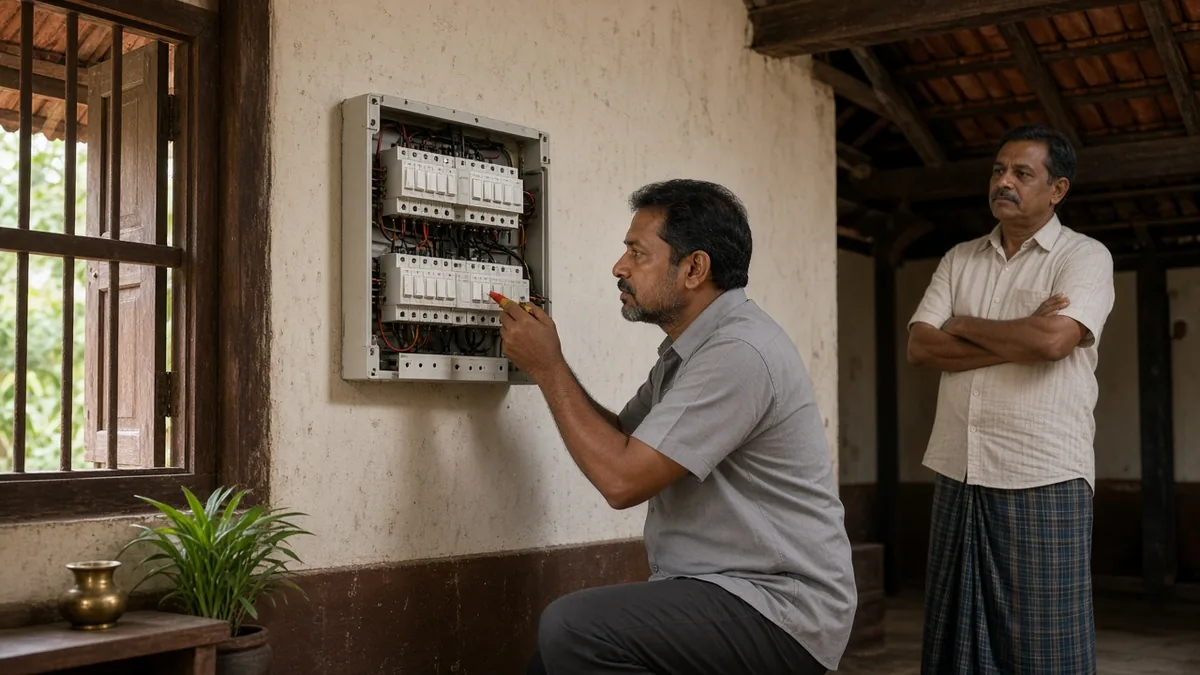
Quick answer: Warm switches, a burning smell, buzzing sockets, flickering lights, frequent tripping or a tingle from an appliance body mean it is time to call a licensed electrician. Safety rules expect a 30 mA residual current device in homes and earthed three-pin sockets in new or renovated wiring. Do not open the board yourself.
Key points before you call an electrician
- In a home, the residual current device (RCD, usually sold as an RCCB) that controls the wiring must have a residual operating current of not more than 30 milliampere (CEA safety regulations, Reg 44).
- Where wiring at up to 250 V is new or renovated, every plug socket must be the three-pin type, with the third pin permanently and effectively earthed (Reg 43).
- Additions, alterations and repairs to wiring must be done by an electrical contractor licensed by the State Government. Only like-for-like replacement of lamps, fans, fuses, switches, domestic appliances and fittings that does not change the installation is left out (Reg 31).
- As the owner, you are responsible for keeping your installation free from danger, as the manufacturer or the relevant standards recommend (Reg 32).
- The gap between periodic inspections or self-certifications of an installation is set by the State Government and cannot be more than five years (Reg 32).
Old house wiring problems: which warning signs should you watch for?
Wiring rarely fails without a warning. Trouble usually starts at joints, sockets and switches that have heated and cooled through many Kerala summers and monsoons, or on circuits now carrying far more than they were built for. Every heavy appliance you add raises the house's connected load in kW on the same old cables. You do not need to open anything to notice the signs below. Look, listen and smell, and note where each one happens.
- A switch plate, socket or plug top that feels warm, or shows brown or black marks around the pins.
- A burning or hot-plastic smell near the distribution board, a socket or a switch, even a faint one.
- Buzzing or crackling from a switch, a socket or the board itself.
- Lights that flicker or dim when the pump, the iron or the AC starts.
- A breaker or RCCB that trips again and again, or a fuse that keeps blowing.
- A tingle when you touch a metal appliance body, a tap near the water heater or a damp wall.
- Old two-pin sockets, loose sockets that do not grip the plug, or cables with cracked, brittle insulation.
- Extension boards plugged into other extension boards to run heavy appliances such as an iron or a heater.
Leakage is not only your problem. If KSEB, as your supplier, or the Electrical Inspector has reason to believe your wiring is leaking current in a way likely to cause danger, it can give you written notice to have the installation inspected and tested. If you refuse access, or the insulation resistance is so low that electricity cannot be used safely, the supply can be disconnected after 48 hours' written notice, and it stays off until the cause of the leakage is removed (CEA safety regulations, Reg 36).
What do the safety rules expect inside a Kerala home?
Beyond the RCD and socket rules in the key points, the Central Electricity Authority's safety regulations set these duties for an ordinary home connection.
| Item | What the rule says in plain words | CEA safety regulation |
|---|---|---|
| Earthed terminal | KSEB provides and maintains an earthed terminal for your use, at or near the point where supply enters your premises | Reg 18(1) |
| Your own earth electrode | An installation above 250 V also needs your own earthing system with an independent electrode, linked to that terminal | Reg 18(1), proviso |
| Protecting the terminal | You must take reasonable care that the earthed terminal and its lead are not damaged | Reg 18(2) |
| Bonding | Every building must have protective equipotential bonding, joining exposed and other conductive metal parts as the standards set out | Reg 43(v) |
| Who does the work | A State-licensed electrical contractor, with a certificate-of-competency holder supervising and a permit holder doing the work | Reg 31(1) |
| KSEB equipment at home | You keep the supplier's installation that is under your control in a safe condition | Reg 15(4) |
Each device in your board has a different job. The RCD is there to disconnect the supply when the residual current, the current leaking out of a circuit instead of returning through it, reaches its rated value (Reg 44). A circuit breaker, the MCB in your board, is a switching device that carries normal current and breaks the current under specified abnormal conditions (definition 2(j)). Earthing connects the exposed metal parts of the installation to the main earthing terminal (definition 2(u)). The plant on the roof has its own earthing and surge rules, covered in earthing and surge protection for a rooftop solar plant.
Most RCCBs have a small test button, often marked T. Pressing it should switch the RCCB off at once. If it does not trip, or will not switch back on, call a licensed electrician. Never tape, bypass or remove an RCCB that trips often; the tripping is the warning. Follow the test interval printed on the device or in its manual.
When must home wiring be tested, and who may do the work?
Before KSEB gives a new or additional supply, or restores supply that has been disconnected for six months, it either tests your installation itself or accepts test results signed by a licensed electrical contractor (CEA safety regulations, Reg 33). For an installation at or below the notified voltage, a Chartered Electrical Safety Engineer can also do the test if you ask. If the test shows the wiring is likely to be dangerous, KSEB can give you written notice of the changes needed and refuse to connect until they are made. Charges for a new connection are set out in KSEB new connection charges by load.
The same care applies when an electrician works on wiring you already have. A circuit taken off for an addition, alteration or repair must not be reconnected until the insulation resistance test has been done (Reg 42). An addition or alteration must not be put on supply until the Electrical Inspector has approved it in writing or it has been self-certified (Reg 45). Ask for the dated test results on paper.
Periodic checks follow the same idea. An installation at or below the notified voltage is self-certified by its owner, who sends the self-certification report to the Electrical Inspector in the set forms, and the owner may instead ask the Electrical Inspector to inspect it. How often this is done is directed by the State Government, and the gap cannot be more than five years (Reg 32). To help owners with self-certification, the State Government authorises Chartered Electrical Safety Engineers and publishes their names on the department's web portal (Reg 6).
In Kerala, electrical contractor licences (grades A, B and C) and permits for supervisors, wiremen and electricity workers come under the Kerala State Electricity Licensing Board, and the Electrical Inspectorate runs them through its SAMRAKSHA portal. Its help page lists the number formats used to check a licence or permit there: a wireman permit starts WP-, an electricity worker permit EW-, supervisor permits SB- or SA-, and contractor licences CC-, CB- or CA-. Ask the contractor for the licence number before work starts, and the name of the permit holder who will do it.
A Kerala example: an older house adding an AC and rooftop solar
Take an older tiled house in Kottayam, wired long before anyone planned an AC. The family wants an inverter AC in the bedroom and, later, a rooftop solar plant. The board still has rewirable fuses on some circuits, the kitchen has two-pin sockets, and the bedroom light dims when the pump starts. They also notice a brown mark on the socket where the iron is used.
Instead of plugging the AC into the nearest socket, they call a licensed contractor for a walk-through first. The electrician checks the board, the earthing and the condition of the cables, tests the RCCB, and suggests a separate circuit for the AC with its own breaker. They keep the written test results with the electricity bill, and before choosing the AC they read keeping a Kerala house cooler with less AC.
When the solar plant comes, the CEA safety regulations add their own rules for it. The switches or breakers that disconnect the plant must be at a readily accessible place, there must be a manual switch outside the AC combiner box to isolate the plant from the grid, the AC phases and the DC positive and negative wires must be marked in different colours, and the plant must be protected against overload, surges, short circuits, voltage and frequency faults, reverse polarity and lightning (Reg 121). The family asks the installer to show them where those switches are; how the plant links into the board is explained in how rooftop solar reaches your switchboard.
Wiring panels into their old home UPS would be a different job altogether, as connecting solar panels to a home inverter explains.
Checklist: what to do this week
- Walk through the house and note any warm, marked or loose switches and sockets, and any burning smell.
- Find your distribution board and see whether it has an RCCB. If it does, press its test button once and note whether it trips.
- Look for two-pin sockets and extension boards running heavy appliances, and list them for the electrician.
- Get a licensed contractor to check the board, earthing and cables before you add an AC, a water heater, an induction cooker or a solar plant.
- Ask for the contractor's licence number and keep the written test results with your house papers.
- Building or rebuilding soon? Read planning wiring for solar in a new house before the walls are plastered.
- Do not open the board, change fuses with wire, or touch a socket that is warm or sparking. Switch off only as your electrician has shown you.
- Call KSEB for a fault on the meter, the service cable or the supply; for a solar plant fault, follow safe checks for a solar inverter grid fault and then call your installer.
Check this against your bill
FGE Solar can review your latest KSEB bill and tell you which system size is worth pricing.
Frequently Asked Questions
How do I know if my house wiring is unsafe?
Heat, smell and sound are the usual early signs: a warm socket, a burning smell, buzzing at a switch. Flickering lights, repeated tripping and a tingle from a metal appliance point the same way. Any one of these is a reason to call a licensed electrician rather than wait.
Is an RCCB compulsory in a Kerala home?
The CEA safety regulations require the use of electricity in an installation to be controlled by a residual current device. In a domestic installation, that device must trip at a residual current of not more than 30 milliampere. An RCCB is the common form of this device.
Can I change a switch or a ceiling fan myself?
The rules leave like-for-like replacement of lamps, fans, fuses, switches and fittings out of the licensed-contractor requirement, as long as the change does not alter the installation. New points, new circuits, repairs to wiring and anything in the board need a licensed contractor. If you are not trained, ask an electrician even for a simple swap.
How often should home wiring be inspected in Kerala?
The CEA safety regulations leave the exact interval to the State Government. They also cap it: the gap between periodic inspections or self-certifications cannot exceed five years. Older wiring that shows warning signs should be checked now, not at the next due date.
Do I need a wiring test before asking KSEB for more load?
Yes, an additional supply is one of the cases where the wiring is tested first. Your licensed contractor's signed results are one accepted route. Book the test before you buy the new appliance, so any fix is done in time.
Why does my RCCB keep tripping after heavy rain?
Damp often finds its way into outdoor sockets, garden lights, a motor switch or a junction box on an outer wall. A faulty appliance can do the same. Unplug the appliances and reset; if it still trips with everything unplugged, leave it off and call a licensed electrician.
Official Sources and Accuracy Note
- 01Central Electricity Authority (Measures relating to Safety and Electric Supply) Regulations, 2023, Gazette of India notification (PDF)
Reg 18 earthed terminal; Reg 31 licensed contractor; Reg 32 five-year inspection ceiling; Reg 33 testing before new or additional supply; Reg 36 leakage; Reg 42 insulation resistance; Reg 43 three-pin sockets and bonding; Reg 44 30 mA domestic RCD; Reg 45 additions; Reg 121 solar isolation and protection.
govt source · opened 2026-11-01 - 02Department of Electrical Inspectorate, Government of Kerala, frequently asked questions (licences, permits and the SAMRAKSHA portal)
Contractor licences grades A, B and C and permit number formats (WP-, EW-, SB-, SA-, CC-, CB-, CA-) used to check papers on SAMRAKSHA.
govt source · opened 2026-11-01
Accuracy note: This guide is built from government pages, regulator orders, and news sources on the web. Rules and amounts change. Some details may be outdated or wrong. Check the official links below before you pay, apply, or complain to KSEB.