Home Inverter Battery Maintenance: Safe Care for Kerala Homes
Many Kerala homes keep the lights and fans running through a power cut with a plain inverter and one battery in a corner. Home inverter battery maintenance is mostly a few careful checks done regularly, plus knowing which jobs belong to a technician. This guide covers what to look at, what to leave alone, how to deal with a flood or a storm, and what to do with an old battery.
Quick answer: Check the battery regularly: keep its top clean and dry, look at the water level and the terminals, and top up only with battery-grade distilled water. Leave opening, wiring and replacement to a technician. Keep the place ventilated and away from sparks. When the battery is finished, hand it to a registered collector.
Key points to remember about your inverter battery
- Most home inverter batteries are made of lead and sulphuric acid, which are dangerous to handle. Keep children away from the battery, and let trained technicians do anything beyond simple checks.
- Keep the top of the battery clean and dry, with every vent cap fitted firmly.
- Top up only with battery-grade distilled water. Tap, bore-well, RO and rain water are not recommended, and acid is never added.
- Keep terminals and cable clamps clean, and protect them with a thin coat of petroleum jelly, not grease.
- Keep the battery in a dry, ventilated place, away from sparks, cigarettes, flames and anything metal that could touch both terminals.
- An old battery still holds lead and acid. Never throw it in the household bin; hand it to a registered collector.
What does home inverter battery maintenance involve?
A lead-acid battery slowly loses water as it charges and discharges, so the routine is short and repetitive: look, wipe, check the level, check the clamps and write down what you saw. If you notice anything unusual, such as a swollen case, a leak, a battery that feels hot or white crust spreading from the terminals, stop and call the service technician instead of fixing it yourself.
A simple routine, in the order that is safest:
- Look at the battery from outside first: the case, vent caps, cables and clamps. Keep tools, chains and jewellery away from the terminals.
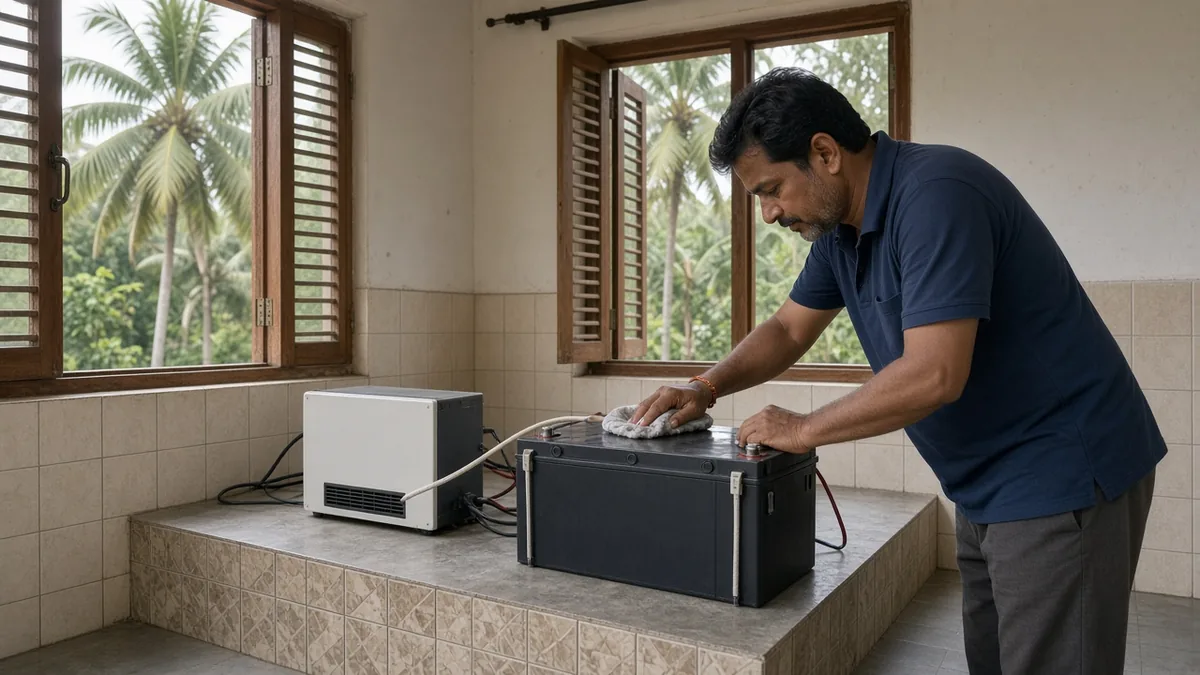
- Wipe the top with a slightly moist cotton cloth. Wool, silk or synthetic cloth can create a spark, so avoid them. Leave the top dry afterwards.
- Check the electrolyte level against the marks on the case, or against the float indicator if your model has one. Do this regularly, as the maker's card for your model says.
- Top up only if the level is low, with battery-grade distilled water, and refit every vent cap firmly.
- Look at each terminal and clamp. Corrosion, dirt and damp make the battery weaker, so ask your technician to clean and refit corroded clamps.
- Note the date and what you did on a card kept near the inverter, so the technician can see the history on the next visit.
Coastal and humid Kerala homes should look at the clamps more often, because salt air and damp speed up corrosion on metal parts. what coastal salt does to metal frames, clamps and boxes explains the same problem on a rooftop plant.
How do you top up the water and clean the terminals safely?
Water comes first. Battery-grade distilled water, which one maker also calls de-mineralised water, is the only liquid the makers tell owners to add. Tap, bore-well, RO and rain water carry minerals and impurities, and one maker's warranty card lists topping up with anything else among the reasons a claim can be refused. Acid is never added, and neither are battery additives.
Level matters in both directions. Top up only when the level is low, and stop at the marks on the case, because overfilling can push acid onto the top of the battery and the clamps. A battery whose float indicator, if fitted, shows low should be topped up through the vent openings and then closed again firmly.
Safety rules while you work near the battery:
- Keep sparks, cigarettes, naked flames, lamps and incense away from the battery. Makers warn that these can cause an explosion.
- Never let a metal tool, chain or wire touch both terminals at once. That causes a short circuit and sparks.
- Do not tilt the battery.
- If acid touches your skin or eyes, rinse with plenty of clean water and get medical help at once.
- Never empty the battery to drain the acid. The electrolyte pollutes ground and water.
- Keep children and pets out of the battery corner.
Where should the battery sit, and who should do the wiring?
Place the battery on a dry, firm, raised base in a clean and ventilated spot, away from heat, direct sun and sparks. Leave clear space around and between batteries so air and hands can reach them. Makers also ask for a short cable run with the right copper size, tight joints and no soldering onto the terminals. Never mix batteries of different brands, models or ratings in one bank.
The electricity safety regulations ask for adequate precautions so that no live parts are exposed in a way that causes danger (CEA safety regulations, Reg 37(7)). Around a battery, that means cable ends and terminals stay covered as the installer fitted them, with nothing loose that a child or a pet could touch. The same regulations say each distinct circuit must be protected against excess energy by a suitable fuse link or circuit breaker (Reg 37(4)). The breaker or fuse in your inverter's circuit is part of that protection, so it should never be bypassed.
Wiring jobs, such as moving the inverter, changing cable sizes, adding a second battery or connecting a different inverter, belong to the installer or a licensed electrician. Who may carry out electrical work in a home is covered in the guide to old house wiring problems and warning signs.
What should you do after a flood, a long power cut or lightning?
After water has entered the house, leave the inverter and battery switched off until the service technician has inspected them. The monsoon electrical safety guide covers wet switchboards and when to switch off at the main.
A lightning strike nearby can damage an inverter or its charger even when the lights seem fine. If the inverter behaves differently after a storm, have it checked before relying on it. Surge protection for a rooftop plant is covered in the rooftop solar lightning protection guide.
Long and repeated power cuts drain the battery deeply, and a battery that is rarely fully charged loses life sooner. One maker lists evidence that a battery was not kept in a charged state as a reason to refuse a warranty claim. After a long cut, let the battery recharge fully before the next long run if you can, and switch off heavy loads during the cut to stretch the backup. Efficient fans and LED lights help, and how to read the BEE star label shows how to compare them.
If long cuts keep happening in your area, that is a supply problem rather than a battery problem. KSEB compensation rules for power cuts and delays explains what you can claim and how.
What should you do with an old inverter battery in Kerala?
India's Battery Waste Management Rules, 2022 call the end user of a battery its consumer, and a waste battery includes one that is used up, at the end of its life or discarded by its user (Rule 3(1)(h) and (ze)). As the consumer, you must discard a waste battery separately from household and mixed waste, and give it to an entity engaged in collection, refurbishment or recycling (Rule 5(1)). The rules apply to every type of battery, whatever its chemistry, so a lithium home battery is covered as well (Rule 2(1)(ii)).
The same rules let a battery maker or importer, called the producer, run a deposit refund or buy-back scheme to collect waste batteries, and let it collect them itself or authorise another entity to do so, while the collection and recycling targets stay with the producer (Rule 4(9) and (10)). The Central Pollution Control Board runs an online portal where producers, recyclers and refurbishers register under these rules.
When you buy a new battery, ask the seller what happens to the old one: whether it takes the old battery back under the maker's scheme, or which registered collector to use. Keep the invoice. The makers' own cards tell customers to hand a used battery to the dealer, the maker or a registered recycler, and never to throw it away.
If you have solar as well, check how the plant and the old inverter fit together before changing anything. Connecting solar panels to a home inverter and battery setup explains why that is a job for a registered solar vendor.
Some grid-connected plants also carry their own battery. The hybrid inverter and battery rules for Kerala solar homes covers those.
Checklist: what to do this week
Take a made-up example. A family in a coastal town finds, after the monsoon, a little white crust on one battery clamp and a low water level. They switch the inverter off as its manual describes, wipe the dry battery top with a moist cotton cloth, top up with distilled water from the dealer and close every cap firmly. They call the technician to clean and refit the clamp, and then write the date on the service card kept beside the inverter.
Seven small jobs for one weekend:
- Look at your inverter and battery corner today. Is it dry, ventilated, tidy and out of reach of children?
- Wipe the battery top with a slightly moist cotton cloth, and look for crust on the clamps.
- Check the water level against the marks, and top up with battery-grade distilled water only if it is low.
- Ask your technician to clean and tighten any corroded clamp, then coat the terminals with petroleum jelly.
- Start a small service card and note the date and what you found.
- Find your battery's warranty card, keep it with the invoice, and ask the seller how the old battery will be taken back.
- Keep the service technician's phone number where everyone at home can find it.
Check this against your bill
FGE Solar can review your latest KSEB bill and tell you which system size is worth pricing.
Frequently Asked Questions
How do I know when my inverter battery needs water?
Look at the level marks on the case, or at the float indicator if your battery has one. If the level is low, top up with battery-grade distilled water and close the vent caps firmly. Check regularly, because the cells lose water as they work.
Can I use tap water or RO water in an inverter battery?
No. Use battery-grade distilled water only. Minerals and impurities in other water can harm the cells, and a maker's warranty card lists those waters as not recommended.
Is it safe to keep an inverter battery inside the house?
It can be, if the spot is dry, ventilated and away from sparks, flames and children. Never keep it in a closed cupboard or next to a stove, a pooja lamp or a heat source. Makers warn that sparks near a battery can cause an explosion.
What should I do with an old inverter battery in Kerala?
Do not put it in household waste. The Battery Waste Management Rules, 2022 make the consumer responsible for discarding a waste battery separately and giving it to an entity engaged in collection, refurbishment or recycling (Rule 5(1)). Ask the seller about a take-back scheme when you buy the new one.
Do the old battery rules apply to a lithium home battery too?
Yes. The Battery Waste Management Rules, 2022 apply to all types of batteries, whatever their chemistry, shape or use (Rule 2(1)(ii)). A lithium battery should therefore go to a collection or recycling entity as well, never into household waste.
Can I change the battery cables or move the inverter myself?
Leave wiring changes to the installer or a licensed electrician. Cable size, joints and the breaker in the circuit all affect safety. If something looks loose, hot or corroded, switch off as the inverter's manual describes and call the service technician.
Official Sources and Accuracy Note
- 01Battery Waste Management Rules, 2022 (MoEFCC, S.O. 3984(E), 22 August 2022), Gazette of India copy on the CPCB EPR portal
Rule 2(1)(ii) all battery chemistries; Rule 3(1)(h) and (ze) consumer and waste battery; Rule 4(9) and (10) producer take-back; Rule 5(1) consumer duty to discard separately and give to a collector, refurbisher or recycler.
govt source · opened 2026-11-03 - 02Battery Waste Management (Amendment) Rules, 2023 (MoEFCC, S.O. 4669(E), 25 October 2023), Gazette of India copy on the CPCB EPR portal
Amendment check: S.O. 4669(E) does not change Rule 2, Rule 3(1)(h) and (ze), Rule 4(9) and (10) or Rule 5.
govt source · opened 2026-11-03 - 03Central Electricity Authority (Measures relating to Safety and Electric Supply) Regulations, 2023, Gazette of India notification (PDF on cea.nic.in)
Reg 37(7) live parts not exposed so as to cause danger; Reg 37(4) each distinct circuit protected by a fuse link or circuit breaker.
govt source · opened 2026-11-03 - 04CPCB EPR Portal for Battery Waste Management (Central Pollution Control Board, MoEFCC)
Registration portal for producers, recyclers and refurbishers under the Battery Waste Management Rules, 2022.
govt source · opened 2026-11-03 - 05Amaron Quanta S-XEL tubular battery user guide and warranty card (manufacturer, PDF)
Trained installation, clean dry top, vent plugs, petroleum jelly, distilled or de-mineralised water only, no sparks or flame, ventilation and take-back of used batteries.
manufacturer source · opened 2026-11-03 - 06Luminous LIFEMAX inverter battery warranty card and battery care tips (manufacturer, PDF)
Lead and sulphuric acid; distilled water only; cotton cloth; petroleum jelly; no sparks; do not empty electrolyte; deposit used batteries with the dealer.
manufacturer source · opened 2026-11-03
Accuracy note: This guide is built from government pages, regulator orders, and news sources on the web. Rules and amounts change. Some details may be outdated or wrong. Check the official links below before you pay, apply, or complain to KSEB.