Standby Power Consumption: What Stays On in Your Kerala Home
Switch the TV off with the remote and a small red light stays on. The set-top box, the router, the phone charger and the microwave clock are still drawing a trickle of current as well. That trickle is standby power consumption, and in a Kerala home it runs every hour of every day. This guide explains how the Bureau of Energy Efficiency describes it for televisions, how to find what your own home leaves switched on, and what to switch off and what to leave alone.
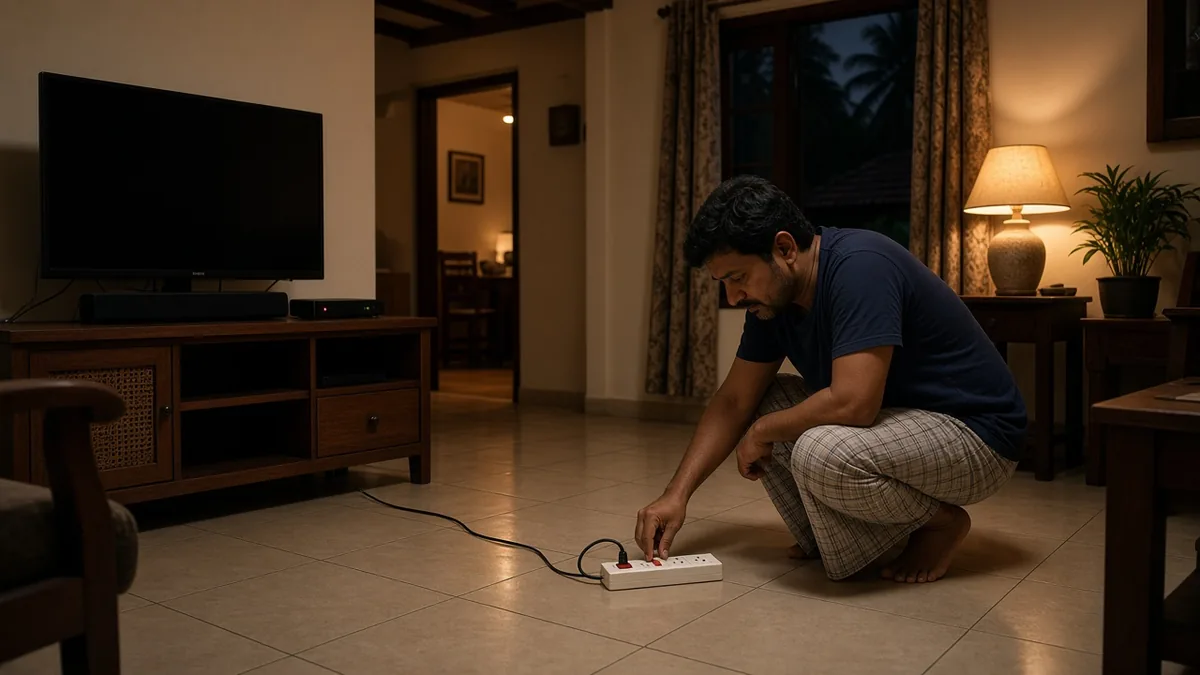
Quick answer: Standby use is the power a device draws while it looks switched off but can still wake from a remote, a timer or a signal. Find the culprits by checking lights, clocks and warm chargers, then switch off at the socket what you do not need. Leave the fridge, home inverter and medical equipment on.
Key points to remember about devices that look off
- Many things keep drawing a little power when they look switched off: televisions, set-top boxes, routers, chargers, microwaves, computers and water purifiers.
- A small light, a clock display or a warm adapter is a sign that something is still powered.
- A remote or front-panel button usually leaves the device waiting for its next command. Only a switch at the socket, or a plug pulled out, cuts it off.
- A power strip with its own switch cuts a whole corner, such as the TV, set-top box and soundbar, in one move.
- Leave the fridge, the home inverter and its charger, medical equipment and anything you rely on for safety switched on.
- In a home with rooftop solar the same habits apply, and the plant's own switches stay with the installer.
What is standby power consumption, and how does BEE define it?
The Bureau of Energy Efficiency (BEE) runs the star label you see on televisions and appliances. Its label rules for ultra-high-definition (4K) televisions describe the states a TV can be in (Schedule 26, clause 3.13). The table puts them side by side.
| Mode | What the TV is doing | What can wake it |
|---|---|---|
| On | Showing a picture and, if it can, sound | Already on |
| Off | No picture or sound, and no other job that needs power | Nothing: the remote and outside signals cannot switch it on |
| Standby passive | No picture or sound | The remote control or an internal signal, but not an outside signal |
| Standby active, low | No picture or sound | The remote, an internal signal or an outside signal |
| Standby active, high | No picture or sound, and the TV is sending or receiving data | The remote, an internal signal or an outside signal |
Even Off mode is not always zero. The schedule notes that some power may still be consumed when a filter or other part sits on the supply side of the power switch (clause 3.13.2). Its word for fully cut off is "disconnected": every connection to the mains is removed or interrupted (clause 3.6). In a home, that means the plug out or the socket switched off.
For a 4K television to join the BEE labelling programme, its standby passive power must be 0.5 watts or less, and that is one of the entry requirements (clauses 8.2.3 and 5.1). The schedule covers ultra-high-definition televisions only, so it gives no figures for set-top boxes, routers, chargers or other devices in your home (clause 1).
The label also counts standby when it rates a TV. BEE works out a TV's annual energy figure as (on-mode watts × 6 + standby active low watts × 12) × 0.365, in kilowatt-hours a year, assuming six hours of viewing and twelve hours in that standby mode every day (clause 5.2). The star level comes from that figure (clause 3.15). How to read a BEE star label explains the rest of the label.
Which things in a Kerala home keep drawing power when they look off?
Most homes have more of these than the family realises, because each draws only a little. A walk through the house, room by room, shows them quickly. Here is where to look:
- Living room: the television, set-top box, soundbar, game console and the Wi-Fi router, which usually share one corner and one socket.
- Kitchen: the microwave with its clock display, an induction cooktop with a display and the water purifier.
- Bedrooms: phone chargers, laptop adapters, a bedside speaker and the air conditioner, which stays ready for its remote while the socket is on.
- Study table: the computer, monitor, printer, speakers and any adapter in a wall socket.
- Utility area: the washing machine with its display, a geyser with an indicator light and the home inverter, which is meant to stay on.
Some of these are meant to stay on. A fridge runs its own cycle, and a home inverter keeps its battery charged for the next power cut. Care for a home inverter battery explains what to look at there. The aim is to switch off what you do not need, not everything.
How can you find out what your own home draws on standby?
Choose a quiet evening, when nobody is watching or cooking, and work through these steps:
- Look around the house after dark for small lights, glowing displays and clocks on appliances that are meant to be off.
- Feel the adapters and chargers that are plugged in with nothing attached. A warm adapter is drawing power.
- Switch off everything you can at the socket or switch, but leave the fridge and the home inverter on.
- Read your KSEB meter display, wait for a quiet spell, and read it again. If the figure keeps climbing steadily, something is still running.
- Never open the meter box or touch the seals. Only read the display.
A plug-in energy meter from a hardware dealer is the easiest tool for single devices. It sits between the socket and the appliance and shows the watts drawn. With rooftop solar, read the import figure rather than the generation figure, and how to read the net meter display shows which screen is which.
A small worked example shows how a trickle adds up. Suppose a TV draws 1 watt in standby active, low mode (an assumed figure, not a measurement). BEE's way of counting twelve hours a day gives 1 × 12 × 0.365 = 4.38 kWh a year for that mode (clause 5.2). Now suppose a home has five small things, each drawing an assumed 3 watts all day. Together they draw 5 × 3 = 15 watts, and 15 watts × 24 hours = 360 watt-hours, which is 0.36 kWh a day, or 10.8 kWh over a 30-day month. Real devices differ. What a unit on your KSEB bill means explains how kWh appear on the bill.
What should you switch off, and what should stay on?
Electricity departments give the same basic advice. The Electricity Department of the Government of Puducherry, a neighbouring union territory, lists switching off the TV, AC, microwave oven, washing machine and computers to avoid standby power in its home tips, and asks consumers to switch off lights, fans and other appliances when nobody is in the room or when they are not needed. The habit carries over to Kerala homes.
Good candidates to switch off at the socket:
- The TV corner: television, set-top box and soundbar, switched off together at one switch when the family goes to bed.
- The study table: computer, monitor, printer and speakers, switched off at the end of the day.
- Chargers: unplug a charger when the phone or laptop is full.
- The microwave, the induction cooktop and the water purifier, if the household is away for a few days.
- The washing machine and the air conditioner at the wall socket when they will not be used for a while, remembering that some settings may reset.
Leave these switched on:
- The fridge and freezer, which are meant to run all the time.
- The home inverter and its charger, so the battery is ready for the next power cut.
- Medical equipment, and anything an elderly or unwell family member depends on.
- Alarms, security cameras and gate controls, if you rely on them.
- The Wi-Fi router if someone works from home or the family uses it for phone calls, unless the provider says otherwise.
- The rooftop solar plant's own breakers and isolators. Leave those to the installer.
A switched power strip is the simplest tool. Plug the TV corner or the study table into one strip, and one switch cuts everything on it. Check the strip's rating label against what you plug in, keep heavy loads such as a heater, an iron or an air conditioner off light-duty strips, and never plug one strip into another. If anything feels hot, smells burnt or sparks, stop using it and have it checked. Signs of old or overloaded wiring lists what to watch for.
A timer or smart plug can do the same job on its own for the TV corner or the study table, but not for the fridge, the home inverter or medical equipment. An air conditioner may need its settings again after a long cut-off, and keeping the house cooler with less AC covers habits that reduce how much it runs at all.
Does standby use matter if you have rooftop solar?
A rooftop plant does not remove standby loads. They run through the day and the night, and some run after sunset, when the plant is not producing.
Daytime habits and night habits work together. Running the washing machine or the pump while the sun is up is one half, and which appliances suit daytime solar hours covers it. Switching off the TV corner at night is the other half.
For the bill itself, how a solar bill shows import and export explains the lines you will see.
One safety rule for solar homes: do not use the plant's breakers or isolators as a nightly switch. Those are for the installer and for emergencies. To learn what the plant itself draws when idle, ask your installer.
Checklist: what to do this week
Take a made-up example. A family in a Kerala town walks round the house after dinner and finds the TV corner glowing, two chargers warming in the bedroom and the computer and printer on standby at the study table. They put the TV corner and the study table on one switched strip each, unplug the chargers when the phones are full, leave the fridge and the home inverter alone and write the new routine on a card by the door.
Seven small jobs for one weekend:
- Walk through each room after dark and note every light and warm adapter.
- Group the living-room devices on one switched power strip and switch it off at night.
- Do the same for the study table.
- Unplug chargers once the phone or laptop is full.
- Make a short list of what must stay on: fridge, home inverter, medical equipment, alarms and the router if needed.
- Try the meter test once: switch off what you can, read the display, wait and read again.
- If you have solar, remind the family that the plant's switches are for the installer.
Check this against your bill
FGE Solar can review your latest KSEB bill and tell you which system size is worth pricing.
Frequently Asked Questions
What does a TV use when it is switched off with the remote?
It stays in a standby state so the remote can wake it. BEE's label rules for UHD televisions describe several such modes, and some of them can also be woken by an outside signal (clause 3.13). Only a switch at the socket, or the plug out, cuts it off completely (clause 3.6).
What standby limit does BEE set for a labelled TV?
BEE's labelling schedule for UHD televisions requires standby passive power of 0.5 watts or less for a set to join the programme (clause 8.2.3). The schedule covers UHD televisions only, so it gives no figures for set-top boxes, routers or chargers (clause 1).
Is it safe to leave chargers plugged in all day?
A working charger in a good socket is usually fine for short periods, but it keeps drawing a little power with nothing attached. Unplug a charger that feels hot, smells burnt, looks damaged or sits on a bed or sofa. Never leave a charging phone under a pillow.
How can I check how much power my home uses when nobody is using anything?
Do the meter test: with the house quiet, read the display, wait, and read it again. A plug-in energy meter shows the watts for one device at a time. Never open the meter box or touch its seals.
Does standby use still matter if I have rooftop solar?
Yes, because the plant produces nothing after sunset while standby loads keep running. That is why a quiet house can still show some import. For which screen shows what, read how to read the net meter display.
Official Sources and Accuracy Note
- 01Bureau of Energy Efficiency, Schedule 26: Ultra-High Definition Televisions (star labelling), Revision 1, 28 December 2021 (PDF on beeindia.gov.in)
Clause 3.13 modes; clause 3.6 disconnected; clause 8.2.3 standby passive 0.5 W or less; clause 5.1(d) prequalification; clause 5.2 annual energy formula; clause 1 UHD televisions only.
govt source · opened 2026-11-04 - 02Electricity Department, Government of Puducherry: Energy Conservation, tips for energy conservation (official website)
At Home list: switch off the TV, AC, microwave oven, washing machine and computers to save standby power; switch off lights, fans and other appliances when occupants leave the room or when they are not required.
govt source · opened 2026-11-04
Accuracy note: This guide is built from government pages, regulator orders, and news sources on the web. Rules and amounts change. Some details may be outdated or wrong. Check the official links below before you pay, apply, or complain to KSEB.