Solar Surplus Settlement in Kerala: How the APPC Rate Works
If your rooftop plant sends more power to the grid than your home takes back over the settlement period, you finish with units left in your favour. Solar surplus settlement in Kerala is how those leftover units are paid for, and the rate used is not the slab rate on your bill. It is the APPC rate approved by the Kerala State Electricity Regulatory Commission (KSERC), fixed at ₹3.26 a unit under the order that was upheld in July 2026.
This guide explains what APPC means, why KSERC refused to raise it to ₹4.34, and what to ask your section office. It is based on the KSERC order dated 27 July 2026 in OP No. 52/2025.
For the wider picture, see our guide to rooftop solar rules in Kerala.
Quick answer
Kerala pays leftover net banked energy from rooftop solar at the APPC rate, not your slab rate.
KSERC approved ₹3.26 a unit in its true-up order dated 30 June 2025 (OP No. 49/2024). On 27 July 2026, in OP No. 52/2025, it refused a plea to raise this to ₹4.34. Monthly net metering adjustments are separate.
Key takeaways
- Surplus settlement pays only for net banked energy left at the end of the settlement period, not for every unit you export.
- The rate is APPC (Average Pooled Power Purchase Cost), a regulator-approved figure, not a retail tariff.
- A petition by four prosumers seeking ₹4.34 a unit (OP No. 52/2025) was disposed of on 27 July 2026, so ₹3.26 stands.
- KSERC reached ₹3.26 from the 2022-23 APPC of ₹3.15, escalated using CPI and WPI in a 70:30 ratio.
- Later years need their own approved APPC, so check the rate for your own settlement period.
- Units you use yourself save you your slab rate. Surplus units earn APPC, which is usually much lower than the higher domestic slabs.
What solar surplus settlement means for a Kerala home
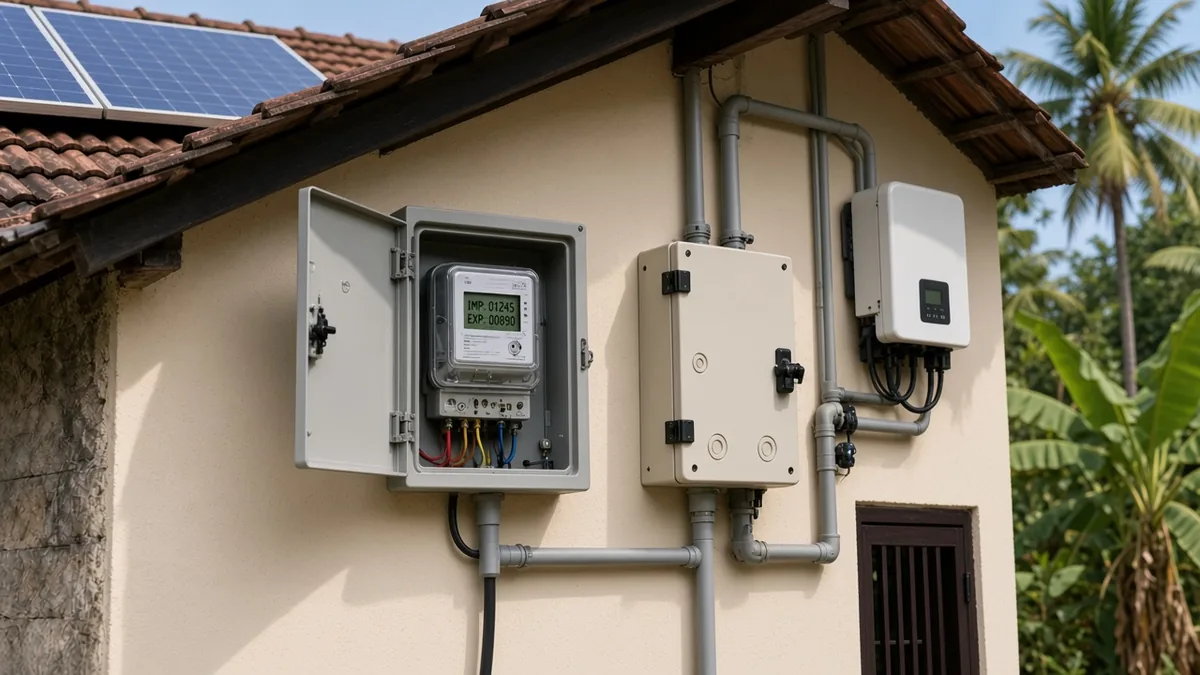
Under solar power net metering, exported units are banked and offset units you import later in the cycle, such as at night. For most homes, this is where the value of solar electricity comes from.
If a balance still sits in your favour when the settlement period ends, those leftover units are settled by the licensee (KSEB for most homes). That end-of-period step is solar surplus settlement, and it uses the APPC rate approved by KSERC.
What the APPC rate in Kerala means in plain words
APPC stands for Average Pooled Power Purchase Cost. In plain words, it is the average cost at which the licensee buys power, with all its purchases pooled together, as approved by the regulator. Think of it as a wholesale price for electricity.
Your retail slab rate also has to cover costs such as the network that carries power to your home. That is why APPC is not the same as your domestic unit rate.
What net banked energy is
Net banked energy is the number of units still in your favour after all exports and imports in the settlement period have been adjusted against each other. It is the only quantity that surplus settlement pays for. If you import more than you export over the period, there is nothing to settle.
Kerala solar surplus settlement: the ₹3.26 APPC rate
In the true-up order dated 30 June 2025 in OP No. 49/2024, KSERC approved APPC at ₹3.26 a unit for settling net banked energy of prosumers and captive consumers. A true-up is the regulator's review of a past year's actual accounts.
Four rooftop solar prosumers later filed OP No. 52/2025. They asked the Commission to use ₹4.34 a unit instead, arguing that this figure followed the 2020 regulation method on the same year's accounts.
The orders at a glance
| Item | Amount or date | Where it appears |
|---|---|---|
| APPC approved for settlement (true-up path upheld) | ₹3.26 per unit | OP No. 49/2024 order dated 30.06.2025, affirmed in OP No. 52/2025 |
| Rate the petitioners sought | ₹4.34 per unit | Prayer in OP No. 52/2025 |
| Base APPC used in the Commission's escalation method | ₹3.15 per unit (2022-23) | Discussion in OP No. 52/2025 |
| Order disposing of the challenge | 27 July 2026 | OP No. 52/2025 |
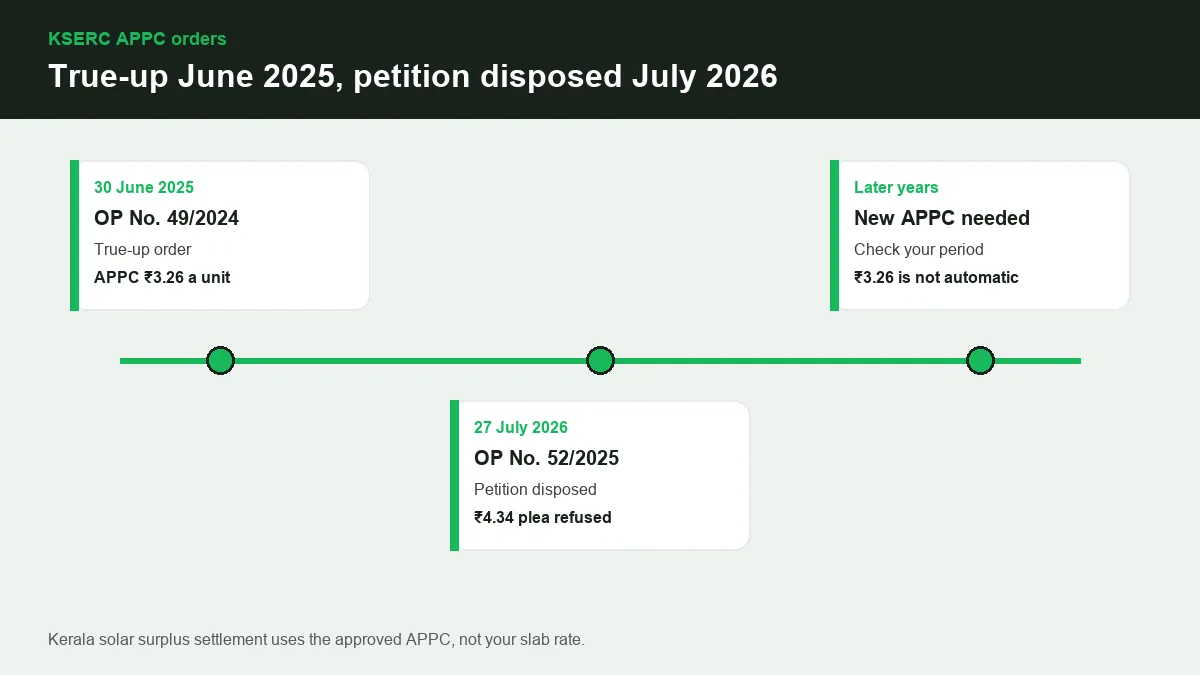
On 27 July 2026 the Commission held that the petition was not maintainable as a review of the 30 June 2025 order. On merits, it found no ground to reopen the APPC, and the petition was disposed of.
Why KSERC kept ₹3.26 instead of ₹4.34
The Commission explained that 2023-24 was an abnormal monsoon and demand year for KSEB's power purchase cost. So it took the APPC of a more normal year, ₹3.15 a unit for 2022-23, and applied an escalation using CPI and WPI (consumer and wholesale price indices) in the ratio 70:30. That gave ₹3.26.
In plain words, KSERC adjusted a normal year's cost for inflation rather than pass on one unusual year's high cost. Paying the higher, force-majeure-driven pooled cost to a small set of prosumers, it said, would load ordinary consumers.
The order also compared Kerala's rate with how other states treated surplus for 2024-25.
Several states paid less than ₹3.26, and some let leftover banked energy lapse. Timing mattered too: daytime solar export helps the grid at noon, but it does not remove KSEB's need to buy costly power in the evening.
APPC settlement rate vs your retail slab rate
Many homeowners expect year-end surplus to be paid at the rate on their bill. It is not.
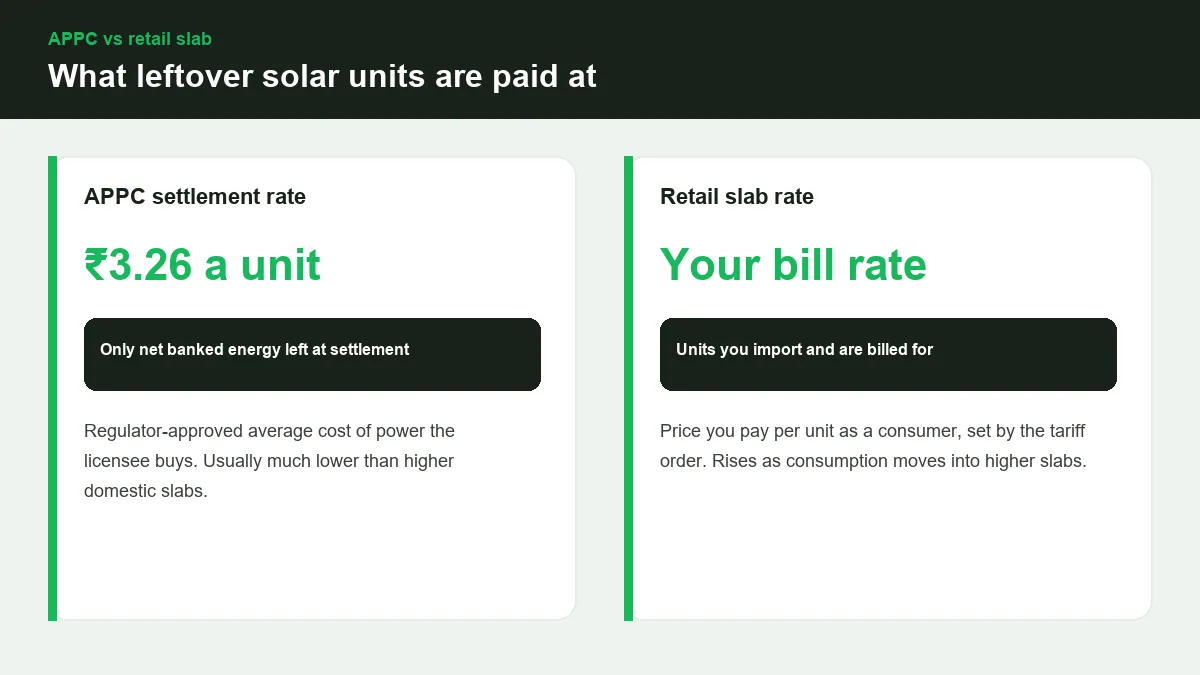
| Point | APPC settlement rate | Retail slab rate |
|---|---|---|
| What it is | Regulator-approved average cost of the power the licensee buys | Price you pay per unit as a consumer, set by the tariff order |
| Which units it applies to | Only net banked energy left at settlement | Units you import and are billed for |
| Current figure | ₹3.26 a unit for the true-up path upheld in OP No. 52/2025 | Depends on your slab; see our guide to KSEB tariff slabs |
| How it changes | A later year needs its own approved APPC | Through KSERC tariff orders |
| Typical level | Usually much lower than the higher domestic slabs | Rises as consumption moves into higher slabs |
Also read our guides to KSEB solar fixed charge options and grid support charges for Kerala solar homes.
Worked illustration: what a surplus credit looks like in rupees
Illustration only. The unit figure is made up to show the arithmetic, and it assumes ₹3.26 is the APPC that applies to your settlement period. Say 400 units of net banked energy remain in your favour at the end of the period.
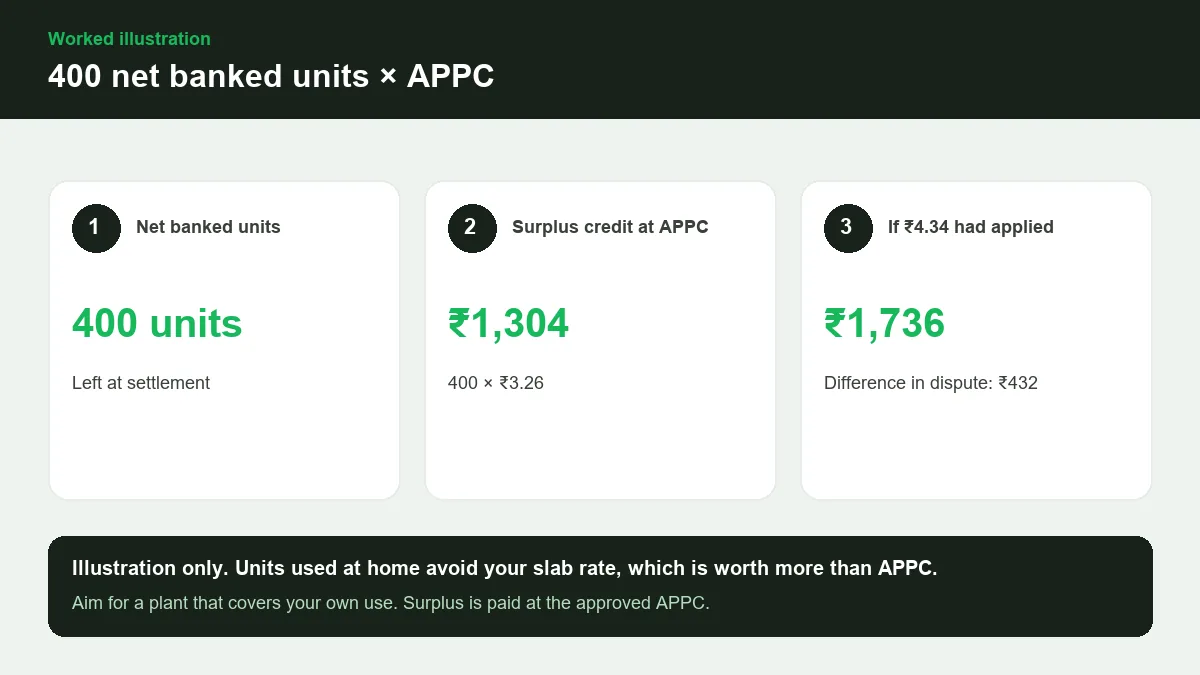
| Step | Value |
|---|---|
| Net banked units left at settlement | 400 units |
| Surplus credit at the APPC rate | 400 x ₹3.26 = ₹1,304 |
| For comparison, at the ₹4.34 the petitioners sought | 400 x ₹4.34 = ₹1,736 |
| Difference that was in dispute, for this illustration | ₹432 |
Now picture those 400 units of solar power electricity used at home instead. Each one avoids buying a unit at your slab rate, worth more than APPC for homes in higher slabs. So aim for a plant that covers your own use. Our KSEB bill calculator and our guide on how much you can save with solar in Kerala show where the real savings come from.
When the KSEB surplus solar payment is due
The APPC rate only matters when a net credit remains at the end of the settlement period.
The older 2020 net-metering framework, as quoted in the July 2026 order, spoke of interest if the licensee delays payment beyond 30 days from the settlement date, at the FBIL rate plus 200 basis points on 1 April of the settlement year. FBIL (Financial Benchmarks India Limited) publishes benchmark interest rates; 200 basis points is 2 percentage points. Ask how this applies under the rules that govern your agreement.
If your plant is still waiting for its bi-directional meter, exports are not yet being recorded for settlement. Our guide to net meter delays explains what you can do.
How the 2025 regulations sit beside the APPC rate
Kerala has since notified the KSERC (Renewable Energy and Related Matters) Regulations, 2025. Their energy accounting, billing and settlement chapters apply from 1 January 2026, and existing prosumers continue under net metering subject to Regulation 2.3.
The 2025 regulations have their own settlement clauses. The July 2026 dispute was about the rate already fixed in the 2023-24 true-up path, not about rewriting the metering framework, so keep the two separate. If you expanded your plant or changed your inverter after the 2025 regulations took effect, ask whether any new settlement clause applies to your agreement in addition to the APPC rate. Our page on KSEB solar net metering explains the arrangement itself.
What FGE Solar recommends if you expect a surplus
Do not assume a surplus will be paid at your slab rate. Under the true-up path that was challenged, the figure is ₹3.26 a unit unless a later order sets a new APPC.
Questions to ask your KSEB section office
- What APPC rate applies to my settlement period ending date?
- How many banked units remain after adjustments?
- Will the amount be paid to my bank account or adjusted in my bills?
- From which date does any interest for delay start, if payment is late?
Documents to keep
Keep your net metering agreement, recent bills showing export and banked units, and any settlement advice. Note the settlement period end date printed in your prosumer documents or bill notes. If a settlement note does not match ₹3.26 for the period covered by the true-up order, ask the section office to show you the Commission order they used.
Keep your surplus small
| Check | Why it matters |
|---|---|
| Plant size vs your yearly use | An oversized plant builds surplus paid at APPC. See which solar system size fits your home. |
| Daytime loads | Running pumps and washing machines while the sun is up uses solar directly. |
| Shared or apartment plants | How units are split between flats is covered in our guide to virtual net metering in Kerala. |
We size every residential solar plant against your past bills.
Frequently asked questions
What is the APPC rate in Kerala for solar surplus settlement?
For the settlement tied to the true-up order dated 30 June 2025 in OP No. 49/2024, KSERC approved APPC at ₹3.26 a unit. On 27 July 2026, in OP No. 52/2025, it refused a petition seeking ₹4.34 a unit. Later years need their own approved APPC.
Will KSEB pay for excess solar units?
Yes, but only for net banked energy: the units still in your favour after exports and imports are adjusted at the end of the settlement period. Those units are paid at the APPC rate approved by KSERC, not at your slab rate.
Is ₹3.26 the same as my domestic unit rate?
No. Domestic energy charges follow the tariff slabs on your bill. APPC is a separate regulator-approved average used to pay leftover banked energy at settlement. It is usually much lower than the higher domestic slabs.
When does KSEB pay the solar surplus amount?
After the settlement period ends and the licensee works out your net banked units. The older 2020 net-metering rules, as quoted in the July 2026 order, speak of payment within 30 days of the settlement date, with interest if late. Ask your section office which timeline applies to your agreement.
Can prosumers make KSEB pay ₹4.34 a unit?
Not through the petition decided on 27 July 2026. KSERC held it was not maintainable as a review and found no ground on merits to reopen the ₹3.26 APPC. Only a fresh lawful process for a later year could set a different rate.
Does the APPC rate change my monthly net metering bill?
No. Monthly adjustment of imports against exports continues under your net metering arrangement. The APPC figure applies only to leftover banked energy at settlement, not to every exported unit.
Official sources and accuracy note
- 01KSERC Order dated 27.07.2026 in OP No. 52/2025 and true-up order dated 30.06.2025 in OP No. 49/2024 (erckerala.org)
- 02KSERC (Renewable Energy and Related Matters) Regulations, 2025, including Regulation 2.3 (erckerala.org)
- 03KSERC Tariff Order dated 05.12.2024 (OP No. 18/2023), for domestic slab rates (erckerala.org)
- 04KSEB, for settlement advice and section office contacts (kseb.in)
This guide summarises official orders and regulations as of 29 September 2026. Rates and rules can change. Please check the latest KSERC and KSEB documents before you pay, apply or file a complaint.
Not sure whether your plant is building a surplus you are paid less for? Send us your last year of KSEB bills and we will check your banked units and plant size. Request a free surplus and sizing review from FGE Solar, a solar company in Kerala that handles solar surplus settlement questions and KSEB paperwork end to end.