KSEB Solar Fixed Charge for Solar Homes: Option-1 vs Option-2 Explained
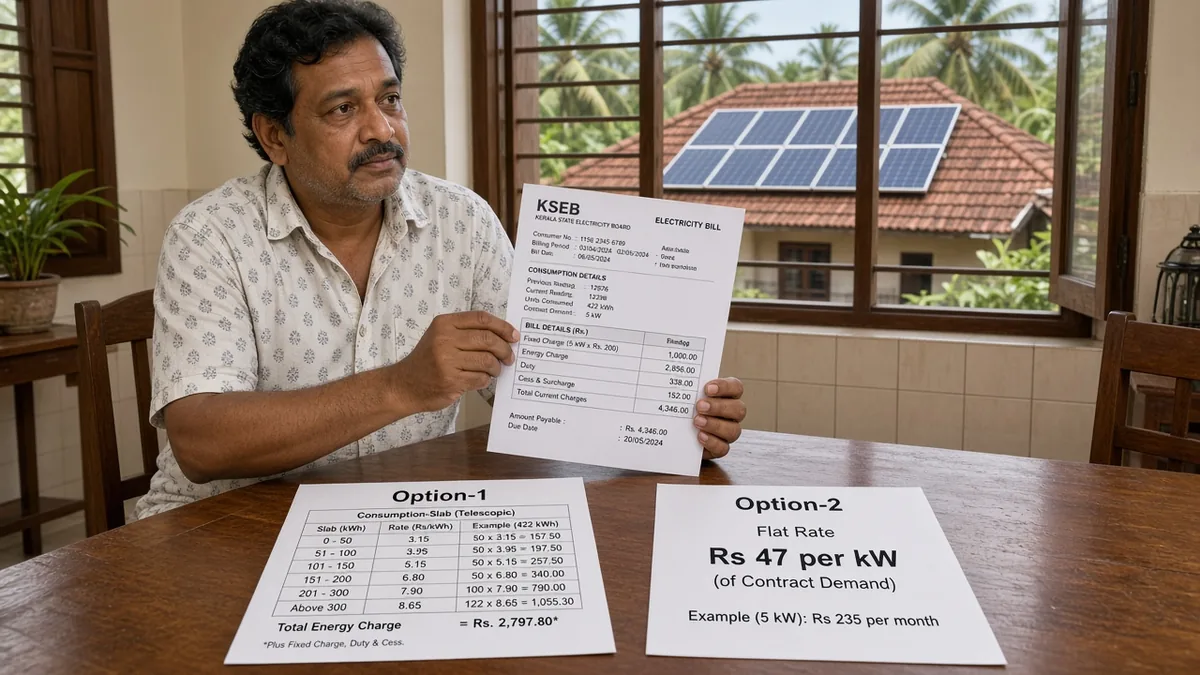
If you have rooftop solar on a domestic connection, the KSEB solar fixed charge on your bill can now be worked out in one of two ways. You can stay on the normal domestic slabs, based on the total units your home uses, or you can pay a flat ₹47 per kW per month on your connected load. Which one costs less depends on your own load and usage.
This guide explains the KSEB fixed charge for solar prosumers in plain words, with worked examples for 3 kW, 5 kW and 8 kW homes and the steps to switch.
Quick answer
Domestic solar homes in Kerala have two fixed charge options. Option-1 uses the tariff order slabs on your total consumption and is the default. Option-2 is ₹47 per kW per month on your total connected load, till further orders. To move to Option-2, write to KSEB at least one month before the date you want it to start.
Key takeaways
- KSERC allowed two options on 22 September 2025 (OP No. 43/2025).
- Option-1 (default): slab-based fixed charge on total consumption under the Tariff Order dated 5 December 2024.
- Option-2: ₹47 per kW per month multiplied by your connected load. It does not change with how much solar you generate.
- Option-2 suits a small connected load with high consumption; a large connected load usually does better on Option-1.
- APTEL dismissed the appeal against the order on 16 February 2026 (APL No. 384 of 2025). Both options remain.
- The ₹47 rate is interim. KSERC has been directed to work out a lasting method.
What is the KSEB solar fixed charge?
A domestic bill in Kerala has an energy charge for the units you use and a fixed charge that recovers network costs separately. For a solar home, KSEB charged the fixed charge on total consumption, including solar units used directly at home. The KSEB solar fixed charge options you see today come from a challenge to that practice.
What KSERC decided in OP No. 43/2025
On 22 September 2025, KSERC decided OP No. 43/2025, filed by six domestic rooftop solar prosumers. It found no illegality in charging the fixed charge on total consumption under the net metering rules, but allowed two ways to pay: the existing consumption-based method (Option-1) or ₹47 per kW per month on connected load (Option-2), till further orders. The order also directed security deposit reviews under the Supply Code, a separate matter.
KSEB fixed charge for solar prosumers: the two options
| Option | How the charge is worked out | What you must do |
|---|---|---|
| Option-1 | Fixed charge from the LT-I domestic tariff slabs, based on total consumption in the billing period | Nothing. This is the default. |
| Option-2 | ₹47 per kW per month multiplied by your total connected load with KSEB | Write to KSEB at least one month before the date you want to switch |
Option-1 moves with your consumption slab. Option-2 stays the same every month unless your connected load on KSEB's records changes.
Option-1: fixed charge slabs from the domestic tariff
Under Option-1, the fixed charge follows the LT-I Domestic schedule in the Tariff Order dated 5 December 2024, which covers 1 April 2025 to 31 March 2027. For the full energy charge rates, see our guide to KSEB tariff slabs.
| Monthly consumption slab | Fixed charge, single-phase (₹) | Fixed charge, three-phase (₹) | Type |
|---|---|---|---|
| 0 to 40 units (BPL, load up to 1000 W) | Nil | Nil | Special |
| 0 to 50 units | 50 | 130 | Telescopic |
| 51 to 100 units | 85 | 175 | Telescopic |
| 101 to 150 units | 105 | 205 | Telescopic |
| 151 to 200 units | 140 | 215 | Telescopic |
| 201 to 250 units | 160 | 235 | Telescopic |
| 0 to 300 units | 220 | 240 | Non-telescopic |
| 0 to 350 units | 240 | 250 | Non-telescopic |
| 0 to 400 units | 260 | 260 | Non-telescopic |
| 0 to 500 units | 285 | 285 | Non-telescopic |
| Above 500 units | 310 | 310 | Non-telescopic |
The higher your total consumption slab, the higher the fixed charge, even if most of those units came from your own solar panels.
What "total consumption" means for a solar home
Total consumption is all the electricity your home used in the billing period: grid imports plus solar units used directly during the day. It is not the net figure after exports that your KSEB net metering account settles.
So a solar home can sit in a higher slab than its import units alone suggest.
Option-2: the ₹47 per kW fixed charge
Under Option-2, the monthly fixed charge is ₹47 multiplied by your total connected load in kilowatts, as recorded with KSEB. It does not depend on your consumption, the weather or your exports. Note that it is based on connected load, not solar plant size, so a later load increase raises it.
Where the ₹47 figure comes from
The Commission arrived at ₹47 per kW per month from the average fixed charge recovery implied by the then-prevailing domestic tariff for 2025-26. It is an interim figure until a lasting method is set.
Option-1 vs Option-2: worked examples for 3 kW, 5 kW and 8 kW
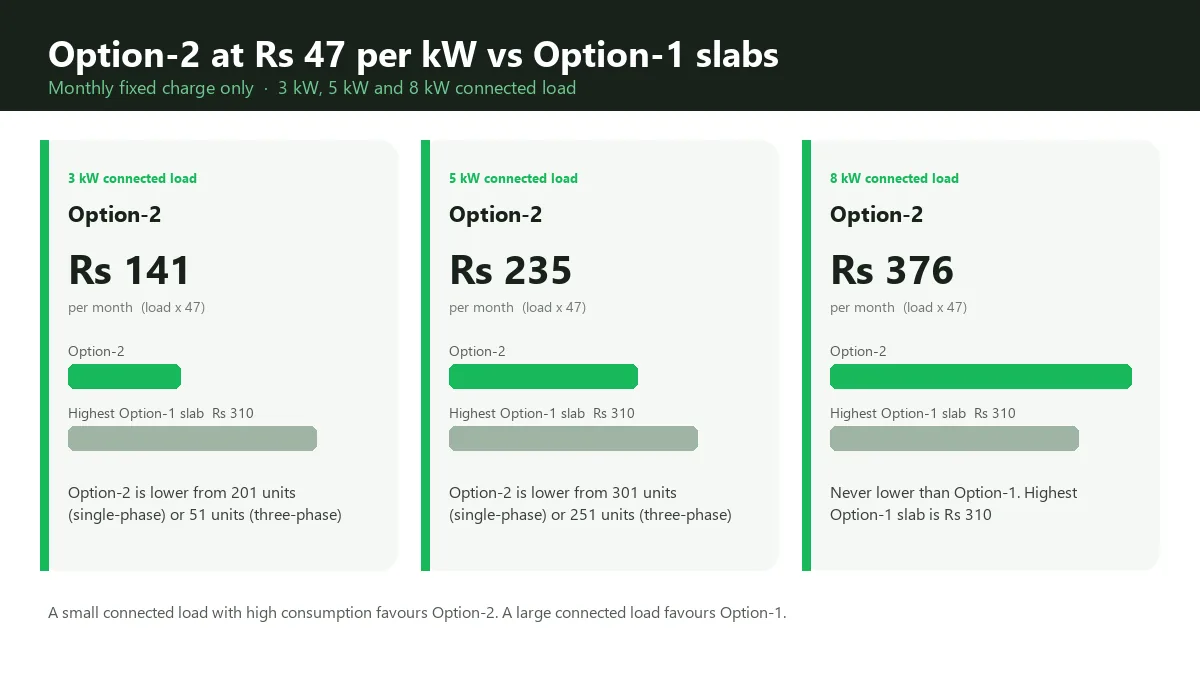
This table compares the monthly Option-2 amount for three connected loads with the Option-1 slabs above (fixed charge line only).
| Connected load | Option-2 per month | Single-phase: Option-2 is lower when monthly consumption is | Three-phase: Option-2 is lower when monthly consumption is |
|---|---|---|---|
| 3 kW | 3 x 47 = ₹141 | 201 units or more (Option-1 is ₹160 at 201 to 250 units) | 51 units or more (Option-1 is ₹175 at 51 to 100 units) |
| 5 kW | 5 x 47 = ₹235 | 301 units or more (Option-1 is ₹240 in the 0 to 350 slab) | 251 units or more (equal at ₹235 in the 201 to 250 slab) |
| 8 kW | 8 x 47 = ₹376 | Never (the highest Option-1 slab is ₹310) | Never (the highest Option-1 slab is ₹310) |
3 kW connected load
Option-2 would be ₹141 a month. On single-phase supply, Option-1 is ₹140 or less up to 200 units, so switching gains nothing below that; from 201 units Option-2 is lower. On three-phase supply, where slabs start higher, Option-2 is lower from 51 units.
5 kW connected load
Option-2 would be ₹235 a month. On single-phase supply, Option-1 stays lower up to 300 units (₹220), and Option-2 wins only from 301 units. On three-phase supply, the two are equal at 201 to 250 units, and Option-2 is lower from 251 units.
8 kW connected load
Option-2 would be ₹376 a month, higher than every Option-1 slab including ₹310 for above 500 units. Option-1 stays lower whatever your consumption.
In short, a small connected load with high consumption favours Option-2, and a large connected load favours Option-1.
How to read the fixed charge on your KSEB bill
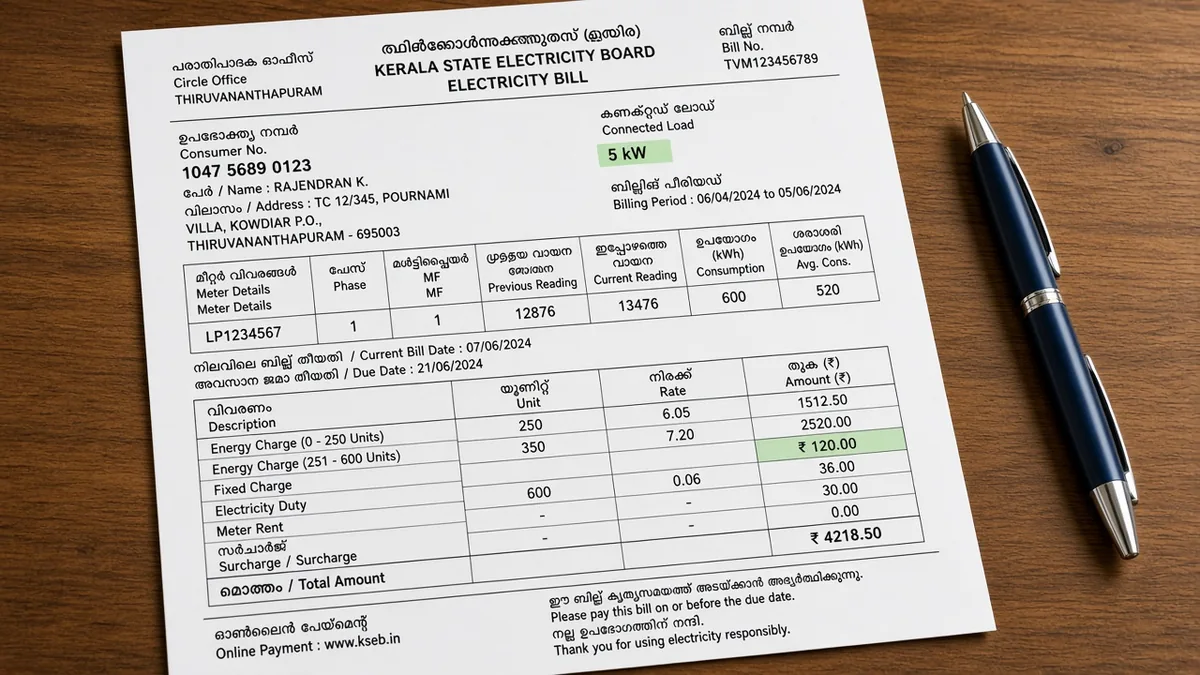
Your KSEB bill details already hold the numbers you need: the connected load (in kW or watts), usually printed near your consumer number, and the fixed charge line in the charges section.
When you check your Kerala electricity bill details, also note your supply type (single-phase or three-phase) and total units consumed. If a bill covers more than one month, divide the fixed charge by the number of months before comparing.
For a quick KSEB bill calculation, multiply your connected load by ₹47 and compare it with the monthly fixed charge on recent bills. Our KSEB bill calculator can help you estimate the energy charge side of the same bill. If the numbers on your electricity bill KSEB issued do not match what you expect, ask your section office before making any change.
How to switch to Option-2
- Find your connected load on your KSEB agreement or latest bill.
- Multiply it by ₹47 to get your Option-2 monthly fixed charge.
- Check the fixed charge on three or four recent bills, including a high-usage month.
- If Option-2 is lower in most months, write to KSEB asking to move to Option-2 under OP No. 43/2025.
- Submit it at least one month before the date you want the change to start.
- Keep a dated copy of your request, and confirm with your section office that the option change has been recorded.
- Check that your first bill after the start date shows the Option-2 amount.

What APTEL said in February 2026
The same prosumers appealed to the Appellate Tribunal for Electricity (APTEL). In APL No. 384 of 2025, decided on 16 February 2026, APTEL dismissed the appeal and left the interim Option-2 arrangement in place. It directed KSERC to finish a lasting method based on connected load or recorded maximum demand quickly. Until a new KSERC order replaces them, both options remain in force.
What the fixed charge option does not change
Your choice changes only the fixed charge method, not the rest of your bill:
- Energy charge still follows the tariff order and your net billing.
- Fuel surcharge (when applicable) and meter rent are unchanged.
- Net meter export and banking still follow the renewable energy regulations.
- Any security deposit refund or top-up follows the Supply Code review rules.
For the other parts of a solar bill, see how Kerala settles surplus solar at the APPC rate, and our explainer on grid support charges for Kerala solar.
What FGE Solar recommends
The KSEB solar fixed charge is paid every month, so the right option adds up over a year.
Before you switch, check:
| Check | Why it matters |
|---|---|
| Connected load on KSEB records | Option-2 is based on it, not on your plant size |
| Single-phase or three-phase supply | Three-phase slabs start higher, so Option-2 can win at lower usage |
| Fixed charge across a full year of bills | Usage changes with season, so compare high and low months |
| Plans to add load (AC, EV charger) | A higher connected load raises the Option-2 amount |
| Later KSERC orders | The ₹47 rate is interim and may be replaced |
The fixed charge is only one line of the bill. Our guide to how much you can save with solar in Kerala looks at the full bill, and our residential solar team can size a plant around your connected load.
Frequently asked questions
What is the ₹47 per kW solar fixed charge in Kerala?
It is Option-2 under the KSERC order of 22 September 2025 in OP No. 43/2025. Domestic solar prosumers who choose it pay ₹47 per kW per month on their total connected load, till further orders, instead of the slab-based fixed charge.
Do I have to switch to the ₹47 per kW option?
No. Option-1 is the default. You can keep paying the domestic fixed charge based on total consumption under the Tariff Order dated 5 December 2024. The Commission approved both options, and the order does not force anyone onto Option-2.
Which is cheaper for a solar home, Option-1 or Option-2?
It depends on your connected load and usual monthly consumption. Multiply your connected load in kW by ₹47 and compare it with the fixed charge line on your recent bills. Small connected loads with high consumption tend to favour Option-2; large connected loads tend to favour Option-1.
How do I tell KSEB I want Option-2?
Send a written request to KSEB at least one month before the date you want the change to start. Keep a dated copy, and confirm with your section office that the option change has been recorded.
Did the court cancel the fixed charge for solar homes?
No. KSERC found no illegality in levying the fixed charge on total consumption for domestic net-metered prosumers. APTEL dismissed the appeal on 16 February 2026 in APL No. 384 of 2025, so both options remain.
Is ₹47 per kW a permanent rate?
No. Option-2 applies till further orders. APTEL directed KSERC to complete a lasting method based on connected load or recorded maximum demand quickly, so the rate may be replaced by a later order.
For net metering, batteries and approvals, see our guide to rooftop solar rules in Kerala.
Official sources and accuracy note
-
01
KSERC order dated 22.09.2025 in OP No. 43/2025 (fixed charges and security deposit of domestic solar prosumers)
(erckerala.org) -
02
KSERC Tariff Order dated 05.12.2024 (OP No. 18/2023), LT-I Domestic tariff schedule
(erckerala.org) -
03
APTEL order dated 16.02.2026 in APL No. 384 of 2025 and IA No. 1662 of 2025
(erckerala.org) -
04
KSEB consumer services and your electrical section office
(kseb.in)
Accuracy note: This guide summarises official orders as of 29 September 2026. Rates and rules can change, and the ₹47 per kW figure is interim. Please check the latest KSERC and KSEB documents before you switch options, pay or file a request.
Not sure which option costs less for your home?
Send us your last few KSEB bills and we will compare your KSEB solar fixed charge under both options. Request a free bill review from FGE Solar, a solar company in Kerala that handles the KSEB paperwork end to end.