Increase Connected Load Before You Add an AC or EV Charger
You have bought an AC, an induction cooktop or an EV charger, and the electrician says the wiring can take it. Then someone says your KSEB connected load may not. Before you plug in, it helps to know when you need to increase connected load, what the Kerala Supply Code lets you add without a formal request, and how to apply. This guide also covers EV chargers, the single-phase ceiling and the wiring checks that come first.
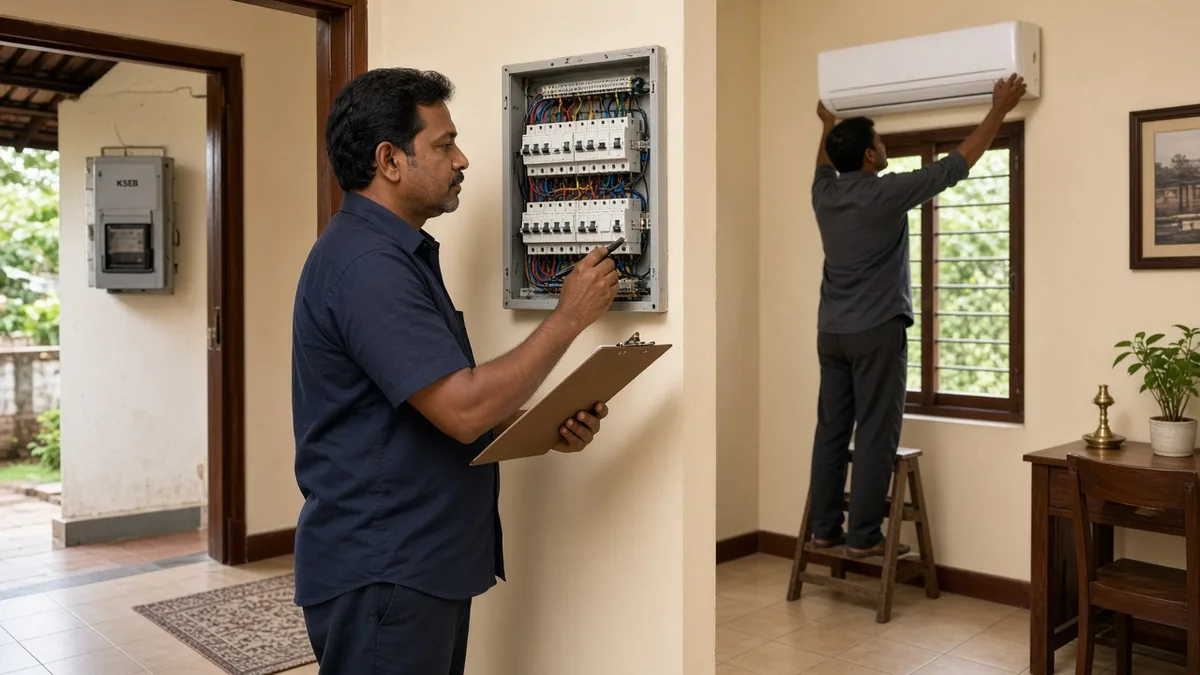
Quick answer: Your connected load is the figure KSEB has on record for your home. A small addition has some room under the Supply Code, but a big appliance, an EV charger or a move past 5 kW on single phase needs a formal load-change application. Apply online, use a licensed electrician and wait for KSEB's sanction.
Key points before you plug in something big
- Your connected load is a figure KSEB keeps on record for your home. A new AC, induction cooktop, geyser or EV charger adds to what is really connected.
- Small additions have some room, but the safe habit is to ask KSEB before the appliance is switched on, not after an inspection.
- A single-phase home connection has a ceiling, so a large new appliance can mean a move to three-phase supply.
- An EV charger has its own rules, and they depend on your approved load.
- A licensed electrician should check the wiring and protection first.
- Keep the rating label, the dealer's bill and your last KSEB bill together before you apply.
When do you need to increase connected load for a new appliance?
The load KSEB has on record for your home is called the contracted connected load. It is the figure written in your application form, or the figure after any later revision (Regulation 2(27) of the Supply Code). If KSEB inspects and finds more connected than that figure, with no sanction for the extra, the difference is called unauthorised additional load. The inspection adds up the rated capacities of every appliance that can be used at the same time (Regulation 153(1) to (3)). For what counts and what is left out, see what connected load means on your bill.
The Code gives a home some room, set out in the table. These limits protect you when an inspection finds extra load. They do not tell you to skip the application.
| Situation | What the Code says | Regulation |
|---|---|---|
| Extra load of 20% of your sanctioned load or less | Not counted as unauthorised additional load | 153(4)(a) |
| Extra load above that 20% | The whole excess is treated as unauthorised, unless KSEB has sanctioned it | 153(5) |
| Home whose total load, with the extra, is 10 kW or less | The unauthorised additional load provisions of 153(1) to (13) do not apply | 153(14) |
Even with those limits, Regulation 99(1) says a consumer shall apply to KSEB for enhancement of connected load, using the online form in Annexure 11. KSEB can regularise a small addition on its own or when you apply (Regulation 153(4)(c)). So the sensible order is to apply first, then switch the appliance on once KSEB has sanctioned it.
There is also protection while you wait. Once you have applied and taken the steps KSEB asks for, such as paying the fees and costs it demands or submitting the Electrical Inspector's approval of the installation, you should not be penalised for the extra load while the request is pending, in cases where regularisation is delayed because of KSEB (first proviso to Regulation 99(1)).
How do you apply to KSEB for a load change?
Before you start, check two things:
- The applicant should be the legal owner, tenant or occupant of the property (KSEB Web Self Service).
- Dues must be clear: the request is not considered while you are in arrears, and an amount under active consideration of a court or appellate forum does not count as arrears (Regulation 99(4)).
KSEB's own page lists these fees for a load change:
| Fee | Single phase | Three phase |
|---|---|---|
| Application fee | ₹25 | ₹25 |
| Inspection fee | ₹25 | ₹50 |
Keep these ready, and expect this path after you submit:
- A proof of identity.
- A work completion certificate and test report from a licensed electric contractor.
- A sketch showing the load.
- The section office receives the application and may inspect the site, then prepare an estimate. If it sanctions the request, you get a demand note for any work needed.
If KSEB finds the request feasible, the demand note comes with a written explanation of the supply voltage, any changes to the distribution system, the additional security deposit and any change in tariff class (Regulation 99(3)). You pay only the extra security for the extra consumption (Regulation 69(2)). The KSEB page says to pay the deposit and any service line cost within fifteen days of the demand note and then sign a supplementary agreement. A small addition, below 10% of your approved load, can carry no connection charge as long as the service line does not change, as what KSEB charges when you add load explains.
What does the single-phase limit mean for an AC or induction cooktop?
Regulation 8 of the Supply Code sets the largest connected load for each kind of supply. A single-phase 240 V home can go up to 5 kW, and a three-phase 415 V home up to 100 kW. The limit applies to your total after the revision, so it counts what you already have plus the new appliance. A single motor on single phase, such as a pump, cannot be above 3 hp, which is 2.2 kW (Regulation 8A(3)). Going from single phase to three phase is a phase conversion, and KSEB's load change page mentions it in its documents list, so ask your section office how to raise the request.
A home inverter or UPS is itself left out of connected load, but the appliances it feeds are counted, up to the inverter's own rated capacity (proviso to Regulation 153(3)(b)). So moving a heavy appliance onto the backup circuit does not make it disappear from the total. For the battery side, see home inverter and battery care.
Here is an example with assumed ratings. A home has an approved connected load of 4 kW on single phase and plans to add a 1.5 kW AC and a 2 kW induction cooktop. The additions come to 1.5 + 2 = 3.5 kW, so the new total is 4 + 3.5 = 7.5 kW. Twenty percent of 4 kW is 0.8 kW, well below the 3.5 kW being added. The total is also 7.5 − 5 = 2.5 kW above the 5 kW single-phase ceiling in Regulation 8. This home needs a sanctioned load change and a three-phase connection before both appliances run. To trim AC use first, read ways to keep a house cooler with less AC.
What are the rules for an EV charger at home?
Regulation 90A of the Supply Code deals with EV charging outlets, and its rules for a home are in the table.
| Point | What the Code says | Regulation |
|---|---|---|
| Single-phase charger | Up to 3.3 kW | 90A(1)(i) |
| Charger above 3.3 kW | Three-phase supply only | 90A(1)(ii) |
| Charger size for a home | Up to 8 kW, and not more than 50% of the approved connected load | 90A(2) |
| Evening hours | Not normally operated 6:00 pm to 11:00 pm, unless the consumer opts for a time-of-day (ToD) tariff | 90A(2) |
For a home that already has a connection, a charger below half of the connected load needs no load enhancement. You still give the KSEB office the details of the EV installation, and it is not treated as unauthorised additional load. A charger above half needs a load change by the usual procedure. Take an assumed home with an 8 kW approved load. Half of 8 kW is 4 kW. A 3.3 kW charger is below that, so no enhancement is needed, but KSEB is told. A 7.4 kW charger is above 4 kW, and above 3.3 kW too, so it needs three-phase supply and a load change. To size a solar plant around EV use, read sizing solar for an EV charger.
Which wiring checks should come before the new appliance goes on?
Adding a point for an AC changes your wiring. Regulation 31(1) of the CEA Safety Regulations 2023 says additions and alterations must be done by a licensed electrical contractor, with a supervisor holding a certificate of competency and a permit holder doing the work. The exception is replacing items like lamps, fans, fuses, switches and domestic appliances up to 250 V where the capacity or character does not change. Work done in breach of this must not be energised or connected to the supplier's works (Regulation 31(2)).
This is why KSEB asks for the contractor's test report. For an application for a new or additional supply, KSEB either tests the installation or accepts the test results signed by a licensed electrical contractor (Regulation 33(1)). If the result shows the installation is likely to be dangerous, KSEB can ask for changes and may refuse to connect until they are made (Regulation 33(5)).
A home's circuits are also meant to be controlled by a residual current device, and for a domestic installation its residual operating current must not exceed 30 milliampere (Regulation 44). Ask your electrician to confirm it is fitted and works before a heavy appliance is added. For an older house, old house wiring warning signs lists what to look for.
Ask the electrician to look at the points that matter for a heavy appliance: a separate circuit from the main board, wire thick enough for the appliance, a socket and plug made for heavy use, a good earth connection and a breaker that suits the circuit. A socket or plug that feels warm, a burnt smell or a tripping breaker is a warning to stop, switch the circuit off and call the electrician. Do not open the main board or the meter box yourself.
What should you do this week?
Work through this list before you buy or switch on the new appliance:
- Write down the rating on the label of each new appliance you plan to add.
- Find your approved connected load on your KSEB agreement or ask your section office for it.
- Add the new ratings to your present load and see whether the total goes past what a single-phase connection allows.
- If a load change is needed, make sure your dues are paid, then apply online or at the section office.
- Book a licensed electrical contractor for the circuit work and the test report.
- Switch the appliance on only after KSEB has sanctioned the change.
- If you run heavy appliances at midday with rooftop solar, running heavy appliances in solar hours shows how to plan them.
- If you rent your home, who can apply on a rented house explains who can sign.
Check this against your bill
FGE Solar can review your latest KSEB bill and tell you which system size is worth pricing.
Frequently Asked Questions
Can I add an AC without telling KSEB?
The Code gives a home some room. Extra load of 20% of the sanctioned load or less is not reckoned as unauthorised (Regulation 153(4)(a)). A home with a total of 10 kW or less is outside the unauthorised additional load provisions (Regulation 153(14)). Regulation 99(1) still says a consumer shall apply, so applying is the safe route.
How much does it cost to apply for a load change?
KSEB's Connected Load Change page lists an application fee of ₹25 and an inspection fee of ₹25 for single phase, or ₹50 for three phase. If the change is feasible you also pay an additional security deposit and the cost of any service line or system work in the demand note.
Can a tenant ask KSEB to change the load?
Yes. KSEB's Connected Load Change page names the legal owner, a tenant or an occupant as eligible applicants. If you rent, clear any dues on the connection before you apply.
Does a home inverter or UPS count towards my connected load?
The inverter or UPS itself does not count. The appliances connected to it do, up to the inverter's own rated capacity (Regulation 2(24) and the proviso to Regulation 153(3)(b)).
Is a 3.3 kW EV charger allowed on a single-phase home connection?
Regulation 90A(1)(i) limits a single-phase charger to 3.3 kW, so that size is the ceiling. For a home it must also stay below half of the approved connected load to avoid a load change, and KSEB should be given the installation details (Regulation 90A(2)).
Why was my load change request not considered?
The most common reason in the Code is unpaid dues. Regulation 99(4) says the request is not considered while the consumer is in arrears, except for an amount that a court or appellate forum is actively considering. Pay the dues, then apply again.
Official Sources and Accuracy Note
- 01Kerala Electricity Supply Code, 2014, consolidated text updated as on 14-10-2025 (KSERC final PDF)
Regs 2(24), 2(27), 8, 8A(3), 69(2), 90, 90A, 99 and 153: contracted connected load, unauthorised additional load, 20% and 10 kW domestic limits, load-change application, single-phase 5 kW ceiling and EV charger rules.
govt source · opened 2026-11-05 - 02Central Electricity Authority (Measures relating to Safety and Electric Supply) Regulations, 2023, notified 8 June 2023 (PDF on cea.nic.in)
Reg 31 licensed contractor for additions; Reg 33 test report for additional supply; Reg 44 domestic residual current device not exceeding 30 milliampere.
govt source · opened 2026-11-05 - 03KSEB Web Self Service: Connected Load Change (kseb.in self-service portal)
Eligibility, application and inspection fees, documents (identity, contractor test report, load sketch) and procedure through sanction and demand note.
govt source · opened 2026-11-05
Accuracy note: This guide is built from government pages, regulator orders, and news sources on the web. Rules and amounts change. Some details may be outdated or wrong. Check the official links below before you pay, apply, or complain to KSEB.