KSEB Power Purchase Petition: What the Reported Plan Means
Your evening bill already feels heavy, and now the news says KSEB wants to spend ₹336 crore more on electricity. The KSEB power purchase petition before KSERC is reported in the news and not yet officially confirmed, because the regulator has not published it. This page separates what the reports say from what KSERC's last order on the same kind of buying already settled, and shows what a solar home can do now.
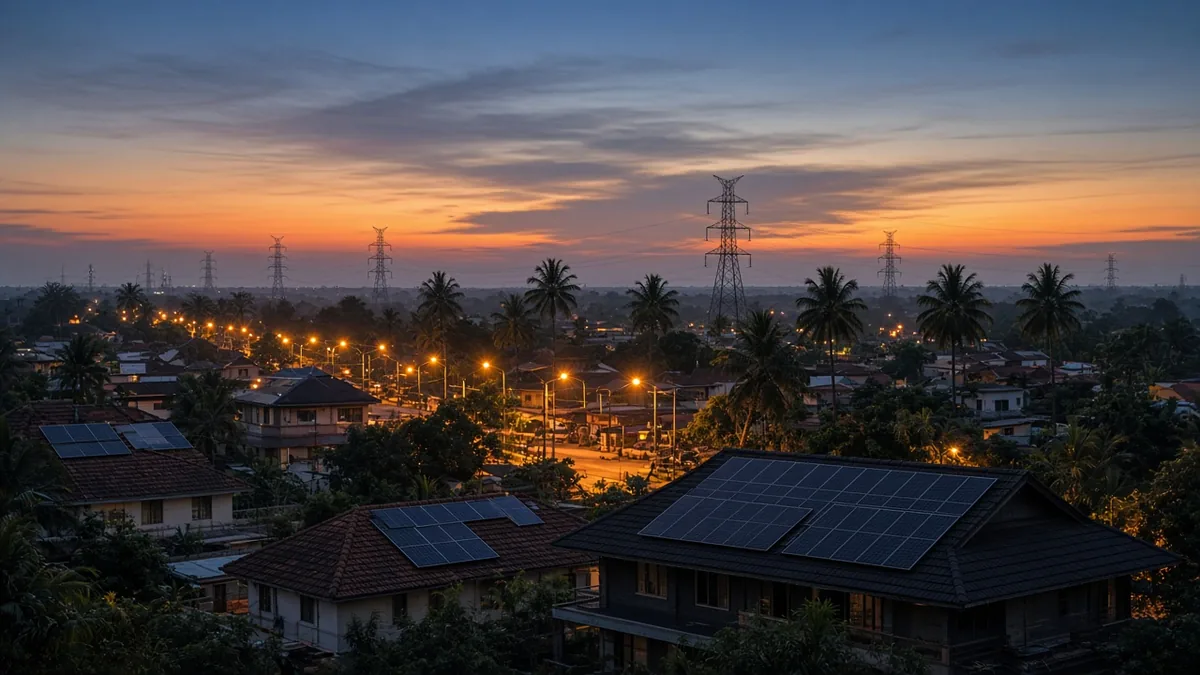
Quick answer: Nothing changes on your bill yet. News reports say KSEB has asked KSERC to approve about ₹336 crore of short-term power for October 2026 to April 2027. KSERC approved a similar ₹347.79 crore plan in September and said such costs ultimately reach consumers through the tariff. Shift heavy loads into solar hours.
What the news reports say about KSEB's new petition
Reported, not yet officially confirmed. The Times of India (21 October 2026) reports that KSEB has asked KSERC to approve power purchases worth ₹336.246 crore from October 2026 to April 2027. Mathrubhumi English (1 October 2026) reports the same plan as 32 short-term agreements totalling ₹336.25 crore. Neither report links the petition, and KSERC's website does not list it yet.
According to The Times of India, KSEB says weak southwest monsoon rain cut the water reaching its hydro reservoirs while evening demand rose. The paper reports that KSEB now expects a shortfall of 1,200 to 1,500 MW in March and April 2027. It says the quoted rates run from ₹6.99 to ₹13.89 per unit, depending on the month and time of day. Mathrubhumi English reports that rates stay below ₹10 per unit until February and reach ₹13.89 per unit in March and April.
The Times of India reports that the petition was filed under Regulation 78 of KSERC's 2021 tariff regulations, after KSEB's full-time directors approved it on 25 September. Kerala Kaumudi (17 October 2026) reports that KSERC will hear the petition on 22 October. The reports do not say whether KSEB has asked to recover this cost through a separate charge on bills.
What is officially confirmed about short-term power buying
KSERC has already ruled on one such request this year. In OP No. 39/2026, KSEB filed a petition on 17 August 2026 to buy short-term power through the central DEEP e-bidding portal for 1 September 2026 to 15 May 2027. KSERC heard it on 2 September and, in its order of 11 September, approved purchases for October 2026 to 15 May 2027 worth ₹347.79 crore, for 346.42 million units at ₹10.04 per unit (paragraphs 1, 6, 17 and 23).
The rule behind these petitions is Regulation 78 of KSERC's 2021 tariff regulations, quoted in that order. KSEB can buy extra short-term power when supply falls short, but if a quarter's power purchase cost rises more than 5% above the approved cost, it must get KSERC's approval by petition (Regulation 78(2)). Approval should be sought in advance where practicable, and KSERC can disallow purchases that break the rule from KSEB's revenue requirement (Regulation 78(5)).
KSERC did not approve everything. It rejected the proposed September 2026 purchases, including 100 MW for midnight to 5 am at ₹9.15 per unit, saying hydro and contracted power could meet that demand (paragraph 16(1)). It said the high-cost approval must not be treated as a precedent (paragraph 18), and told KSEB to reassess the power position by the middle of December 2026 (paragraph 22).
Will the KSEB power purchase cost reach your electricity bill?
Not straight away, going by the last order. In OP 39/2026, KSEB said there was no mechanism to recover extra power purchase costs immediately and asked KSERC to approve a way to pass them on to consumers (paragraph 6(1)). KSERC replied that the whole ₹742.52 crore outlay could not be treated as an extra liability; only the increase over the approved cost, after counting extra sales revenue, could be assessed (paragraph 6(3)).
KSERC was also plain about where the money comes from. It worked out that this power would cost more than ₹9.90 per unit at Kerala's border and about ₹11 per unit at the consumer end, and said such costs ultimately have to be passed on to consumers through the tariff (paragraph 12). That order approved purchases; it did not change any tariff.
The bill line to watch is the fuel surcharge. Our guide to the KSEB fuel surcharge rules explains how changes in power costs are passed to bills through that line, how it is worked out, published and capped, and who is exempt.
Your energy and fixed charges stay as set in the current tariff order, listed in current KSEB domestic tariff slabs. A petition being filed or heard does not change either of them on its own. If KSERC later approves a recovery method, it has to say so in an order, and that order will be the thing to read.
How did KSERC decide KSEB's last request, month by month?
Approved commitments in KSERC's order of 11 September 2026 (OP 39/2026, paragraph 16):
| Month | What KSERC approved | Financial commitment |
|---|---|---|
| October 2026 | Peak-hour power, 63 MW, 6.30 pm to midnight | ₹14.99 crore |
| November 2026 | Peak-hour power, 6.30 pm to midnight | ₹37.30 crore |
| December 2026 | Peak-hour power, 6.30 pm to midnight | ₹61.47 crore |
| January 2027 | Peak-hour power, 295 MW from three bidders | ₹47.28 crore |
The pattern is useful for reading the new petition. KSERC approved evening peak power and turned down purchases it saw as poor value, so the reported figure in the new petition is what KSEB has asked for, not what it will be allowed to spend. The next KSERC order will show what was approved.
Why rooftop solar homes matter in Kerala's evening power gap
KSERC's order explains why this keeps happening. Peak demand in non-solar hours has risen 10% to 15% over last year, while the large number of rooftop solar plants is cutting daytime demand year after year (paragraph 13). So KSEB gives up some round-the-clock power by day and buys costly short-term power for the evening.
- Run the washing machine and dishwasher in the daytime instead of the evening peak (paragraph 19).
- Pump water and charge an EV in the daytime; see solar sizing for EV charging at home.
- Cut induction cooker use during peak hours where you can.
- Set air conditioners at a sensible temperature and switch off lights and fans you are not using.
For a solar home these steps line up with how your plant already works. Units you use while the sun is up are used at home before anything is exported, so moving loads into the day is the simplest change you can make; when to run appliances on solar power gives a room-by-room plan.
Evening use is the harder part, because the panels stop producing at sunset. If you are thinking about adding storage to carry some of that load, read battery rules for hybrid inverters first, and ask your installer to size it from your own bills rather than a rule of thumb.
A Kerala example: moving evening loads in a solar home
Picture a family in Kollam with a rooftop plant. Their bill shows most imported units fall after sunset, when the pump, washing machine and induction cooker all run. They move the pump and laundry to late morning, cook the main meal earlier on the induction hob, and charge the scooter at noon.
Their plant now covers more of those loads directly, and the evening import on the bill falls. This is an illustration, not a real customer or a promised saving. To see where your own units go, compare import and export on how import, export and banked units appear on a solar bill.
What this means for you now
- Nothing on your bill changes because a petition has been filed or heard.
- Keep your recent bills and note the fuel surcharge line each month.
- Watch for the KSERC order on the new petition and any notice inviting public comments.
- Shift pumping, laundry and charging into solar hours from this week.
- Know your rights during outages; see what KSEB owes you for power cuts.
- If a bill line looks wrong, ask your KSEB section office in writing.
The official petition and hearing notice for the reported purchase plan are not yet available on the KSERC or KSEB websites. This page will be updated when KSERC publishes the petition or its order.
Check this against your bill
FGE Solar can review your latest KSEB bill and tell you which system size is worth pricing.
Frequently Asked Questions
What is KSEB's ₹336 crore power purchase petition?
The Times of India reports KSEB asked KSERC to approve about ₹336 crore of short-term power for October 2026 to April 2027. Mathrubhumi English reports 32 agreements totalling ₹336.25 crore. Neither outlet cites a published KSERC petition or order.
Will my electricity bill go up because of this petition?
Not because a petition is filed. In its last order KSERC said such costs ultimately pass to consumers through tariff, after assessing only the increase over approved costs. Your present tariff stays as fixed in KSERC's current tariff order.
How much does this short-term power cost per unit?
For the earlier approval, KSERC put the total at ₹347.79 crore for 346.42 million units, or ₹10.04 per unit. It estimated about ₹11 per unit at the consumer end. Rates in the new petition are only reported so far.
Why does KSEB need to buy power at night when so many homes have solar?
KSERC says rooftop solar is cutting daytime demand while evening and night demand keeps rising. Solar does not generate after sunset, so the evening gap is met with short-term purchases.
What can a solar home do to help during peak hours?
KSERC's order asks homes to move washing machines, dishwashers, water pumping and EV charging into the daytime. It also suggests less induction cooking at peak hours and sensible AC settings.
Official Sources and Accuracy Note
- 01The Times of India, 21 Oct 2026 (B S Anilkumar): KSEB seeks nod to procure power worth Rs 336 crore
Reports KSEB asked KSERC to approve ₹336.246 crore of DEEP e-bidding purchases from October 2026 to April 2027, with rates from ₹6.99 to ₹13.89 per unit. Describes the petition but does not link a document.
news source · opened 2026-10-22 - 02Mathrubhumi English, 1 Oct 2026 (S N Jayaprakash): Power crisis: Kerala seeks cheap electricity from Himachal to avert October outages
Reports KSEB submitted 32 short-term power purchase agreements totalling ₹336.25 crore to KSERC, spanning October to April.
news source · opened 2026-10-22 - 03Kerala Kaumudi, 17 Oct 2026 (Web Desk): Regulatory Commission hearing on power purchase on the 22nd
Reports KSERC will take evidence on 22 October on KSEB's application to buy short-term power at an estimated ₹336.246 crore. No KSERC hearing notice was found to confirm the date.
news source · opened 2026-10-22 - 04KSERC Order in OP No. 39/2026 dated 11.09.2026: Short term procurement of power through the DEEP portal, 01.09.2026 to 15.05.2027 - KSEB Ltd (PDF)
Official order: petition filed 17.08.2026, heard 02.09.2026, approved ₹347.79 crore for 346.42 MU at ₹10.04/unit for October 2026 to 15 May 2027. Quotes Regulation 78; paragraph 12 says such costs ultimately pass to consumers through tariff; paragraph 19 lists household demand-side steps.
govt source · opened 2026-10-22
Accuracy note: This guide is built from government pages, regulator orders, and news sources on the web. Rules and amounts change. Some details may be outdated or wrong. Check the official links below before you pay, apply, or complain to KSEB.