How to Choose the Right Solar Company in Kerala (2025 Guide)
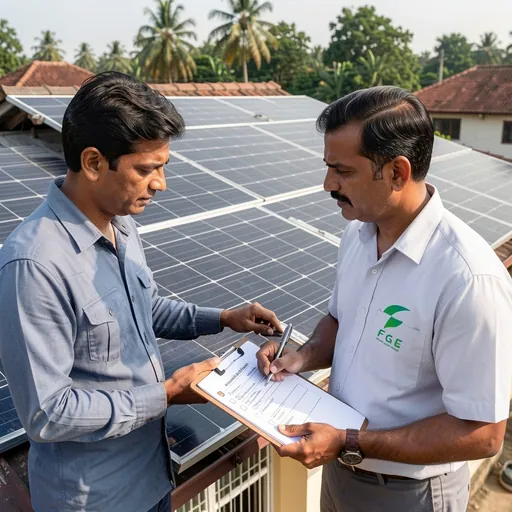
Kerala's rooftop solar market has grown rapidly since PM Surya Ghar launched in 2024, and with that growth has come a flood of new installers — some excellent, some dangerously underqualified. A poorly installed solar system can damage your roof, underperform for 25 years, or leave you without warranty support when you need it most.
Here are the seven checks every Kerala homeowner should do before signing a solar contract.
Check 1 — MNRE Empanelment (Non-Negotiable for Subsidy)
If you want the PM Surya Ghar subsidy (up to ₹78,000), your installer must be on the MNRE (Ministry of New and Renewable Energy) empanelled vendor list for Kerala. Only empanelled installers can submit subsidy applications on your behalf through the national portal.
You can verify empanelment on the PM Surya Ghar portal at pmsuryaghar.gov.in. Search for the installer by name or registration number. If they're not on the list, you cannot get the subsidy — regardless of what they promise.
Ask directly: "Are you MNRE empanelled for Kerala? Can you show me your empanelment certificate?" A legitimate installer will have this immediately available.
Check 2 — KSEB Net Metering Track Record
KSEB's net metering process involves an application, inspection, approval, and meter replacement — a process that can take 1–4 months depending on the division. An experienced installer who works regularly with your KSEB section office can significantly reduce this timeline.
Ask the installer: "How many net metering connections have you completed in my district? What's the typical wait time at the [your area] KSEB division?"
If they can't give specific answers, they may be new to Kerala or outsourcing the metering process to a third party — which adds delays and potential complications.
Check 3 — What's Actually in the Quote
Solar quotes in Kerala vary wildly, and comparing them requires careful itemisation. A complete quote must specify:
- Panel brand, model, wattage, efficiency, and warranty (25-year performance guarantee)
- Inverter brand, model, capacity, and warranty (minimum 5 years)
- Mounting structure material (hot-dip galvanised steel or aluminium)
- DC/AC wiring specifications and earthing system
- KSEB net metering application handling — is this included or extra?
- PM Surya Ghar subsidy application — included?
- Workmanship warranty — how long? Who handles it?
- AMC options post-warranty
Red flag: Any quote that doesn't specify panel brand, wattage, and inverter model. "Quality panels" or "Tier-1 brands" without specifics is a warning sign — these get substituted at installation time.
Check 4 — Warranty Clarity
Solar involves three separate warranties, and each must be understood:
- Panel product warranty: Covers manufacturing defects. Standard is 10–12 years. Some premium panels offer 25 years. If a panel shatters or delamination occurs, this covers replacement.
- Panel performance warranty: Guarantees that output won't fall below a certain level. Standard is >80% at 25 years, >90% at 10 years. Lower thresholds on budget panels mean earlier replacement need.
- Inverter warranty: Typically 5 years standard, extendable to 10–15 years with extended coverage. Inverters are the most likely component to need replacement in a 25-year system life.
- Workmanship warranty: Covers installation quality — roof penetrations, cable routing, structural integrity. Minimum 1 year, good installers offer 5 years.
Get all warranties in writing, with the actual manufacturer's warranty card — not just the installer's assurance.
Check 5 — Local Presence and After-Sales
Who will fix your inverter fault in 2028? This is the question most homeowners forget to ask. Solar equipment is reliable but not infallible, and when something goes wrong, you need a local service team — not an 1800 number that routes you to a call centre in another state.
Questions to ask:
- Do you have a service office/team in Kerala?
- What's your typical response time for service calls?
- Are you authorised service partners for the inverter brands you install?
- Can you show me references from installations done 3+ years ago?
Check 6 — Site Assessment Quality
A serious installer will conduct a physical site assessment before quoting — not just a WhatsApp quote based on your electricity bill. The site visit should include:
- Roof structural assessment (can it bear panel weight?)
- Shading analysis (trees, water tanks, neighbouring buildings)
- Roof area measurement and usable space calculation
- Roof type and mounting requirements
- Existing electrical panel check (is your MCB sizing adequate?)
- Confirmation of KSEB meter location and phase details
Skipping the site visit and sending a quote remotely based on Google Maps satellite imagery is a red flag — especially for complex rooftops common in Kerala homes.
Check 7 — References and Completed Projects
Ask for contact details of 2–3 customers in your district whose systems were commissioned at least 1–2 years ago. Call them. Ask:
- How long did installation take?
- How long did KSEB net metering take?
- Have you needed any service calls? Were they resolved quickly?
- Is the system generating as promised?
- Would you recommend this installer?
Reputable installers welcome this and will readily provide references. Those who deflect or say they can't share customer details due to "privacy" should be viewed with scepticism.
The 2025 Buyer's Checklist — Print and Use
Before Signing — Verify All 7
One More Thing — Beware of Rock-Bottom Prices
If a quote is significantly cheaper than everything else you've received (say, ₹40,000–60,000 below market for the same system size), investigate what's been compromised. Common tricks include:
- Unbranded or rebadged panels without BIS certification
- Undersized cabling (causes energy losses and fire risk)
- Missing or inadequate earthing (KSEB will fail the inspection)
- Net metering application "not included" (revealed after payment)
- No AMC or service capability post-installation
A solar system is a 25-year investment. The cheapest quote is rarely the best value over that time horizon.
FGE Solar is MNRE-empanelled, Kerala-native, and has completed 50+ installations across the state.
We welcome all seven questions above — and have answers for every one of them.